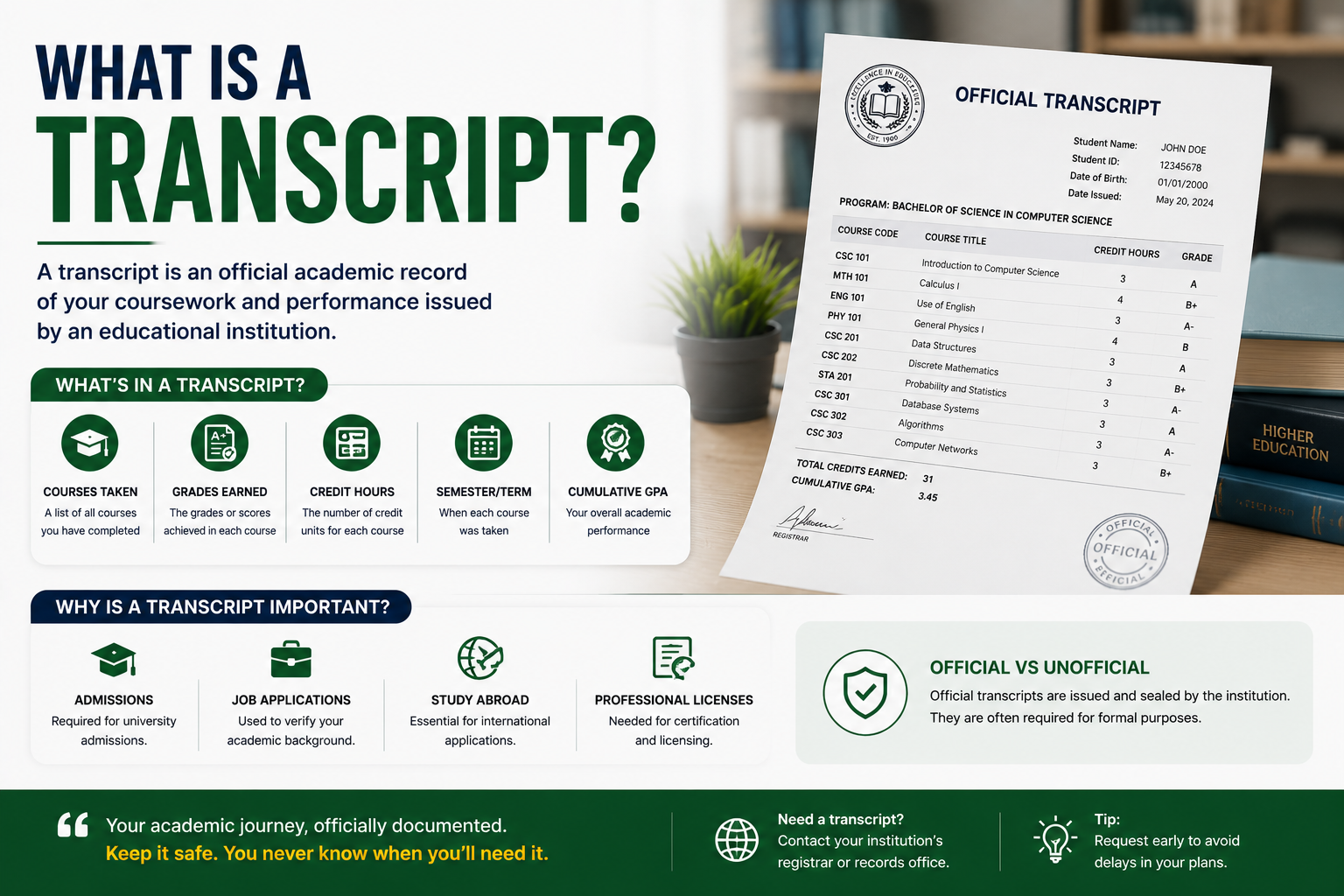
What is transcript? That’s the question a lot of Nigerian graduates only start asking when they urgently need one — usually in the middle of a master’s program application abroad, a job that requires academic verification, or an immigration document checklist. At some point in your academic or professional journey, someone is going to ask you this exact thing, and not having a clear answer in that moment can cost you valuable time.
This guide explains what a transcript actually contains, why it matters so much, and how to actually get one from your Nigerian university — clearly and completely.
What Is a Transcript?
An academic transcript is an official document that contains a comprehensive record of your academic performance throughout your time at an educational institution. It is essentially a detailed breakdown of every course you took, the grades you earned in each course, your semester-by-semester academic standing, and your overall cumulative grade point average (CGPA) from the start of your program to graduation.
Think of it as the full academic story behind your certificate. Your degree certificate tells the world what you graduated with and when. Your transcript tells the much more detailed story of how you got there — every course, every grade, every semester, laid out in an official, verifiable format.
In the Nigerian university context, a transcript is issued by the institution’s Academic Registry or Examinations and Records Department. It carries the official seal, signature, and letterhead of the university, which is what gives it credibility as an authentic academic record rather than a document the student can alter or fabricate.
What Information Does a Transcript Contain?
A standard academic transcript from a Nigerian university typically includes the following:
- Your full name — exactly as registered with the institution
- Your matriculation or registration number
- Your programme of study — the specific degree and department
- Your duration of study — the years you were enrolled, from admission to graduation
- A semester-by-semester breakdown of courses taken — including course codes, course titles, and credit units
- Grades earned in each course — typically presented as letter grades or grade points depending on the institution’s grading system
- Grade Point Average (GPA) per semester
- Cumulative Grade Point Average (CGPA) at the point of graduation
- Class of degree awarded — First Class, Second Class Upper, Second Class Lower, Third Class, or Pass
- Official university seal, signature, and stamp — confirming the document’s authenticity
This level of detail is exactly why transcripts carry so much weight. Unlike a certificate, which simply states that you graduated, a transcript shows precisely how you performed across every single course of your academic program.
Transcript vs Certificate vs Statement of Result — What Is the Difference?
Many Nigerian students use these three terms interchangeably, but they are not the same thing, and understanding the difference matters when you are asked to provide one specifically.
Transcript
A detailed, course-by-course academic record showing every grade earned throughout your program, issued directly by the university’s registry, and typically sent confidentially from institution to institution or organisation.
Certificate
A formal document confirming that you completed your degree program and were awarded a specific class of degree. It does not show individual course grades — it simply confirms the qualification and the date it was conferred.
Statement of Result
An interim document, usually issued immediately after graduation before the certificate itself is ready (which can sometimes take months or even years at some Nigerian universities). It typically confirms your CGPA and class of degree but is generally less detailed than a full transcript and is sometimes used as a temporary substitute while waiting for the certificate to be processed.
If an institution or employer specifically requests a transcript, providing only your certificate or statement of result will not meet that requirement — they are asking for the detailed, course-level academic record, not just confirmation of your final qualification.
Types of Transcripts Issued by Nigerian Universities
Nigerian universities typically issue transcripts in two main formats, and it is important to know which one applies to your situation.
Official Transcript (Hard Copy and Electronic)
This is the formal, legally recognised version of your transcript. It is sealed, signed, and stamped by the university’s registry before it is released, and it is sent directly from your university to the destination institution or organisation — it is not handed to the student to forward themselves. This direct-from-institution delivery is precisely what makes it “official” and trusted by receiving institutions.
Official transcripts can be issued in two delivery formats:
- Hard copy transcript — A physical, sealed paper document sent via courier services such as DHL, FedEx, or EMS directly to the receiving institution. Because of courier charges, hard copy transcripts tend to be more expensive, particularly for international delivery.
- Electronic transcript (e-transcript) — A digital version sent securely by email or through a dedicated platform directly to the receiving institution or organisation. Many Nigerian universities now offer this option through e-transcript platforms, and it is generally faster and more affordable than hard copy delivery.
Unofficial or Student Copy Transcript
Some universities also allow students to request a personal copy of their transcript — sometimes called a student copy or unofficial transcript — sent directly to the student’s own email address rather than to a receiving institution. This version is useful for your personal records or for reviewing your academic history before requesting the official version, but it is explicitly not accepted for official purposes such as admissions, employment, or credential evaluation. If an institution requires an official transcript, a student copy will not satisfy that requirement.
Why Do You Need a Transcript?
Transcripts come up at several important points in a Nigerian graduate’s journey. Here are the most common situations where you will be asked to provide one:
Postgraduate Admissions Abroad
This is, by far, the most common reason Nigerian graduates request transcripts. Universities abroad — in the United States, United Kingdom, Canada, Europe, and elsewhere — require a detailed, course-by-course transcript as part of their admissions process for master’s and PhD programs. Unfortunately, many Nigerian applicants have lost admission offers simply because their transcript request was delayed or mishandled, which is why understanding this process properly matters.
Postgraduate Admissions Within Nigeria
Nigerian universities also typically require official transcripts as part of their postgraduate admission requirements, particularly for master’s and PhD applications.
Credential Evaluation Services
If you are applying for further studies or certain professional licences abroad, you may be required to have your academic credentials evaluated by services such as World Education Services (WES) or similar credential evaluation bodies. These organisations require your official transcript directly from your university as part of the evaluation process.
Employment Verification
Certain employers — particularly in regulated industries, multinational organisations, or roles requiring professional licensing — may request an official transcript as part of their pre-employment verification process, especially when the role requires confirmation of specific coursework or academic specialisation.
Immigration and Visa Applications
Some immigration processes, particularly those involving study permits, work visas tied to specific qualifications, or skilled migration pathways, require an official transcript as supporting documentation of your educational background.
Professional Licensing and Certification
Certain professional bodies that require formal verification of your academic coursework — to confirm you covered specific subjects relevant to a licence or certification — may request your official transcript as part of their assessment.
How to Get a Transcript From a Nigerian University — Step by Step
The exact process varies slightly from one Nigerian university to another, but the general approach follows a similar pattern. Here is a step-by-step guide that applies broadly across most institutions.
Step 1 — Determine Which Type of Transcript You Need
Before doing anything else, confirm with the receiving institution or organisation exactly what they require. Do they need a hard copy sent by courier, or will an electronic transcript sent by email be accepted? Some institutions are strict about only accepting sealed hard copies, while others readily accept e-transcripts. Knowing this in advance saves you from paying for the wrong format.
Step 2 — Visit Your University’s Transcript Office or Online Portal
Most Nigerian universities now offer an online transcript request system, often through a dedicated portal — sometimes referred to as an e-transcript platform. Check your university’s official website for a transcript or academic records section. If your university does not offer an online option, you will need to visit the Academic Registry or Examinations and Records Department in person.
Step 3 — Create an Account or Obtain an Application Form
For online requests, you will typically need to create an account on the transcript platform using your matriculation number and personal details. For in-person requests, visit the registry and request a transcript application form to fill out manually.
Step 4 — Provide the Recipient’s Details
Whether applying online or in person, you will need to provide accurate details of where the transcript should be sent — the full name, address, and email of the receiving institution or organisation. Errors here are one of the most common causes of delay, so double-check every detail before submitting.
Step 5 — Pay the Processing Fee
Transcript requests from Nigerian universities are not free. Costs vary by institution and by delivery method, but generally range from around ₦10,000 to ₦45,000 depending on whether you are requesting a local transcript, an international electronic transcript, or an international hard copy sent by courier. International courier delivery tends to be the most expensive option due to shipping charges.
Step 6 — Upload or Submit Supporting Documents
Some universities require you to upload supporting documents alongside your transcript request — such as your degree certificate, statement of result, or birth certificate. Confirm exactly what your specific institution requires before submitting your request, as incomplete submissions are a common cause of delay.
Step 7 — Track Your Request and Follow Up
After submission, most institutions will notify you of your request status, either through the portal or by email. Processing time typically takes between one and three weeks, though this can vary depending on the institution’s efficiency and the volume of requests being processed at the time. If you do not receive an update within the expected timeframe, follow up directly with the registry or transcript office rather than assuming the request is being handled.
Step 8 — Confirm Delivery
Once your transcript has been sent, confirm with the receiving institution or organisation that it has arrived. For electronic transcripts, this is usually quick to verify. For hard copy transcripts sent by courier, ask for tracking information so you can monitor delivery, particularly for international shipments.
What If You Are Outside Nigeria and Need Your Transcript?
Many Nigerian graduates living abroad — in the United States, the United Kingdom, Canada, or elsewhere — find themselves needing to request a transcript from their Nigerian university without being physically present. This situation typically arises during a graduate school application, a credential evaluation request, or an immigration document checklist.
The process is still possible from abroad, but it requires extra clarity and consistent follow-up since you cannot simply walk into the registry to check on your request in person. Most Nigerian universities that offer online transcript portals make this process significantly more manageable for diaspora graduates. If your university does not offer an online option, you may need to authorise a trusted family member or friend in Nigeria to handle the in-person aspects of the request on your behalf — many universities allow a representative to collect or submit documents if properly authorised.
Given the time-sensitive nature of admissions deadlines and immigration processes, it is advisable to start your transcript request as early as possible when applying from abroad, rather than waiting until close to a deadline.
Common Mistakes to Avoid When Requesting a Transcript
- Requesting the wrong type — Always confirm whether the receiving institution wants a hard copy or an electronic transcript before paying for the wrong format.
- Providing incorrect recipient details — Double-check the name, address, and email of the receiving institution. A single typo can delay your transcript by weeks.
- Assuming a statement of result will work as a transcript — These are different documents. If a transcript is specifically requested, a statement of result will not meet that requirement.
- Waiting until the last minute — Transcript processing typically takes one to three weeks at minimum, and delays are common. Apply well ahead of any deadline.
- Not keeping proof of payment — Always retain your payment receipt or transaction reference, as you may need it to follow up on your request or resolve any disputes.
- Forgetting to follow up — Submitting a request is not the end of the process. Actively track its progress and follow up if you do not hear back within the expected timeframe.
Frequently Asked Questions About Academic Transcripts
What is the difference between a transcript and a certificate?
A transcript is a detailed, course-by-course record of every grade you earned throughout your academic program. A certificate simply confirms that you completed your degree and the class of degree awarded, without showing individual course grades. They serve different purposes and are not interchangeable.
Can I collect my own official transcript and forward it myself?
Generally, no. Official transcripts are sealed, signed, and stamped before release, and they are meant to be sent directly from the university to the receiving institution or organisation to maintain their authenticity. Handing it directly to the student to forward themselves typically defeats the purpose of an “official” transcript, which is why most universities send it directly rather than through the student.
How long does it take to get a transcript from a Nigerian university?
Processing time generally takes between one and three weeks, though this can vary depending on the specific institution and the volume of requests being handled. Some universities with efficient online systems may process requests faster, while others may take longer, particularly during peak admission seasons.
How much does a transcript cost in Nigeria?
Costs vary by institution and delivery method, but generally range from approximately ₦10,000 for a basic local request to ₦35,000 or more for international transcripts, with hard copy courier delivery typically costing more than electronic delivery due to shipping charges.
Can someone else collect or submit my transcript request on my behalf?
Yes, in many cases. If you are unavailable — particularly if you are living abroad — a family member or friend can often collect or submit your transcript request on your behalf, provided they have the necessary authorisation and your personal details. Confirm your specific university’s policy on this beforehand.
Is an electronic transcript as valid as a hard copy transcript?
Generally, yes, provided it is sent as an official electronic transcript directly from the university to the receiving institution, rather than as a student copy sent to your personal email. However, some institutions specifically require sealed hard copies, so always confirm with the receiving institution which format they accept before requesting.
What is a student copy transcript and can I use it for admissions?
A student copy transcript is a personal copy sent directly to your own email address for your records. It is not accepted for official purposes such as admissions or employment verification — only an official transcript sent directly from the university to the receiving institution satisfies those requirements.
Why do some Nigerian graduates lose admission offers because of their transcript?
This typically happens when transcript requests are submitted too late, recipient details are entered incorrectly, the wrong type of transcript is requested, or graduates fail to follow up and confirm delivery before an admissions deadline passes. Starting the process early and tracking it closely significantly reduces this risk.
Final Thoughts
An academic transcript is far more than a formality — it is the detailed proof of everything you achieved, course by course, throughout your time at university. Whether you need it for a postgraduate application abroad, a job opportunity, an immigration process, or simply to keep your academic records complete, understanding what a transcript actually is and how to properly request one puts you in control of a process that trips up a surprising number of Nigerian graduates every year.
Know which type of transcript you need, confirm the recipient’s details carefully, pay the appropriate fee, and follow up consistently until you have confirmation of delivery. Starting early is the single biggest factor that separates a smooth transcript request from a stressful one.
If this guide was helpful, share it with a fellow graduate who might be preparing an application that requires a transcript. And if you have questions about your specific situation, drop them in the comments section below.