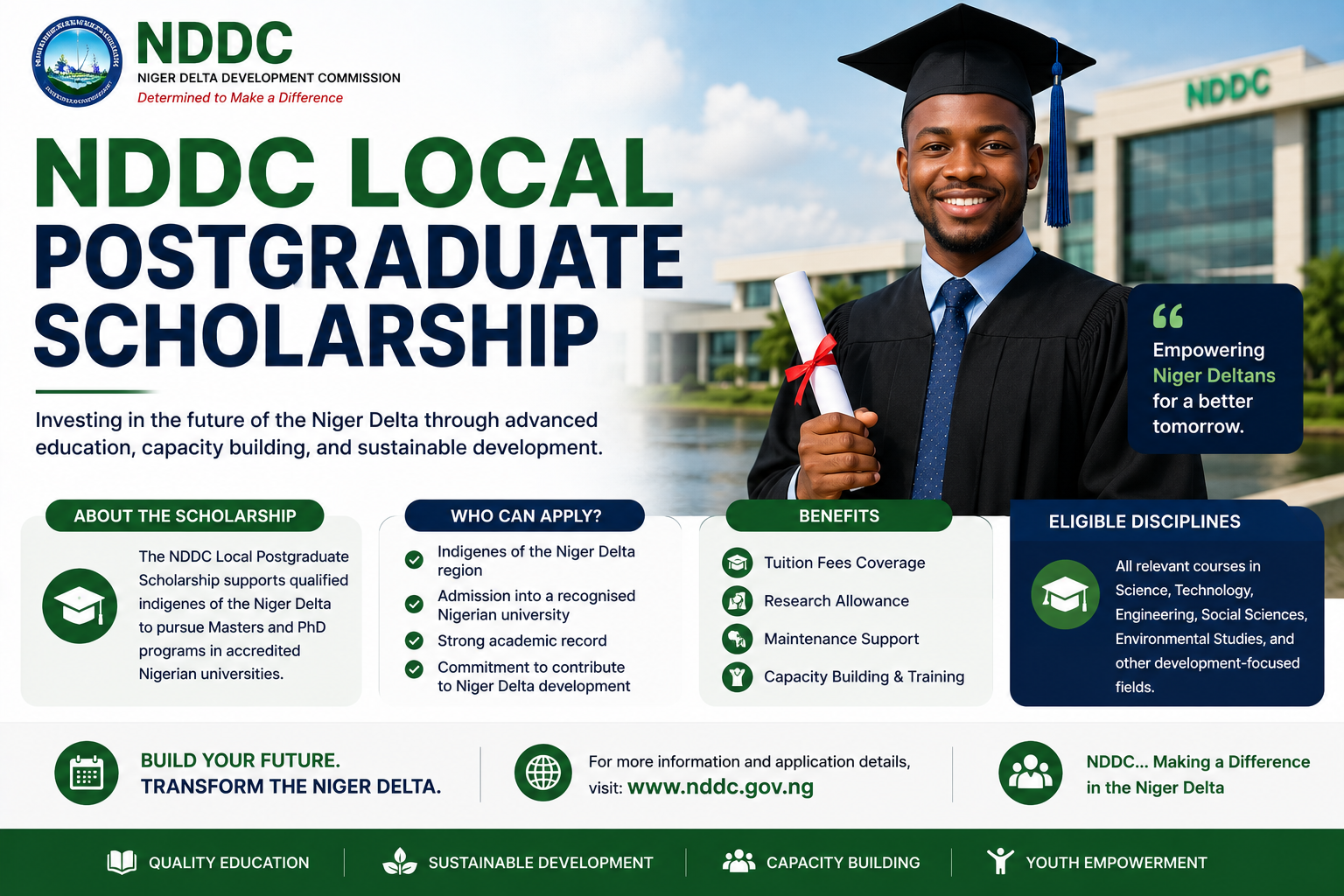
The NDDC local postgraduate scholarship is one of the most valuable funding opportunities available to indigenes of the Niger Delta region who want to pursue a master’s degree without leaving Nigeria. Unlike the Commission’s foreign postgraduate scholarship, which sponsors study abroad, this particular program is designed specifically for candidates pursuing their postgraduate studies at accredited Nigerian universities.
If you are from the Niger Delta and have been searching for a scholarship that supports advanced studies within Nigeria, this guide breaks down everything you need to know about the NDDC local postgraduate scholarship — what it is, who qualifies, what documents you need, and exactly how to apply.
What Is the NDDC Local Postgraduate Scholarship?
The Niger Delta Development Commission (NDDC) is a Federal Government agency established to drive the sustainable development of the Niger Delta region — covering Abia, Akwa Ibom, Bayelsa, Cross River, Delta, Edo, Imo, Ondo, and Rivers States. As part of its human capital development mandate, the NDDC runs an annual postgraduate scholarship program aimed at equipping young people from the region with advanced skills and specialised knowledge.
The local postgraduate scholarship specifically supports candidates pursuing master’s degree studies at accredited Nigerian universities, across a wide range of fields relevant to regional and national development. This is distinct from the NDDC’s foreign postgraduate scholarship, which sponsors study at universities abroad and typically requires applicants to already hold an admission letter from a foreign institution before applying.
The objective behind this initiative is straightforward — the NDDC wants to build a pool of skilled professionals from the Niger Delta who can meaningfully participate in the region’s development, contribute to the Federal Government’s local content programme, and remain competitive across various professional disciplines, all without requiring them to leave the country to do so.
NDDC Local Scholarship vs Foreign Scholarship — Know the Difference
Before going further, it is important to clear up a common point of confusion. The NDDC actually runs two separate postgraduate scholarship tracks, and mixing them up can lead you to apply for the wrong one or submit the wrong documents.
The local postgraduate scholarship — the focus of this guide — supports master’s degree study at accredited Nigerian universities. You do not need a foreign admission letter to apply, since the entire program is designed around studying within Nigeria.
The foreign postgraduate scholarship is a separate, fully funded program that covers tuition, flights, visa costs, accommodation, and living expenses for candidates studying at universities abroad. This track typically requires applicants to have already secured admission into a master’s program at a foreign university before applying — it is not something you apply for hoping to receive admission afterward.
If you intend to study within Nigeria, the local postgraduate scholarship is the one relevant to you, and that is what the rest of this guide focuses on.
Eligibility Requirements for the NDDC Local Postgraduate Scholarship
To qualify for the NDDC local postgraduate scholarship, applicants must meet the following criteria:
- Niger Delta origin — You must be an indigene of one of the nine Niger Delta states: Abia, Akwa Ibom, Bayelsa, Cross River, Delta, Edo, Imo, Ondo, or Rivers State.
- Age limit — Applicants must be 40 years old or younger at the time of application.
- Academic qualification — You must hold a Bachelor’s degree from an accredited Nigerian university. The NDDC accepts candidates with a First Class, Second Class Upper, or Second Class Lower division. Candidates with a Higher National Diploma (HND) with Upper Credit alongside a Postgraduate Diploma may also be considered eligible.
- Nigerian citizenship — You must be a Nigerian citizen.
- Not currently on another scholarship — Applicants who are already benefiting from another scholarship or grant are typically not eligible to apply simultaneously.
Note that the specific academic requirements and supporting criteria can be adjusted slightly from one application cycle to the next, so it is always advisable to cross-check the current cycle’s official guidelines on the NDDC website before applying.
Fields of Study Covered Under the Local Postgraduate Scholarship
The NDDC local postgraduate scholarship covers a wide range of professional disciplines that are relevant to both regional development and the broader Nigerian job market. While the exact list of approved courses is published with each application cycle, the scholarship generally supports fields including:
- Engineering (various specialisations)
- Sciences and Applied Sciences
- Environmental Management and Studies
- Project Management
- Public Administration and Policy
- Business Administration and Management Sciences
- Information and Communication Technology
- Health and Medical Sciences
- Education
- Law
- Agriculture and Agricultural Sciences
This breadth of coverage means candidates from a wide variety of academic backgrounds have a realistic shot at qualifying, provided their intended postgraduate course aligns with the published list for that particular application cycle.
Documents Required for the NDDC Local Postgraduate Scholarship
Before starting your application, gather the following documents. Having everything ready in advance will make the online application process significantly smoother:
- Birth certificate or sworn declaration of age
- First degree certificate — your Bachelor’s degree certificate or statement of result
- NYSC certificate — your discharge certificate, exemption certificate, or exclusion letter as applicable
- Local Government Identification letter — confirming your indigeneship of a Niger Delta state and local government area
- Academic transcript where applicable
- A recent passport photograph
- Valid means of identification
- Any additional supporting documents specified in the current application cycle’s guidelines, such as professional certifications or awards
Make sure every document is scanned clearly and saved in the file format and size specified on the application portal. Blurry or oversized files are a common and entirely avoidable reason for applications being rejected at the verification stage.
How to Apply for the NDDC Local Postgraduate Scholarship — Step by Step
The application process for the NDDC local postgraduate scholarship is conducted entirely online. Here is how to go about it:
- Confirm your eligibility — Before starting, go through the eligibility requirements above carefully and make sure you genuinely qualify. There is no benefit to starting an application you cannot complete or that will be disqualified at verification.
- Visit the official NDDC scholarship portal — Go to the NDDC’s dedicated scholarship application platform, accessible through www.nddc.gov.ng or directly at scholarship.nddc.gov.ng. Always confirm you are on the official NDDC domain before entering any personal information.
- Create your applicant account — New applicants will need to register by providing basic personal details such as your name, email address, and phone number. After registering, check your email — including your spam or junk folder — for an account activation link.
- Log in and complete your profile — Once your account is activated, log in and fill in your full personal details, including your date of birth, residential address, state of origin, Local Government Area, phone number, and gender.
- Provide your academic details — Enter information about your first degree, including the institution you attended, your discipline, your class of degree, and your intended postgraduate course and Nigerian university of choice.
- Upload all required documents — Attach scanned copies of your birth certificate, degree certificate, NYSC certificate, Local Government identification letter, passport photograph, and any other requested documents.
- Review your application carefully — Before submitting, go through every section of your application form to confirm accuracy. Mistakes in personal details or academic records can cause delays or outright disqualification during the verification stage.
- Submit your application — Once you are confident everything is accurate and complete, submit your form. A registration number will typically be generated automatically upon successful submission.
- Print your acknowledgment — Print a hard copy of your online-generated acknowledgment or registration number and keep it safe. You will need this reference for any future correspondence regarding your application.
- Await shortlisting — After the application window closes, the NDDC reviews submissions and shortlists candidates based on stated criteria, including academic qualifications and supporting documentation. Shortlisted candidates are announced on the official NDDC website.
Selection Process After Application Submission
Getting your application submitted is only the first stage. The NDDC follows a structured, multi-step selection process before final scholarship awards are made:
1. Preliminary Shortlisting
Applications are reviewed and an initial shortlist is generated based on the stated eligibility criteria, academic qualifications, and completeness of submitted documentation.
2. Computer-Based Test (CBT)
Shortlisted candidates are invited to sit a Computer-Based Test conducted by NDDC-approved consultants, typically at designated centres in states such as Akwa Ibom, Delta, or Rivers. Applicants are usually required to select their preferred test centre during the registration process.
3. Minimum Test Score Requirement
To proceed beyond the CBT stage, candidates must achieve a minimum score of 70%. This cut-off is non-negotiable, and candidates who score below this threshold do not advance to the next stage.
4. Oral Interview
Candidates who clear the CBT stage are typically invited for an oral interview as the next layer of assessment.
5. Final Verification
The final verification stage is carried out through the candidate’s Local Government Area (LGA) and Community Development Committee (CDC), confirming the authenticity of the applicant’s claimed indigeneship and supporting documentation.
It is worth noting that the NDDC has stated that preference is given to candidates from oil-producing host communities, provided they meet the approved cut-off mark. The Commission has also made clear that its decisions at each stage are final, with no appeals process, and that candidates cannot later change their chosen course, defer admission, or switch institutions once selected.
Important Things to Know Before Applying
- The NDDC does not communicate with unsuccessful applicants — If you are not shortlisted for the Computer-Based Test or do not pass the oral interview stage, you should not expect direct communication from the Commission regarding the outcome. Monitor the official website for shortlist announcements instead.
- Apply early — Application portals can experience heavy traffic as deadlines approach. Submitting early reduces the risk of technical issues preventing you from completing your application on time.
- Use accurate information throughout — Any inconsistency between your application details and your uploaded documents can raise concerns during the verification stage and may cost you your selection.
- Do not pay anyone to “process” your application — The NDDC scholarship application is free and is conducted entirely through the official portal. Be wary of individuals or platforms claiming to guarantee selection or expedite processing for a fee — this is not how the legitimate process works.
- Keep your registration number safe — This is your primary reference for any follow-up regarding your application status.
How to Stay Updated on Application Deadlines
NDDC scholarship application windows typically open and close within a specific period each year, and missing the deadline means waiting for the next cycle. To avoid missing your opportunity:
- Regularly check the official NDDC website at www.nddc.gov.ng
- Follow NDDC’s official social media channels for announcements
- Monitor trusted Nigerian scholarship and education platforms that track NDDC updates
- Set a personal reminder to check during the months when NDDC scholarship applications have historically opened
Final Thoughts
The NDDC local postgraduate scholarship represents a genuine opportunity for qualified Niger Delta indigenes to pursue advanced studies within Nigeria without bearing the full financial burden alone. With a structured application process, a clearly defined eligibility criteria, and a selection process built around merit and verified indigeneship, it remains one of the more credible regional scholarship programs available to Nigerian graduates today.
If you meet the eligibility requirements, take the time to prepare your documents carefully, apply as early as the portal opens, and prepare seriously for the Computer-Based Test, since this stage determines whether you move forward at all. A scholarship of this nature can meaningfully change the trajectory of your postgraduate education — it is worth approaching with the seriousness it deserves.
If this guide was helpful, share it with a fellow Niger Delta indigene who might be eligible. And if you have questions not covered here, drop them in the comments section below.
Frequently Asked Questions About the NDDC Local Postgraduate Scholarship
Who is eligible for the NDDC local postgraduate scholarship?
You must be an indigene of one of the nine Niger Delta states — Abia, Akwa Ibom, Bayelsa, Cross River, Delta, Edo, Imo, Ondo, or Rivers State — hold a Bachelor’s degree (First Class, Second Class Upper, or Second Class Lower) from an accredited Nigerian university, and be 40 years old or younger at the time of application.
Is the NDDC local postgraduate scholarship the same as the foreign scholarship?
No. These are two separate programs. The local scholarship supports master’s degree studies at accredited Nigerian universities, while the foreign scholarship sponsors study at universities abroad and typically requires applicants to already hold a foreign admission letter before applying.
How do I apply for the NDDC local postgraduate scholarship?
You apply entirely online through the official NDDC scholarship portal at scholarship.nddc.gov.ng or via www.nddc.gov.ng. You will need to register an account, complete your personal and academic details, upload required documents, and submit your application before the stated deadline.
What is the minimum score required in the Computer-Based Test?
Candidates must score a minimum of 70% in the Computer-Based Test to proceed to the next stage of the selection process. Candidates who score below this threshold are not shortlisted further.
Can I apply if I am already receiving another scholarship?
Generally, no. The NDDC scholarship is typically not available to applicants who are already benefiting from another scholarship or grant for the same level of study. Confirm this specifically in the current cycle’s official guidelines before applying.
What documents do I need to apply?
You will generally need your birth certificate, first degree certificate, NYSC certificate (or exemption/exclusion letter), Local Government identification letter, academic transcript where applicable, a recent passport photograph, and a valid means of identification.
Is there an appeal process if I am not selected?
No. The NDDC has stated that its selection decisions are final, and there is no formal appeals process. If you are not shortlisted in one cycle, your best option is to prepare thoroughly and apply again when the next application window opens.
Does the NDDC give preference to candidates from oil-producing communities?
Yes. The NDDC has indicated that preference is given to candidates from oil-producing host communities and Local Government Areas, provided they meet the approved cut-off mark for selection.
How will I know if NDDC scholarship applications are open?
Application announcements are published on the official NDDC website and through the Commission’s official social media channels. It is advisable to check these sources regularly, particularly during the months when NDDC has historically opened its scholarship application windows.