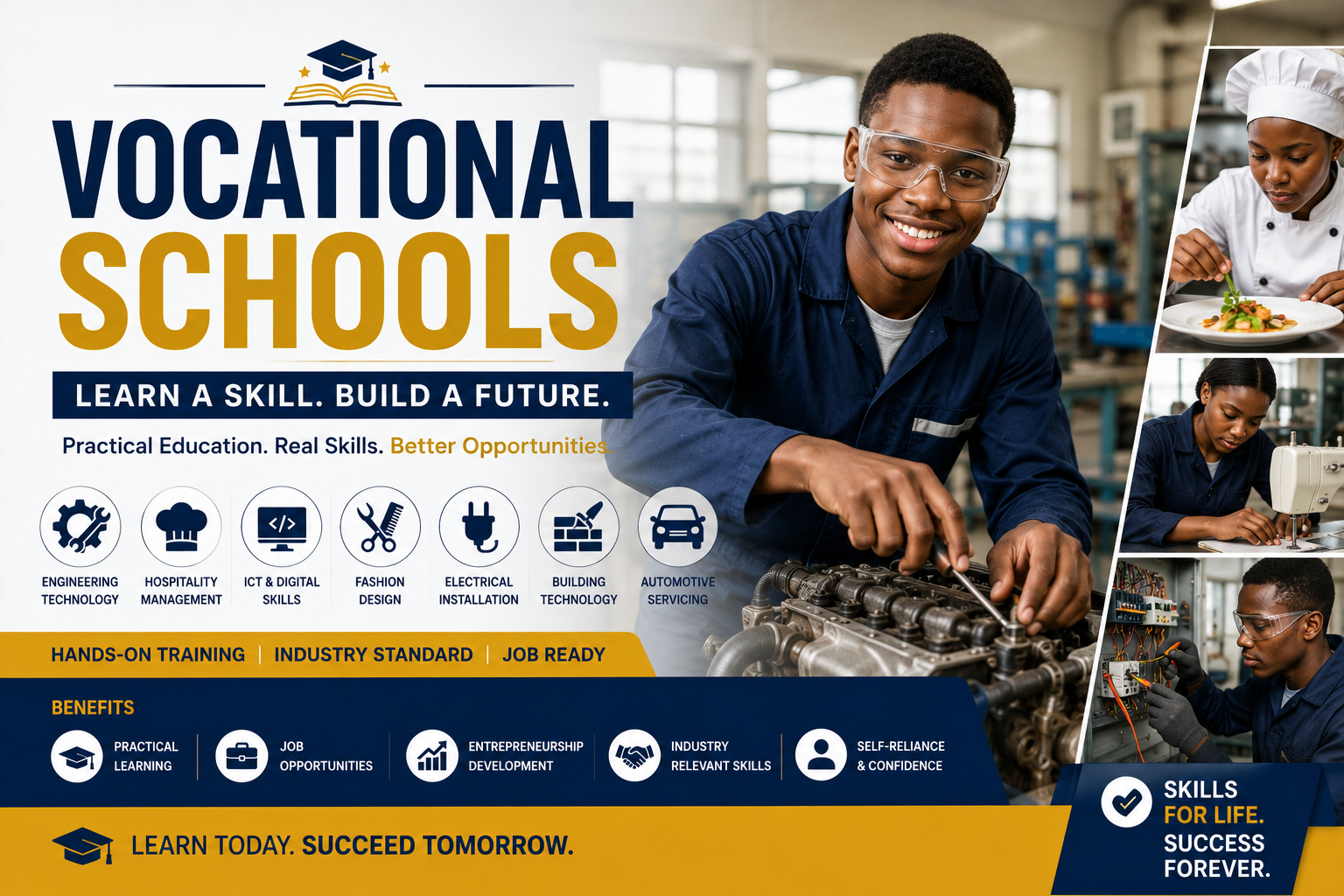
Vocational schools in Nigeria are quietly producing some of the most employable and self-reliant graduates in the country — and more young Nigerians are beginning to realise it. For too long, the conversation around education in Nigeria has been dominated by university admission, JAMB scores, and degree certificates. But the reality on the ground tells a different story — skilled tradespeople, technicians, and certified vocational professionals are in high demand, often earn well, and frequently enter the workforce faster and with less financial pressure than their university-educated peers.
This guide covers everything you need to know about vocational schools in Nigeria — what they are, the types that exist, the courses they offer, notable schools across the country, who should consider them, and an honest comparison between vocational education and the university route.
What Are Vocational Schools?
Vocational schools are educational institutions that provide hands-on, skills-based training designed to prepare students for specific trades, crafts, or technical careers. Unlike conventional universities and polytechnics, which place heavy emphasis on theoretical, academic knowledge across broad disciplines, vocational schools are built around practical competence — teaching students to do a specific thing, do it well, and enter the workforce ready to perform from day one.
In Nigeria, vocational education is formally regulated under the broader umbrella of Technical and Vocational Education and Training (TVET). The National Board for Technical Education (NBTE) oversees the regulation and accreditation of TVET institutions in Nigeria, setting curriculum standards and ensuring quality across the sector. The National Business and Technical Examinations Board (NABTEB) conducts the examinations and awards the certificates — primarily the National Technical Certificate (NTC) and the Advanced National Technical Certificate (ANTC) — that graduates of vocational and technical schools receive.
NABTEB certificates are nationally recognised and are widely accepted by employers in technical and trades-related sectors. They are considered equivalent to WAEC and NECO certificates for students pursuing technical education pathways, and holders can use them to progress to polytechnics for higher-level National Diploma (ND) and Higher National Diploma (HND) programs.
Types of Vocational Schools in Nigeria
Vocational education in Nigeria is delivered through several types of institutions, each with a slightly different structure and level of qualification offered:
Technical Colleges
These are the most widely recognised type of vocational school in Nigeria. Technical colleges offer three-year programs primarily at the secondary level, combining practical trade skills with foundational academic subjects. Graduates earn a National Technical Certificate (NTC) from NABTEB. Technical colleges exist across all states in Nigeria and cover a broad range of trades — electrical installation, welding and fabrication, plumbing, carpentry, auto mechanics, and many others.
Skill Acquisition Centres
These are government or privately run centres that offer shorter, more focused skills training programs — typically ranging from a few weeks to several months. They do not follow the full NABTEB curriculum and generally do not award nationally recognised academic certificates, but they can provide a quick and affordable pathway to a specific skill. Many state governments run skill acquisition centres as part of their youth empowerment programs.
Vocational Training Institutes
These are more structured than skill acquisition centres and offer certificate programs in specific trades or industries. Some are run by federal agencies or industry-specific bodies, while others are private. Examples include fashion institutes, hospitality schools, beauty schools, and agricultural training institutes.
Federal Government Technical Colleges
These are federal government-owned technical colleges distributed across the country, offering standardised technical and vocational education under NBTE oversight. They tend to be better resourced than many state-run equivalents and are particularly popular for engineering-related trades.
Private Vocational and Technical Schools
A growing number of private vocational training providers have emerged in Nigeria, particularly in urban areas, offering internationally aligned curricula, recognised certifications, and job placement support. These schools often charge higher fees than government-run institutions but frequently offer better equipment, more structured programs, and stronger links with industry employers.
Courses Offered at Vocational Schools in Nigeria
Vocational schools in Nigeria cover a remarkably broad range of skills and trades. Here is a breakdown of the major course categories available:
Engineering and Technical Trades
- Electrical Installation and Maintenance
- Welding and Fabrication
- Plumbing and Pipe Fitting
- Auto Mechanics and Vehicle Technology
- Refrigeration and Air Conditioning (HVAC)
- Civil and Building Construction
- Carpentry and Joinery
- Mechanical Engineering Craft
- Electronics and Radio/TV Servicing
Information and Communication Technology
- Computer Hardware Maintenance and Repair
- Software Development and Web Design
- Cybersecurity
- Data Analysis and Digital Marketing
- Graphic Design
Hospitality, Catering, and Tourism
- Catering and Hotel Management
- Event Planning and Management
- Tourism and Travel Services
- Food Processing and Technology
Fashion, Beauty, and Creative Arts
- Fashion Design and Garment Making
- Cosmetology and Beauty Therapy
- Hairdressing and Barbering
- Textile Design
- Photography and Videography
- Pottery, Woodwork, and Metalwork
Agriculture and Natural Resources
- Crop Production and Agronomy
- Animal Husbandry and Livestock Management
- Agricultural Economics and Agribusiness
- Fisheries and Aquaculture
- Forestry and Wildlife Management
Health and Allied Health
- Community Health
- Dental Technology and Therapy
- Pharmacy Technician Programs
- Medical Laboratory Assistant Training
Business and Commercial Skills
- Secretarial Studies and Office Management
- Bookkeeping and Accounting Assistant Programs
- Cooperative Economics
- Business Administration Certificate Programs
Specialised and Industry-Specific Programs
- Aviation Technology — at the Nigerian College of Aviation Technology (NCAT), Zaria
- Maritime Studies — at the Nigerian Maritime Academy, Oron
- Broadcasting and Media Production — at the NTA Television College, Jos
- Leather Technology and Footwear Design — at the Nigerian Institute of Leather and Science Technology (NILEST), Zaria
Top Vocational Schools in Nigeria
Nigeria has a wide range of vocational and technical institutions across its six geopolitical zones. Here are some of the most recognised ones:
Federal Science and Technical College (FSTCs)
Federal Science and Technical Colleges are spread across the country and are among the most recognised government-run vocational and technical schools in Nigeria. They offer a combination of academic and technical education, preparing students for both WAEC/NECO and NABTEB examinations. Many Nigerian professionals in engineering, construction, and manufacturing trace their foundational skills training back to an FSTC.
Nigerian College of Aviation Technology (NCAT) — Zaria
NCAT is a highly specialised vocational and technical institution offering courses in aviation, including aircraft maintenance engineering, air traffic services, and airline operations. It is one of the most respected aviation training institutions in West Africa and attracts students from across the region.
Nigerian Maritime Academy — Oron, Akwa Ibom State
Known for its maritime programs, this academy offers vocational courses in marine engineering, nautical science, and maritime transport. Given Nigeria’s extensive coastline and significant oil and gas sector, maritime training from a recognised institution carries real employment value.
Federal Craft Development Institute — Ibadan
This institute is known for craft and artistic skills training, including pottery, textile design, woodwork, and metalwork. It nurtures creative and artisanal skills that have both local and international market value.
Lagos State Vocational Training and Skill Acquisition Centre
One of the leading state-run vocational schools in Lagos, this centre offers a wide range of programs including catering and event management, fashion design, and beauty therapy. Its Lagos location gives students access to one of Nigeria’s most active commercial and employment markets upon graduation.
Federal College of Agriculture — Akure
Specialising in agricultural vocational training, this institution offers programs in crop production, animal husbandry, agricultural economics, and agribusiness — highly relevant given the growing demand for skilled agricultural professionals in Nigeria.
National Institute of Construction Technology — Uromi
With a focus on construction-related skills, this institute offers vocational training in civil engineering, architectural technology, and quantity surveying, positioning graduates for careers in Nigeria’s active construction sector.
EtiwaTech — Lagos
One of Nigeria’s newer but highly regarded private vocational schools, EtiwaTech focuses on construction and engineering excellence. With an internationally aligned curriculum, over a decade of excellence, and more than 8,000 graduates, it has become a preferred training partner for leading local and international construction and engineering organisations.
Kaduna Polytechnic
Renowned for its engineering programs, Kaduna Polytechnic offers vocational courses in electrical engineering, mechanical engineering, and civil engineering, bridging the gap between pure vocational training and higher-level technical education.
Federal School of Dental Technology and Therapy — Enugu
Providing vocational training in dental technology and therapy, this school equips students with skills for the dental industry — a field where qualified technicians are consistently in demand.
Admission Requirements for Vocational Schools in Nigeria
Admission requirements vary depending on the type and level of the vocational school, but here are the general criteria that apply across most institutions:
Technical Colleges (Secondary Level)
- Completion of Junior Secondary School Certificate (JSS3) — Junior WAEC or BECE
- Minimum age of approximately 14 to 16 years depending on the institution
- Basic literacy and numeracy skills
- Some institutions may require a placement or aptitude test
Vocational Training Institutes and Skill Acquisition Centres
- Requirements vary widely — some programmes require a minimum of SSCE (WAEC/NECO) while others accept candidates with only basic literacy
- Some programmes have no formal academic requirement, focusing entirely on motivation and aptitude
- Age requirements vary but most programmes accept candidates from age 16 upwards
Specialised Vocational Institutions (NCAT, Maritime Academy, etc.)
- Minimum of five O’Level credits including English Language, Mathematics, and relevant science subjects in WAEC or NECO
- Some programmes require additional aptitude tests, medical examinations, or fitness assessments
- Age limits vary by programme — aviation and maritime programmes typically have specific age requirements
School Fees
Fees at Nigerian vocational schools vary widely depending on whether the institution is government-run or private, and the specific programme. Government-run technical colleges generally charge between ₦15,000 and ₦80,000 per year, making them significantly more affordable than most Nigerian universities. Private vocational schools may charge higher fees but often provide better equipment, more structured training, and stronger job placement support.
Vocational Schools vs University — Which Is Better for You?
This is the question a growing number of Nigerian students and families are asking — and it deserves an honest, nuanced answer. The truth is that neither path is universally better. The right choice depends entirely on your goals, interests, financial situation, and career aspirations.
Where Vocational Schools Have the Edge
Faster entry into the workforce — A technical college program typically lasts three years, and many skill acquisition programs run for just six to twelve months. Compare this to a four to five year university degree, and the time-to-employment advantage is significant.
Lower cost — Government technical colleges charge a fraction of what most Nigerian universities charge. Even private vocational schools are often more affordable on a per-year basis than private universities, which can charge well over ₦1,000,000 annually.
Practical, employment-ready skills — Vocational graduates enter the workforce with demonstrable, hands-on skills that employers can deploy immediately. Many university graduates spend additional months or years acquiring practical competencies after graduation.
Entrepreneurship potential — Many vocational skills — plumbing, electrical installation, fashion design, welding, catering — are directly applicable to self-employment. A vocational graduate can start their own business without needing an employer, which is a significant advantage in Nigeria’s employment market.
No JAMB required for most programs — Unlike universities, most vocational schools do not require JAMB UTME scores, removing one of the biggest barriers that prevents many Nigerian students from accessing tertiary education.
Where University Has the Edge
Higher earning potential in certain fields — In professional fields like Medicine, Law, Engineering, and Accounting, a university degree is not just preferred — it is often legally required for professional practice. The earning ceiling in these fields is typically higher than in most trades.
Academic and research opportunities — University provides access to research, postgraduate studies, and academic careers that vocational training cannot offer.
Broader social and professional networks — University exposes students to a wider range of peers, faculty networks, and professional opportunities that extend across industries.
Social perception — In Nigeria’s current cultural context, a university degree still carries significant social capital. This is gradually changing, but it remains a relevant factor for many families.
The Honest Bottom Line
The best choice is the one that aligns with who you are, what you want to do, and what your financial reality allows. A student who genuinely loves electrical work, plumbing, or fashion design will likely build a more fulfilling and financially rewarding life through a vocational pathway than through a university degree in a course they studied reluctantly. Conversely, a student with clear aspirations for a career that requires professional certification — medicine, law, engineering — needs the university route.
What Nigeria genuinely needs is for both pathways to be respected equally — and the economy increasingly reflects this. Skilled tradespeople in Lagos, Port Harcourt, and Abuja are in consistent high demand and often earn more per month than fresh university graduates in entry-level jobs.
Frequently Asked Questions About Vocational Schools in Nigeria
Are vocational school certificates recognised in Nigeria?
Yes. Certificates from accredited Nigerian vocational schools — particularly the National Technical Certificate (NTC) and Advanced National Technical Certificate (ANTC) awarded by NABTEB — are nationally recognised and accepted by employers in relevant sectors. They are considered equivalent to WAEC and NECO for students in technical education pathways.
Can I go to university after attending a vocational school?
Yes. Holders of NABTEB certificates can progress to polytechnics for National Diploma (ND) and Higher National Diploma (HND) programs. From there, they can also pursue degree programs through direct entry routes. Some vocational qualifications also qualify holders for university direct entry, subject to the specific requirements of the institution and course.
Do I need JAMB to get into a vocational school?
In most cases, no. The majority of technical colleges and vocational training institutes in Nigeria do not require JAMB UTME scores for admission. This makes them accessible to students who did not write JAMB or did not perform well enough to gain university admission.
Which vocational courses are most in demand in Nigeria?
Based on current market trends, the most in-demand vocational skills in Nigeria include electrical installation, plumbing, welding, auto mechanics, refrigeration and air conditioning (HVAC), software development, graphic design, catering and hospitality, fashion design, and agricultural skills. Tech-related vocational skills in particular are experiencing explosive growth in demand.
How much do vocational school graduates earn in Nigeria?
Earnings vary widely by trade, location, experience, and whether the graduate is employed or self-employed. Skilled electricians, plumbers, and HVAC technicians in Lagos and Abuja, for example, can earn between ₦100,000 and ₦500,000 or more per month as experienced professionals or business owners. Tech-skilled vocational graduates in software development and data analysis can earn even more, particularly with international client exposure.
Are there vocational schools in every state in Nigeria?
Yes. Federal Science and Technical Colleges exist across all states in Nigeria, and most states also have their own state-run technical colleges and skill acquisition centres. Private vocational training providers are more concentrated in major urban centres but are increasingly expanding to secondary cities.
Is vocational education the same as TVET?
Yes, largely. TVET stands for Technical and Vocational Education and Training, which is the broader regulatory and institutional framework that covers all forms of practical, skills-based education in Nigeria, including technical colleges, vocational training institutes, and skill acquisition centres. Vocational education is a core component of Nigeria’s TVET system, overseen by the National Board for Technical Education (NBTE).
Final Thoughts
Vocational schools in Nigeria are not a consolation prize for students who could not get into university. They are a legitimate, often faster, frequently more affordable, and sometimes more financially rewarding educational pathway that deserves serious consideration by any student weighing their options after secondary school.
The right question is not “university or vocational school?” — it is “which pathway best aligns with my genuine interests, my career goals, and my financial situation?” For a large number of Nigerian students, the honest answer to that question points toward vocational education.
Whether you are a student making a post-secondary decision, a parent trying to guide your child, or someone looking to acquire a new skill at any stage of life, Nigeria’s vocational schools offer a genuine, credible path to a productive and fulfilling career.
If this guide was helpful, share it with a student or family navigating the same decision. And if you have questions about vocational schools or training programs in a specific state or field, drop them in the comments section below.