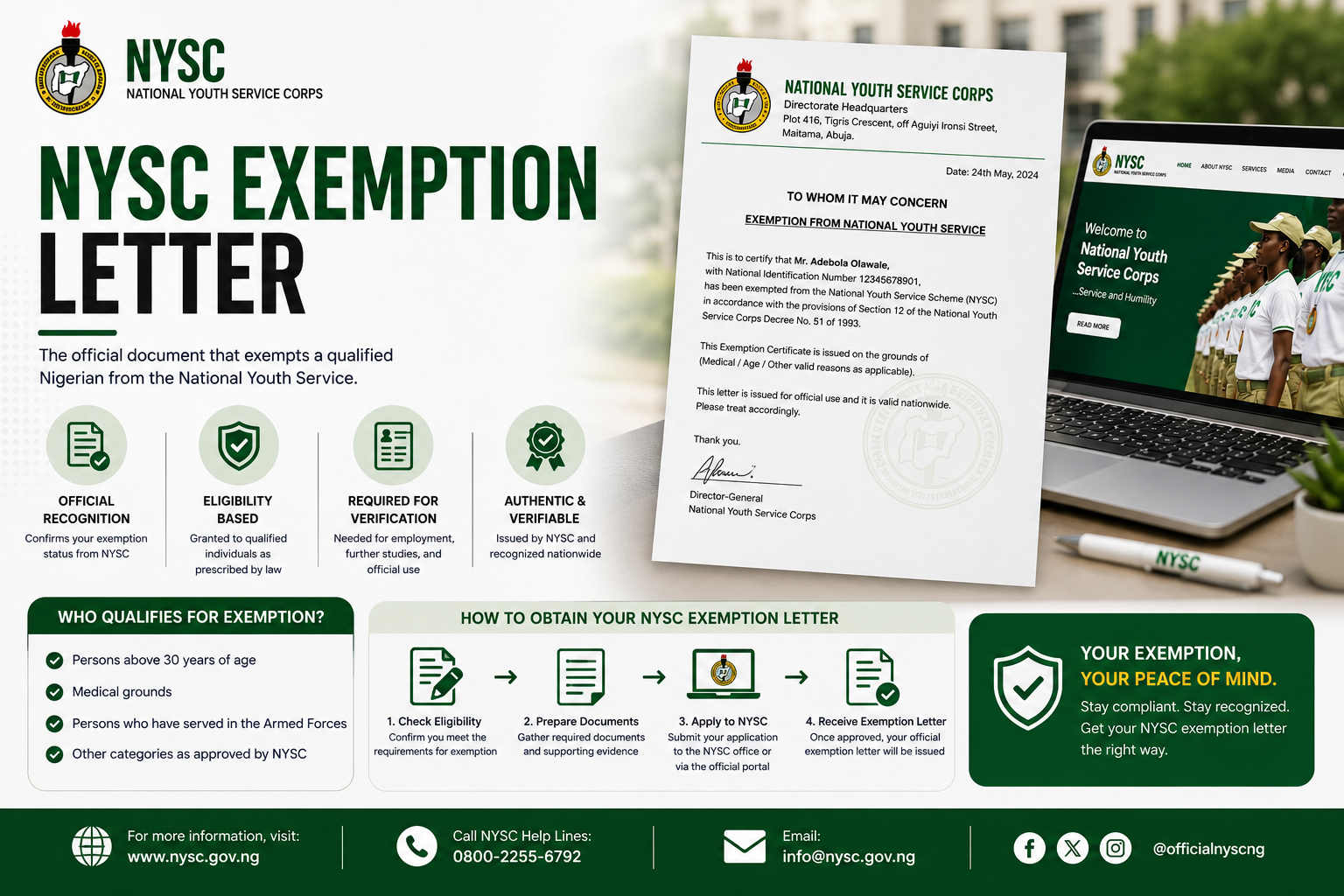
Not every Nigerian graduate is required to participate in the one-year National Youth Service Corps program. If you fall into a specific category recognised by law, you may be entitled to what is known as the NYSC exemption letter — an official document that formally confirms you are not required to serve.
A lot of confusion exists around this topic. Some graduates assume exemption is something they can simply request because they do not want to participate. Others confuse it with a completely different document — the exclusion letter — which applies to an entirely different category of people. This guide clears up all of that confusion and walks you through exactly who qualifies for the NYSC exemption letter, what the requirements are, how to apply, and what to do if your certificate gets lost.
What Is the NYSC Exemption Letter?
The NYSC exemption letter, also referred to as the Certificate of Exemption, is a formal document issued by the National Youth Service Corps to graduates who are not eligible to participate in the mandatory one-year service program due to specific conditions recognised under the NYSC Decree of 1993.
It is important to understand that exemption is not a matter of personal choice or preference. You cannot simply decide you do not want to serve and apply for exemption on that basis. Exemption is strictly determined by specific, legally defined criteria — age at the point of graduation, certain professional service history, national honours, and a few other recognised conditions. Once you meet any of these criteria, exemption becomes automatic rather than something you negotiate or request as a favour.
The exemption letter serves as official proof that you have been formally excused from the service year. It is essential for job applications, particularly in sectors that require evidence of NYSC participation or exemption, as well as for visa processes, postgraduate admissions, and other official and legal purposes where proof of your NYSC status is required.
NYSC Exemption Letter vs Exclusion Letter — What Is the Difference?
This is, without question, the single most common point of confusion among Nigerian graduates, and it is worth addressing clearly before anything else.
The Exemption Certificate is issued to full-time graduates who qualify for a waiver due to specific conditions — primarily age at graduation, prior military or police service, possession of a national honour, or certain recognised medical conditions. These are graduates who, under normal circumstances, would be required to serve, but are formally excused because they meet one of these specific conditions.
The Exclusion Letter, on the other hand, is a completely different document reserved for graduates whose mode of study does not align with NYSC’s regular mobilisation rules in the first place. This typically includes part-time graduates, distance learning graduates, and graduates of institutions or programs that do not qualify for full NYSC mobilisation — such as certain National Open University of Nigeria (NOUN) part-time programs and some College of Education part-time tracks.
In simple terms — exemption is for people who would normally serve but are excused due to a recognised condition. Exclusion is for people whose academic pathway was never structured to lead to NYSC mobilisation in the first place. These two documents are not interchangeable, and applying for the wrong one will only delay your process.
Who Qualifies for the NYSC Exemption Letter?
Several distinct categories of Nigerian graduates qualify for NYSC exemption. Here is a breakdown of each:
1. Graduates Who Are 30 Years or Older at Graduation
This is the most common basis for exemption. If you are 30 years of age or older by the time you graduate, you are automatically exempt from the NYSC program. This is determined strictly by your age at the point of graduation, not your age when you eventually register on the NYSC portal.
It is worth noting an important detail here — if you graduated while under 30 years of age, you remain eligible to serve whenever you choose to register, even if you are well into your forties by the time you actually do so. Age-based exemption is locked in at the moment of graduation, not at any later point.
NYSC determines your age by checking the date of birth on your JAMB record and comparing it with your graduation date as provided by your institution. For foreign-trained graduates who did not register through JAMB, the date of birth on your international passport is used instead. Once you complete your NYSC online registration, your exemption status — if applicable — will reflect on your dashboard.
2. Graduates Who Served in the Armed Forces or Nigeria Police Force
If you have served in the Nigerian Armed Forces or the Nigeria Police Force for a period of more than nine months, you are exempt from the NYSC program. This recognises that you have already fulfilled a significant period of national service in a different capacity.
3. Recipients of National Honours
Individuals who have been conferred with any national honour by the Federal Government of Nigeria are exempted from the NYSC service year. This is a relatively rare category but is formally recognised under the NYSC framework.
4. Nigerian Graduates of Foreign Universities (Diaspora Graduates)
Nigerian graduates who completed their degree programs and obtained their certificates from institutions outside Nigeria may, in certain circumstances, be exempt from service. However, this is not automatic in every case — foreign-trained graduates are typically required to present their degree certificates to NYSC’s Mobilisation Department for evaluation before any exemption status is confirmed. The evaluation process determines whether your foreign qualification and circumstances meet the criteria for exemption.
5. Graduates Who Hold a Diploma or HND Before Their Bachelor’s Degree
Individuals who obtained a diploma or Higher National Diploma (HND) before subsequently acquiring a bachelor’s degree may be exempt from NYSC, since their prior HND-level qualification would typically have already involved a service requirement at that level.
6. Graduates With Certain Recognised Medical Conditions
Some medical conditions can qualify a graduate for exemption from the service year. In these cases, the individual is required to provide proper medical documentation from a recognised medical authority to support the claim. This category is assessed on a case-by-case basis.
Important Things to Understand About Exemption Eligibility
Before moving on to the application process, there are a few critical points worth understanding clearly:
- Exemption is not optional or by request — You cannot apply for exemption simply because you prefer not to serve. You must meet one of the legally recognised criteria listed above.
- Exemption status appears after online registration — You will only see your exemption status reflected on your NYSC dashboard after you complete the online registration process. There is no separate “apply for exemption” button that exists independently of registration.
- You cannot be processed twice under different categories — Once you have been issued an exemption or exclusion letter, that status stands. NYSC does not reprocess the same individual under a different category afterward.
- Meeting exemption criteria removes the requirement, not the registration — Even if you qualify for exemption, you are still expected to go through NYSC’s online registration process, after which your exemption status is confirmed and reflected.
Requirements for the NYSC Exemption Letter
The specific documents required depend on which exemption category applies to you, but generally, you will need the following:
- A valid government-issued means of identification — National ID card, international passport, or voter’s card
- Your degree certificate or statement of result — confirming your graduation date and qualification
- Proof of age — typically your birth certificate, age declaration, or the date of birth reflected on your JAMB profile or international passport
- For Armed Forces or Police exemption — official discharge papers or service records confirming more than nine months of service
- For national honour exemption — official documentation confirming the conferment of the honour
- For foreign-trained graduates — original degree certificates and transcripts for evaluation by the NYSC Mobilisation Department, along with a photocopy of your international passport
- For medical exemption — comprehensive medical documentation from a recognised hospital or medical authority detailing the condition
- For HND/diploma-before-degree exemption — your original HND or diploma certificate alongside your subsequent bachelor’s degree certificate
How to Apply for the NYSC Exemption Letter — Step by Step
Here is the process for obtaining your NYSC exemption letter:
- Complete NYSC online registration — Visit the official NYSC portal at portal.nysc.org.ng and complete the standard online registration process just as any other graduate would. This includes entering your bio-data, academic details, and other required information accurately.
- Allow the system to assess your eligibility — Once you submit your registration, NYSC’s system automatically cross-checks your details — particularly your date of birth and graduation date — against their records to determine whether you qualify for exemption based on age or any other automatically detectable criteria.
- Check your dashboard for your exemption status — After registration, log back into your NYSC dashboard. If you qualify for exemption, your status will reflect this, and you will not be required to proceed with the payment option for call-up or mobilisation, since this does not apply to exempted graduates.
- Submit supporting documents where required — Depending on your specific exemption category — particularly for foreign-trained graduates, medical exemption cases, or those exempted due to Armed Forces or Police service — you may need to submit additional documentation either through the portal or directly to the NYSC Mobilisation Department for verification and evaluation.
- Await issuance of your printed exemption certificate — Once your exemption status is confirmed and any required verification is complete, NYSC processes and issues your printed Certificate of Exemption.
- Collect your certificate from your institution — Printed exemption certificates are typically sent to the institution you graduated from for collection. Contact your institution’s Student Affairs Officer (SAO) or NYSC liaison office to confirm when your certificate has arrived and is ready for collection.
- Collect within the stipulated timeframe — It is important to collect your certificate promptly once it arrives at your institution. Certificates that are not collected within six months are typically returned to NYSC headquarters, which can complicate and delay your ability to retrieve it later.
For further clarification at any stage of this process, you can visit the official NYSC website or consult your institution’s Student Affairs Officer, who handles NYSC-related matters on behalf of graduating students.
What If You Lose Your NYSC Exemption Letter?
Losing your exemption certificate is a situation many graduates eventually face, particularly years after graduation. If this happens to you, here is what to do, broken down by whether you are a home-trained or foreign-trained graduate.
For Home-Trained Graduates (Studied in Nigeria)
- Write a formal letter of notification and request addressed to the Director-General, NYSC
- Route this letter through your institution of graduation — your university or institution forwards or endorses the letter on your behalf
- Attach a police report or police extract confirming the loss
- Attach a sworn court affidavit declaring the loss
- Include a photocopy of the lost certificate if you have one available
- Submit the complete documentation to the NYSC National Directorate Headquarters
For Foreign-Trained Graduates (Studied Abroad)
- Write a formal letter of notification and request addressed directly to the Director-General, NYSC — this does not need to be routed through an institution
- Attach a police report confirming the loss
- Attach a sworn court affidavit
- Include a photocopy of your international passport
- Include a photocopy of the lost certificate if available
- Submit at NYSC headquarters
It is important to manage your expectations here — it is the official policy of NYSC not to reprint lost or burnt certificates, including the Certificate of Exemption. Instead of a reprinted certificate, NYSC issues a Letter of Confirmation in its place. This letter officially confirms that an exemption certificate was issued to you and serves the same practical purpose for most job applications and official verification processes.
Important Notice — Be Wary of Fraudulent Claims
Because the NYSC exemption process involves specific legal criteria, there are unfortunately individuals and platforms that exploit graduates who are eager to avoid service by falsely promising to “process” exemption letters for people who do not actually qualify. This is fraudulent and carries serious legal risk.
Exemption is determined exclusively by NYSC based on the legally recognised criteria outlined in this guide — age, prior service, national honours, foreign qualifications subject to evaluation, HND-before-degree status, or recognised medical conditions. There is no legitimate way to “purchase” or unofficially obtain an exemption letter outside of genuinely meeting one of these criteria. Always go through the official NYSC portal and your institution’s Student Affairs Officer for anything related to your exemption status.
Frequently Asked Questions About the NYSC Exemption Letter
Can I apply for NYSC exemption simply because I do not want to serve?
No. Exemption is strictly determined by specific legal criteria — age at graduation, prior Armed Forces or Police service, national honours, certain foreign qualifications, HND-before-degree status, or recognised medical conditions. Personal preference is not a valid basis for exemption.
What is the age cutoff for NYSC exemption?
If you are 30 years of age or older at the time of your graduation, you are automatically exempt from NYSC. This is based strictly on your age at graduation, not your age at the time you eventually register on the NYSC portal.
If I graduated under 30, can I still be exempted later for being too old?
No. If you graduated while under 30 years old, you remain eligible to serve whenever you choose to register, regardless of how old you are by the time you actually do so. The age-based exemption is determined strictly at the point of graduation.
Do I need to register on the NYSC portal even if I know I am exempt?
Yes. You must still complete the standard NYSC online registration process. Your exemption status is only confirmed and reflected after registration — there is no separate exemption-only application route that bypasses registration.
How do I know if I should apply for exemption or exclusion?
Exemption applies if you would normally be required to serve but qualify for a waiver due to age, prior service, national honours, or medical conditions. Exclusion applies if your mode of study — such as part-time or distance learning — was never structured to lead to NYSC mobilisation in the first place. If you are unsure which applies to you, consult your institution’s Student Affairs Officer.
Will NYSC reprint my exemption certificate if I lose it?
No. It is NYSC’s official policy not to reprint lost or burnt certificates, including the Certificate of Exemption. Instead, you will be issued a Letter of Confirmation, which serves the same practical purpose for most official and employment-related verification needs.
How long does it take to collect the exemption certificate after it is processed?
Printed exemption certificates are sent to your institution of graduation for collection. You should collect it promptly once notified, as certificates not collected within six months are typically returned to NYSC headquarters, which can complicate and delay future retrieval.
Can a foreign-trained graduate get automatic exemption without evaluation?
Not necessarily. Nigerian graduates of foreign universities are generally required to submit their degree certificates to the NYSC Mobilisation Department for evaluation before exemption status is confirmed. It is not automatically granted simply because the degree was obtained abroad.
Final Thoughts
The NYSC exemption letter exists for a specific purpose — to formally excuse graduates who meet clearly defined legal criteria from the mandatory service year. It is not a document you can request based on personal preference, and understanding the actual qualifying categories is the first step to knowing whether it applies to you.
If you believe you qualify — whether due to your age at graduation, prior service in the Armed Forces or Police, a national honour, your foreign academic background, your HND-before-degree status, or a recognised medical condition — complete your NYSC online registration as required, gather the relevant supporting documents for your category, and follow up through your institution’s Student Affairs Officer to collect your certificate once it is processed.
And if your certificate is ever lost down the line, remember that the process exists to get you a Letter of Confirmation — so a misplaced document, while inconvenient, does not have to become a lasting problem.
If this guide helped you, share it with a fellow graduate who might be confused about their NYSC exemption status. And if you have questions about your specific situation, drop them in the comments section below.