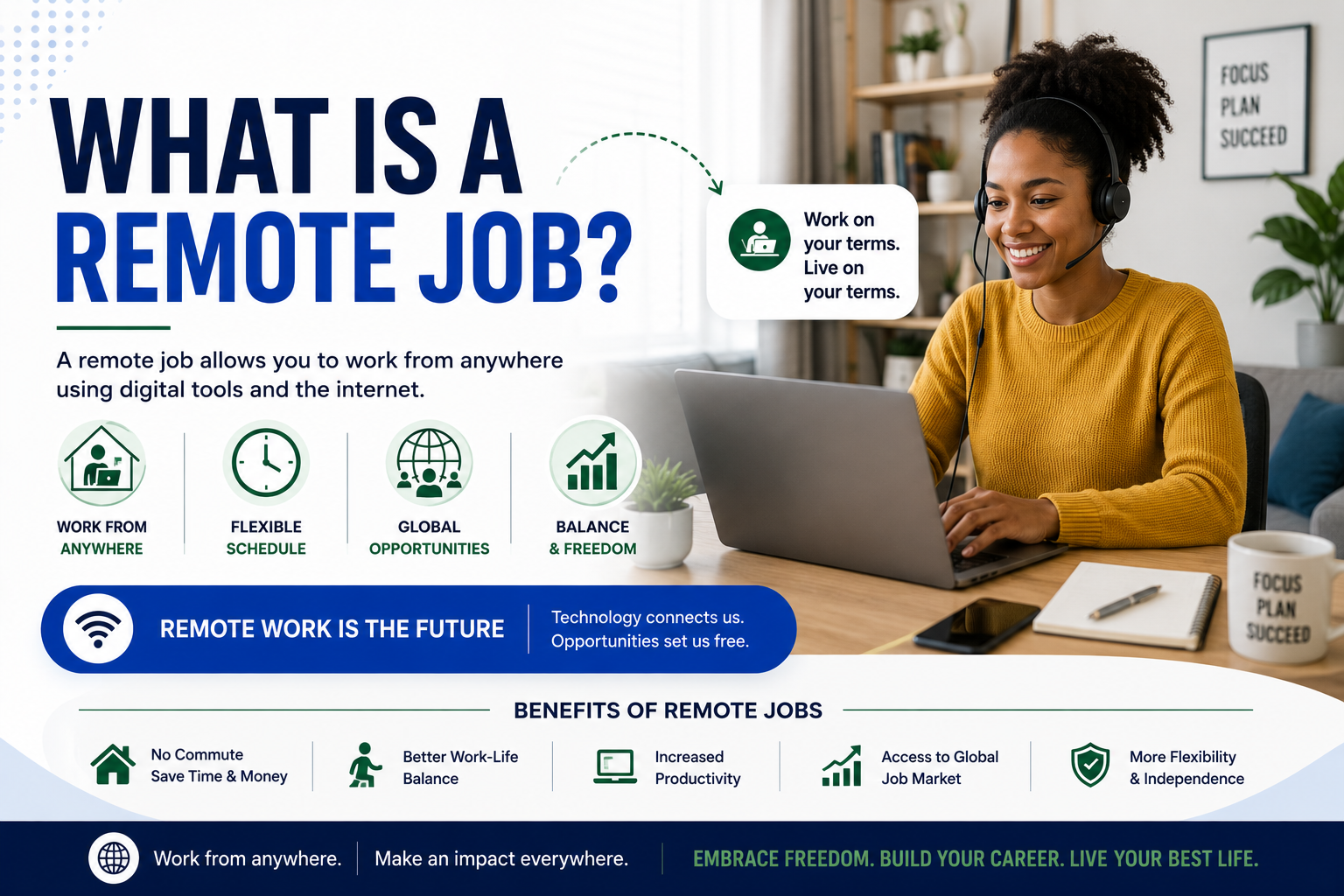
Over the last few years, the phrase “remote job” has gone from being something only a small group of freelancers talked about to becoming one of the most searched terms in the global job market. More people than ever are working from home, from coffee shops, from co-working spaces, and even from different countries entirely. But if you are still trying to wrap your head around exactly what a remote job is, how it works in practice, and whether it is something that could work for you, this guide has everything you need.
Understanding what a remote job is goes beyond just knowing that you work from home. It involves understanding the different types of remote work arrangements, what employers expect from remote workers, the tools that make remote work possible, and how to set yourself up for success in this kind of environment. Let us break it all down.
What Is a Remote Job?
A remote job is any employment arrangement where the employee performs their work outside of a traditional office setting. Instead of commuting to a physical office every day, remote workers complete their tasks from a location of their choosing — most commonly their home, but also potentially a co-working space, a café, a library, or anywhere with a reliable internet connection.
The defining characteristic of a remote job is that it does not require the employee to be physically present at a specific location to do their work. Everything — from communication with colleagues and managers, to accessing work files and systems, to attending meetings — is done digitally using a range of online tools and platforms.
It is important to note that remote jobs are real, legitimate employment arrangements with proper contracts, salaries, and benefits, just like any traditional office job. The only difference is where the work gets done.
Types of Remote Jobs
Not all remote jobs work the same way. There are several different types of remote work arrangements, and understanding the differences helps you know what to expect when you see a role described as “remote.”
Fully Remote Jobs
A fully remote job means the employee works remotely at all times, with no requirement to visit a physical office. Companies that operate on a fully remote model either have no central office at all, or have offices that employees are never required to use. In a fully remote setup, everything — hiring, onboarding, day-to-day work, team meetings, and performance reviews — happens online.
This type of arrangement offers the highest level of flexibility and is particularly common in tech companies, content and media businesses, and organizations that were built with a distributed team model from the start.
Partially Remote or Hybrid Jobs
A partially remote job, also commonly referred to as a hybrid job, requires the employee to split their time between working remotely and working from a physical office. For example, an employee might work from home three days a week and come into the office for the remaining two days.
This type of arrangement has become very popular among companies that want to offer flexibility without giving up in-person collaboration entirely. It combines the benefits of remote work with the structure and social aspects of office life.
Remote-First Jobs
Remote-first companies are those that have built their culture, processes, and tools around the assumption that most or all employees will be working remotely. In these organizations, remote work is not an afterthought or a perk — it is the default. Even if the company has a physical office, it is designed as an optional space rather than the primary workplace.
Asynchronous Remote Jobs
Some remote jobs operate on an asynchronous model, meaning that team members do not all work at the same time and are not expected to be available simultaneously. This is particularly common in companies with team members spread across multiple time zones. Instead of real-time meetings and instant responses, communication happens through recorded messages, detailed written updates, and collaborative platforms that allow people to contribute at their own pace.
Synchronous Remote Jobs
In contrast, synchronous remote jobs require employees to be online and available during specific hours, even though they are not in a physical office. This might involve daily video calls, real-time chat responses, and set working hours that mirror a traditional office schedule, just carried out from a remote location.
How Does a Remote Job Work?
Understanding what a remote job is becomes clearer when you see how it actually functions on a day-to-day basis. Here is a general picture of what working remotely looks like in practice.
Communication Tools
Since remote workers cannot walk over to a colleague’s desk, digital communication tools become the backbone of how teams stay connected. The most commonly used tools include:
- Video Conferencing: Platforms like Zoom, Google Meet, and Microsoft Teams are used for team meetings, one-on-one check-ins, client calls, and virtual presentations.
- Instant Messaging: Tools like Slack and Microsoft Teams (which doubles as both a messaging and video platform) allow team members to have quick conversations, share updates, and collaborate in real time without needing to schedule a formal meeting.
- Email: For more formal communication, documentation, and correspondence with external parties, email remains a core tool in remote work environments.
Project Management and Collaboration Tools
Remote teams rely heavily on project management platforms to track tasks, deadlines, and progress without being in the same room. Popular tools in this category include Trello, Asana, Monday.com, and Notion. These platforms allow teams to assign tasks, set deadlines, share updates, and track project progress transparently across the entire team.
Cloud-Based File Sharing
Instead of working on files stored on a single office computer, remote workers use cloud-based platforms to store, access, and collaborate on documents and files from anywhere. Google Drive, Microsoft OneDrive, and Dropbox are among the most widely used solutions for this purpose. These platforms allow multiple team members to work on the same document simultaneously, comment on each other’s work, and access files from any device.
Time Tracking and Productivity Tools
Some remote employers, particularly those managing large distributed teams, use time tracking tools to monitor how employees spend their working hours. Tools like Toggl, Clockify, and Hubstaff allow workers to log their hours and track time spent on specific tasks, giving managers visibility into workload and productivity without needing to physically observe their team.
Virtual Onboarding and Training
When a new employee joins a remote company, the onboarding process happens entirely online. This typically involves going through digital documentation, completing online training modules, attending virtual introduction sessions with team members, and being set up with all the tools and access permissions needed to do the job — all without ever stepping into an office.
What Types of Jobs Can Be Done Remotely?
One of the most common misconceptions about remote work is that it is only available for people in tech. While technology roles were among the earliest to go remote, the range of jobs that can be done remotely has expanded significantly. Here are some of the most common categories.
Technology and Software Development
Software developers, web designers, UX/UI designers, data analysts, cybersecurity professionals, and IT support specialists are among the most common remote workers. The nature of their work — which primarily involves a computer, coding tools, and collaboration platforms — makes it highly compatible with remote arrangements.
Writing and Content Creation
Content writers, copywriters, editors, journalists, bloggers, and social media managers can perform all of their work remotely. As long as they have access to the internet and their writing tools, location is largely irrelevant to their output.
Digital Marketing
Digital marketing professionals, including SEO specialists, email marketers, paid advertising managers, and social media strategists, work primarily with online tools and platforms, making their roles highly suitable for remote work.
Customer Service and Support
Many companies now run remote customer service teams, with support agents handling customer inquiries via phone, email, live chat, or social media from their homes. This has become one of the more accessible entry points into remote work, as it often requires strong communication skills rather than highly specialized technical knowledge.
Finance and Accounting
Roles like financial analyst, bookkeeper, accountant, and tax consultant can often be performed remotely, particularly in organizations that have moved their financial systems and records to cloud-based platforms.
Human Resources
HR professionals handling recruitment, employee relations, payroll processing, and organizational development can frequently work remotely, especially within companies that are themselves distributed across multiple locations.
Education and Training
Online tutors, e-learning content developers, corporate trainers, and virtual classroom teachers all perform their work remotely. The growth of online education has created a wide range of opportunities for educators to teach and train students and professionals around the world without geographic limitations.
Project Management and Consulting
Project managers and consultants who work primarily through coordination, planning, and advisory activities can often manage their responsibilities remotely, using digital tools to track progress and communicate with stakeholders.
Benefits of Working a Remote Job
Remote work has attracted so much interest for good reasons. Here are some of the most significant benefits that draw people to remote employment.
Flexibility and Autonomy
One of the most valued aspects of remote work is the flexibility it offers. Many remote roles allow employees to structure their workday in a way that suits their personal productivity patterns and lifestyle. Whether you are most productive early in the morning or late at night, remote work can often accommodate that — as long as the work gets done and key collaboration windows are maintained.
Elimination of Commute
Removing the daily commute saves time, money, and a significant amount of stress. For people living in cities with heavy traffic, this alone can represent hours of reclaimed time every week, which can be redirected into personal development, family time, or additional rest.
Access to a Global Job Market
Remote work breaks down geographical barriers, allowing professionals to apply for and work in roles with companies based anywhere in the world. For professionals in countries where local salaries are lower, working remotely for a company in a higher-income country can represent a transformative increase in earning potential.
Cost Savings
Working from home reduces or eliminates many of the costs associated with office work — commuting expenses, work clothing, daily lunch costs, and so on. Over time, these savings can add up to a meaningful difference in overall financial wellbeing.
Improved Work-Life Balance for Many
The ability to be present at home — available to family, able to handle personal responsibilities during the day without needing to request time off — is something many remote workers cite as one of the most significant quality-of-life improvements they have experienced since transitioning to remote work.
Challenges of Remote Jobs
Remote work is not without its difficulties, and understanding these challenges upfront helps you prepare to handle them effectively.
Isolation and Loneliness
Working from home can be a lonely experience, particularly for people who thrive on social interaction. Without the casual conversations, shared lunches, and spontaneous interactions of an office environment, some remote workers find themselves feeling isolated over time. Building social connection intentionally — through virtual team activities, local networking events, or co-working spaces — helps address this.
Difficulty Separating Work From Personal Life
When your home is also your office, it can be genuinely difficult to mentally switch off at the end of the working day. Without clear boundaries, work can spill into personal time, leading to overwork and burnout. Establishing a dedicated workspace and maintaining consistent start and end times for your working day are important strategies for managing this.
Distractions at Home
Household chores, family members, noise, and other domestic distractions can make it difficult to maintain focus during working hours. Creating a structured work environment and communicating clearly with household members about your working hours helps minimize these distractions.
Internet and Power Reliability
Remote work depends entirely on reliable internet and power supply, which can be inconsistent in certain locations. For remote workers in areas where connectivity or power supply is unreliable, investing in backup solutions such as mobile data, a UPS system, or access to a co-working space with reliable infrastructure becomes a practical necessity rather than a luxury.
Communication Gaps
Without the ability to walk over to a colleague’s desk or have a spontaneous conversation in the hallway, miscommunications can sometimes occur in remote settings. Being deliberate, clear, and thorough in written communication, and knowing when to escalate a conversation to a video call, helps reduce these gaps.
How to Succeed in a Remote Job
Succeeding in remote work requires a slightly different set of habits and disciplines compared to a traditional office role. Here are some of the most effective practices.
- Create a Dedicated Workspace: Having a specific area in your home that is reserved for work helps your brain associate that space with focus and productivity, making it easier to get into a working mindset when you sit down each day.
- Set and Maintain a Consistent Schedule: Working consistent hours helps maintain your productivity and makes it easier for colleagues to know when you are available. It also makes it easier to mentally switch off at the end of the day.
- Communicate Proactively: In a remote setting, no one can see that you are working. Keeping your manager and teammates updated on your progress, flagging issues early, and responding promptly to messages all contribute to being seen as a reliable and effective remote team member.
- Invest in Your Setup: A reliable internet connection, a comfortable chair, a decent webcam, and a good microphone make a genuine difference to both your productivity and how you are perceived in video meetings. These are worth treating as professional investments rather than optional extras.
- Take Regular Breaks: It is easy to forget to step away from your screen when you are at home. Building regular short breaks into your working day helps maintain focus and prevents the mental fatigue that comes from extended screen time.
- Stay Connected With Your Team: Make an effort to engage with your colleagues beyond strictly work-related conversations. Participating in team chats, virtual social events, and informal check-ins helps maintain the sense of connection and belonging that office workers often take for granted.
Final Thoughts
Understanding what a remote job is and how it works is the first step toward making an informed decision about whether this kind of work arrangement is right for you. Remote work offers genuine benefits — flexibility, elimination of commute, access to a wider job market, and improved work-life balance for many people. At the same time, it comes with real challenges that require deliberate effort to manage effectively.
Whether you are exploring remote work for the first time or you are actively searching for your first remote role, the most important thing is to go in with a clear understanding of what it involves, what it demands from you, and how to set yourself up to perform at your best outside of a traditional office setting.
If you found this guide helpful, share it with someone who has been wondering about remote work. And if you have any questions about finding or succeeding in a remote job, drop them in the comments below.