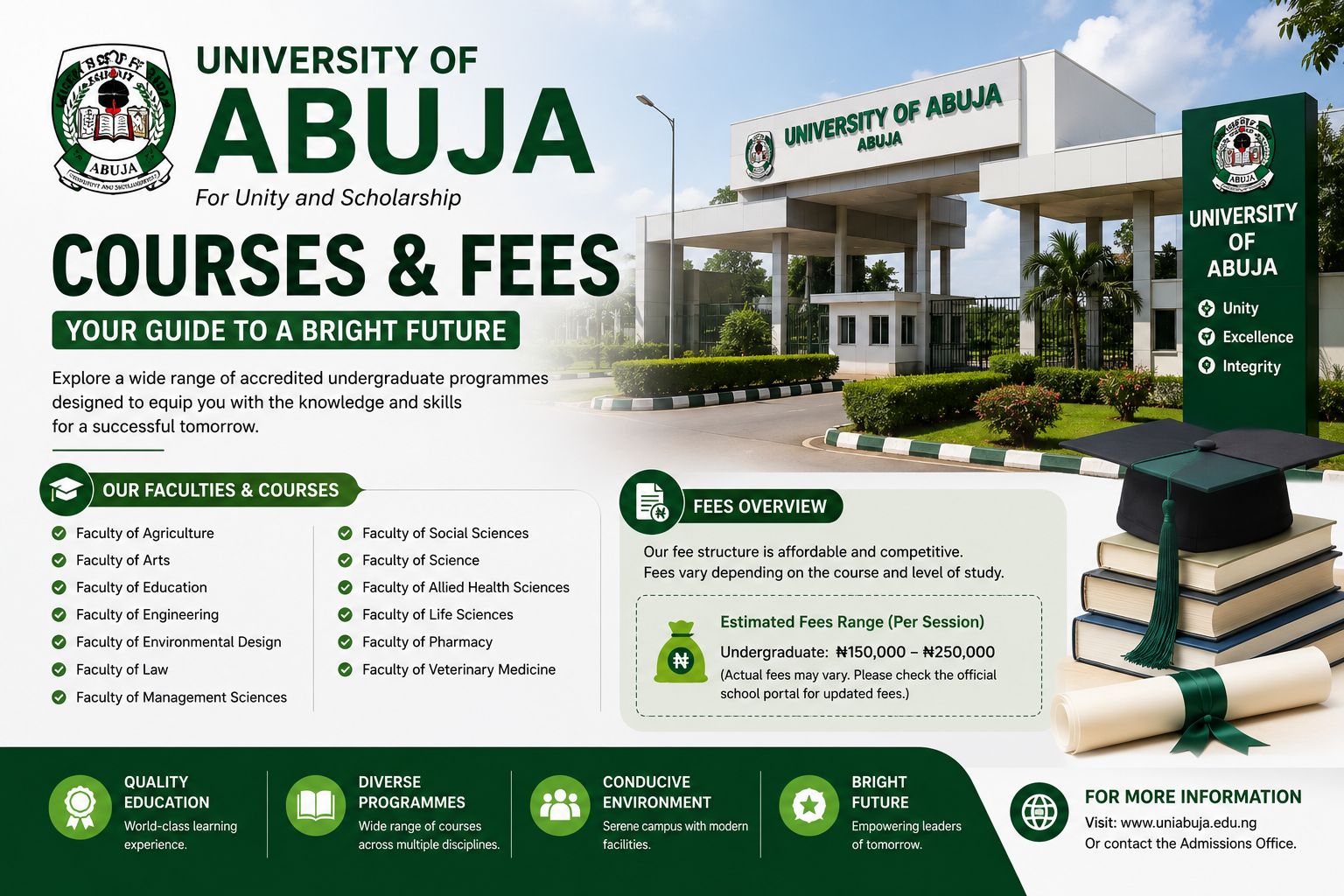
If you are considering the University of Abuja for your tertiary education, you are looking at one of Nigeria’s most strategically located federal universities — situated in the heart of the nation’s capital and offering a wide range of accredited programmes across sciences, arts, law, management, and health sciences. Whether you are a JAMB candidate choosing your first-choice institution, a parent planning your child’s university education, or a student who has just received an admission offer and needs to understand the financial commitment ahead, this guide on University of Abuja courses and fees for 2025/2026 covers everything you need to make an informed decision.
From the full list of faculties and departments to the current school fees structure, JAMB cut-off marks, admission requirements, and what student life looks like on campus — this is the most comprehensive resource you will find on the University of Abuja in one place.
About the University of Abuja
History and Background
The University of Abuja — popularly known as UniAbuja or UNIABUJA — was established in 1988 by the Federal Government of Nigeria as part of the broader effort to expand access to quality tertiary education in the Federal Capital Territory and its surrounding states. It operates as a dual-mode institution, offering both regular full-time programmes for fresh school leavers and distance learning programmes for working professionals and mature students who cannot attend full-time.
The university is located along the Airport Road in Gwagwalada, Abuja — a location that places it approximately forty kilometres from the Abuja city centre but within the Federal Capital Territory proper. The campus spans a large expanse of land and continues to develop its infrastructure in line with the university’s growing student population. A second campus — the main campus — is located in the Abuja city centre, specifically in Jabi, bringing academic activity closer to the heart of the capital for certain programmes and administrative functions.
Over the years, the University of Abuja has grown into a comprehensive federal university with multiple faculties, postgraduate programmes, a law school, and a college of health sciences — making it one of the more complete academic offerings among the newer generation of Nigerian federal universities. Its location in the FCT gives it unique advantages in terms of proximity to federal government agencies, international organisations, diplomatic missions, and the growing private sector ecosystem of Nigeria’s capital city.
Accreditation and Recognition
The University of Abuja is fully accredited by the National Universities Commission (NUC) — the federal regulatory body for university education in Nigeria. All programmes offered at the university have been assessed and approved by the NUC, and professional programmes are additionally accredited by their respective regulatory bodies. The Nigerian Law School recognises the University of Abuja’s Law degree for admission to the Bar, the Medical and Dental Council of Nigeria accredits its medical programmes, and the Council for the Regulation of Engineering in Nigeria (COREN) covers its engineering disciplines. Graduates of the University of Abuja hold nationally and internationally recognised degrees.
University of Abuja Faculties and Courses
The University of Abuja organises its undergraduate programmes across several faculties and colleges. Understanding the full range of University of Abuja courses and fees helps you identify the right programme for your academic background and career goals. Below is a comprehensive breakdown of every faculty and the programmes available within each.
Faculty of Agriculture
The Faculty of Agriculture at the University of Abuja trains students in agricultural science and related disciplines, with a focus on the practical application of agricultural knowledge to food production, resource management, and rural development in Nigeria. The faculty offers the following programmes:
- Agricultural Economics and Farm Management
- Animal Production
- Crop Production
- Forestry and Wildlife Management
- Soil Science
- Fisheries and Aquaculture
JAMB Subject Combination: English Language, Biology, Chemistry, and Mathematics or Physics. The minimum JAMB cut-off for Agriculture at the University of Abuja is typically 180. O’Level requirements include five credits in relevant subjects including English Language, Mathematics, Biology, Chemistry, and Agricultural Science or Physics.
Faculty of Arts
The Faculty of Arts is one of the university’s established faculties, offering humanities and language programmes that develop critical thinking, communication, and cultural understanding. Programmes include:
- Arabic and Islamic Studies
- English and Literary Studies
- French
- History and Diplomatic Studies
- Linguistics
- Philosophy
- Religious Studies
- Theatre and Performing Arts
JAMB Subject Combination: English Language, Literature in English or any two Arts subjects depending on the specific programme. Minimum cut-off is typically 180. O’Level credits must include English Language and relevant Arts subjects.
Faculty of Education
The Faculty of Education produces qualified teachers and education professionals for Nigeria’s primary and secondary school systems, as well as educational administrators and counsellors. Programmes available include:
- Education and Biology
- Education and Chemistry
- Education and Computer Science
- Education and Economics
- Education and English
- Education and French
- Education and Geography
- Education and History
- Education and Integrated Science
- Education and Mathematics
- Education and Physics
- Education and Religious Studies
- Early Childhood and Primary Education
- Educational Administration and Planning
- Guidance and Counselling
- Health Education
- Library and Information Science
- Physical and Health Education
- Special Education
JAMB Subject Combination: Varies by teaching specialisation — science education combinations require Mathematics and relevant science subjects; arts education combinations require relevant Arts subjects. Minimum cut-off is typically 180.
Faculty of Engineering
The Faculty of Engineering at the University of Abuja offers COREN-accredited engineering programmes that prepare graduates for careers in Nigeria’s infrastructure, energy, manufacturing, and technology sectors. The faculty offers:
- Civil Engineering
- Computer Engineering
- Electrical and Electronics Engineering
- Mechanical Engineering
JAMB Subject Combination: English Language, Mathematics, Physics, and Chemistry. Engineering is one of the more competitive faculties at the University of Abuja — JAMB scores of 200 and above are typically required, with scores of 220 and above being more competitive for the more sought-after programmes like Computer and Electrical Engineering. O’Level requirements include credits in Mathematics, Physics, Chemistry, and English Language.
Faculty of Environmental Studies
The Faculty of Environmental Studies addresses the growing demand for professionals in urban planning, architecture, surveying, and environmental management — disciplines that are particularly relevant given Abuja’s status as a planned city experiencing rapid development. Programmes include:
- Architecture
- Building
- Estate Management
- Geography and Environmental Management
- Quantity Surveying
- Urban and Regional Planning
JAMB Subject Combination: English Language, Mathematics, Physics, and one other relevant subject — Geography, Chemistry, or Fine Art depending on the specific programme. Architecture typically requires a JAMB score of 200 and above. O’Level requirements include credits in Mathematics, Physics, and English Language at a minimum.
Faculty of Law
The Faculty of Law at the University of Abuja offers the LL.B (Bachelor of Laws) degree — the foundation qualification for legal practice in Nigeria. Given the university’s location in the Federal Capital Territory, Law students benefit from unique proximity to the Supreme Court, the Federal High Court, the National Assembly, federal ministries, and major law firms — providing unparalleled opportunities for mooting, attachment, and professional exposure during the five-year programme.
Law at the University of Abuja is one of the most competitive programmes at the institution — it consistently attracts high JAMB scores and is oversubscribed each year. The programme is accredited by the Council of Legal Education, and graduates are eligible to apply for admission to the Nigerian Law School for the Bar Part Two programme leading to the call to the Bar as a Barrister and Solicitor of the Supreme Court of Nigeria.
JAMB Subject Combination: English Language, Literature in English, Government or History, and one other Arts or Social Science subject. Law at the University of Abuja typically requires a JAMB score of 240 and above for realistic consideration, alongside strong O’Level results including credits in English Language and Literature in English.
Faculty of Management Sciences
The Faculty of Management Sciences is one of the university’s most popular faculties — offering programmes that lead directly into Nigeria’s growing private sector, financial services industry, and public administration. Programmes include:
- Accounting
- Banking and Finance
- Business Administration
- Entrepreneurship
- Insurance
- Marketing
- Public Administration
JAMB Subject Combination: English Language, Mathematics, Economics, and one other Social Science subject — Government, Commerce, or Literature depending on the specific programme. Minimum JAMB cut-off is typically 180 to 200. O’Level requirements include credits in English Language, Mathematics, and Economics.
Faculty of Natural and Applied Sciences
The Faculty of Natural and Applied Sciences covers the core science disciplines — providing both theoretical foundations and practical laboratory training for students pursuing careers in research, industry, healthcare support, and technology. Programmes offered include:
- Biochemistry
- Biology
- Chemistry
- Computer Science
- Geology
- Mathematics
- Microbiology
- Physics
- Statistics
JAMB Subject Combination: Varies by department — most science programmes require English Language, Mathematics, Physics or Biology, and Chemistry. Computer Science requires Mathematics, Physics, and one other science subject. Cut-off scores range from 180 to 220 depending on the programme’s competitiveness. O’Level requirements include credits in Mathematics, English Language, and the relevant science subjects.
Faculty of Social Sciences
The Faculty of Social Sciences offers programmes that examine society, economy, governance, and human behaviour — preparing graduates for careers in government, international organisations, NGOs, financial institutions, and the private sector. Programmes include:
- Criminology and Security Studies
- Economics
- International Relations
- Mass Communication
- Political Science
- Psychology
- Sociology
JAMB Subject Combination: English Language, Mathematics or Literature, and two relevant Social Science subjects. Mass Communication requires English Language, Literature, and two Arts or Social Science subjects. Cut-off scores are typically between 180 and 200. O’Level requirements include credits in English Language and relevant Social Science subjects.
College of Health Sciences
The College of Health Sciences is one of the most significant additions to the University of Abuja’s academic portfolio. It houses health science programmes that address Nigeria’s growing need for qualified healthcare professionals. Programmes offered include:
- Medicine and Surgery (MBBS)
- Nursing Science
- Medical Laboratory Science
- Physiotherapy
- Radiography
- Pharmacy
JAMB Subject Combination for Health Sciences: English Language, Biology, Chemistry, and Physics or Mathematics. Medicine and Surgery at the University of Abuja is extremely competitive — JAMB scores of 280 and above are typically required, alongside very strong O’Level results that include credits in English Language, Mathematics, Biology, Chemistry, and Physics, preferably at one sitting.
The university’s teaching hospital — the University of Abuja Teaching Hospital in Gwagwalada — serves as the primary clinical training ground for medical and health science students. The Gwagwalada Specialist Hospital, one of the foremost public hospitals in the FCT, also provides additional clinical training opportunities for health science students given its proximity to the university’s main campus.
Distance Learning Programme
The University of Abuja’s Distance Learning Centre (DLC) is a distinctive feature of the institution that sets it apart from many Nigerian federal universities. The DLC offers degree programmes to working professionals, mature students, and individuals who cannot attend full-time on-campus classes. Distance learning programmes are available in selected disciplines from the faculties of Arts, Education, Management Sciences, and Social Sciences.
Distance learning students at the University of Abuja attend intensive face-to-face sessions during designated periods — typically at weekends or during short intensive school periods — while completing the bulk of their coursework through study materials and self-directed learning. This mode of study makes university education accessible to a much broader population of Nigerians than traditional full-time attendance alone would allow.
University of Abuja School Fees for 2025/2026
Understanding the Fee Structure
As a federal university, the University of Abuja operates under the Federal Government’s university fee guidelines — which keep tuition significantly lower than private university fees in Nigeria. However, students pay a range of charges beyond basic tuition, including acceptance fees, registration fees, development levies, and faculty-specific charges. The total payable amount varies between faculties and between new and returning students.
The figures below reflect the most current available information for the 2025/2026 academic session. Students are strongly advised to verify the exact figures directly with the University of Abuja bursary department or through the official university website at uniabuja.edu.ng, as fee schedules are subject to revision at the beginning of each academic session.
Acceptance Fee for Newly Admitted Students
Newly admitted students are required to pay a non-refundable acceptance fee to confirm and secure their admission offer. The acceptance fee at the University of Abuja for the 2025/2026 session is approximately ₦50,000 for Nigerian students. This fee must be paid within the stipulated deadline after receiving your admission offer — failure to pay within the deadline may result in the forfeiture of the admission. The acceptance fee is paid separately from and in addition to the regular school fees.
School Fees for New Students (100 Level) — 2025/2026
New students at the University of Abuja pay a higher total in their first year due to one-time charges including matriculation fees, student union dues, and other first-year levies. The approximate breakdown for new students in the 2025/2026 session is as follows:
- Tuition Fee: ₦40,000 — ₦80,000 (varies by faculty — Science, Engineering, Medicine, and Health Sciences attract higher fees than Arts, Education, and Social Sciences)
- Registration Fee: ₦15,000
- Development Levy: ₦20,000
- Library Fee: ₦5,000
- Student Union Fee: ₦5,000
- Medical Fee: ₦10,000
- Matriculation Fee (first year only): ₦10,000
- Examination Fee: ₦10,000
- ICT Levy: ₦5,000
Total estimated first-year school fees for new students: approximately ₦120,000 — ₦160,000 depending on faculty — excluding the acceptance fee and accommodation costs. Medicine, Pharmacy, and Engineering programmes attract fees at the higher end of this range.
School Fees for Returning Students (200 Level and Above) — 2025/2026
Returning students pay slightly lower fees because the one-time first-year charges no longer apply. The approximate total for returning students in the 2025/2026 session is:
- Tuition Fee: ₦40,000 — ₦80,000 (faculty-dependent)
- Registration Fee: ₦15,000
- Development Levy: ₦20,000
- Library Fee: ₦5,000
- Student Union Fee: ₦5,000
- Medical Fee: ₦10,000
- Examination Fee: ₦10,000
- ICT Levy: ₦5,000
Total estimated annual school fees for returning students: approximately ₦110,000 — ₦150,000 depending on faculty.
Distance Learning Programme Fees
Distance learning students at the University of Abuja pay a different fee structure from full-time students — reflecting the different mode of delivery and associated costs. Distance learning fees are typically in the range of ₦80,000 — ₦120,000 per session depending on the programme, with additional charges for study materials and the intensive school sessions. Contact the Distance Learning Centre directly at uniabuja.edu.ng for the most current distance learning fee schedule.
Accommodation Fees
The University of Abuja has on-campus student hostels at the Gwagwalada main campus. As with most Nigerian federal universities, hostel demand exceeds supply and not all students who apply for on-campus accommodation will be successful. Students who secure on-campus hostel accommodation pay approximately ₦30,000 — ₦50,000 per session depending on the hostel and room type.
Students who do not secure on-campus accommodation — the majority — typically rent private accommodation in Gwagwalada town and surrounding areas near the campus. Off-campus accommodation near the University of Abuja is relatively affordable compared to accommodation in the Abuja city centre — students typically pay between ₦80,000 and ₦250,000 per year for shared or self-contained accommodation within a reasonable commute of the campus.
JAMB Cut-Off Marks for University of Abuja 2025/2026
The JAMB institutional cut-off mark for the University of Abuja is 180 — the same minimum set for most federal universities in Nigeria. However, it is essential to understand that this is an institutional minimum and not an admission guarantee. The actual admission cut-off for any specific programme depends on the number and quality of applicants who chose that programme, and it varies from year to year.
For highly competitive programmes — Medicine and Surgery, Law, Pharmacy, Computer Engineering, and Computer Science — actual admission scores are typically between 240 and 300. For programmes in Agriculture, Education, and some Arts disciplines, the practical cut-off may be closer to the institutional minimum. Candidates should research the historical admission cut-off trends for their specific programme and aim well above the minimum to be genuinely competitive.
The University of Abuja also conducts a Post-UTME screening exercise for eligible JAMB candidates. The Post-UTME score is combined with the JAMB score in determining admission ranking. Strong performance in both the JAMB examination and the Post-UTME screening is essential for admission into competitive programmes.
O’Level Requirements for the University of Abuja
All candidates for admission to the University of Abuja must have a minimum of five O’Level credits from WAEC, NECO, or NABTEB in subjects relevant to their intended programme. English Language is a compulsory credit requirement for all programmes. Mathematics is required for all science, engineering, management, and social science programmes.
Credits must be obtained in not more than two sittings for most programmes. Medicine, Pharmacy, and other health science programmes at the University of Abuja typically require all required credits at one sitting — check the specific requirement for your target programme in the JAMB brochure and on the university’s official admissions page before finalising your application.
Scholarships and Financial Support at the University of Abuja
Students at the University of Abuja have access to several scholarship and financial support opportunities that can reduce the cost of their education. The Federal Government of Nigeria provides bursaries to students at federal universities through the Federal Scholarship Board — students should apply through their state scholarship board early in their first year to maximise their chances of accessing available funding.
The FCT Administration offers scholarships and bursaries specifically for FCT indigenes studying at the University of Abuja and other institutions. The Niger Delta Development Commission (NDDC) provides bursaries and scholarships for students from Niger Delta states studying at any Nigerian university including the University of Abuja. The Tertiary Education Trust Fund (TETFund) supports infrastructure and scholarship programmes at federal universities including the University of Abuja.
Beyond government sources, several private foundations, corporate organisations, and international bodies offer scholarships open to Nigerian university students regardless of institution. Students are encouraged to research all available opportunities at the beginning of each academic year — many scholarships go unclaimed simply because students are not aware of them in time to apply.
Student Life at the University of Abuja
Campus Environment
The University of Abuja’s main campus in Gwagwalada is a large, developing campus with ongoing infrastructure improvements that continue to enhance the student experience. The campus has lecture theatres, laboratories, a library, student hostels, a sports complex, a health centre, a post office, banks, and various commercial outlets serving the student community. The environment is generally safe and organised, and the university administration maintains standards of campus security and facility management that reflect its federal university status.
The Jabi mini-campus in the Abuja city centre houses certain programmes and administrative functions and gives students associated with it direct access to the commercial, professional, and cultural opportunities of one of Nigeria’s most dynamic cities. Students on the Gwagwalada campus can travel to the city centre by public transport or shared taxi — the journey takes approximately forty-five minutes to one hour depending on traffic, which is a consideration for students who need to combine campus life with internships, part-time work, or other activities in the city.
Academic Culture
The University of Abuja has a reputation as a relatively organised federal university — one where academic calendars are more consistently maintained than at some other institutions, and where the relationship between students and faculty is generally professional and accessible. The university’s location in the FCT means that its student population includes a significant number of students from across Nigeria — giving campus life a genuinely national character that enriches the social and cultural experience of studying there.
The proximity to federal government agencies, international organisations, embassies, and the private sector in Abuja creates internship, attachment, and networking opportunities for University of Abuja students that are simply not available to students at universities in less commercially active locations. Law students can attend Supreme Court sessions and observe federal court proceedings. Management and Social Science students have access to federal ministries and agencies for research and industrial attachment. Engineering and Computer Science students can connect with the growing tech and infrastructure sector in the FCT.
Student Associations and Extracurricular Activities
The University of Abuja has an active student union government and a range of faculty-based and interest-based student associations — covering academic debate, professional development, religious organisations, cultural groups, and sports clubs. These associations provide social connection, leadership development, and professional networking opportunities that complement the academic programme and are an important part of the full university experience.
How to Apply to the University of Abuja
Step One: Register for JAMB and Select the University of Abuja
The University of Abuja admission process begins with the JAMB UTME. Register for JAMB at jamb.gov.ng during the annual registration window — typically between January and March. Select the University of Abuja as your first-choice institution and choose your intended programme. Ensure your JAMB subject combination matches the requirements for your target department as specified in the JAMB brochure.
Step Two: Sit for JAMB and Achieve a Competitive Score
Prepare thoroughly for your JAMB examination using past questions, the JAMB syllabus, and regular CBT practice. Aim for a score well above the institutional minimum of 180 — the higher your score, the more competitive your application will be, particularly for oversubscribed programmes. Check your results on the JAMB portal as soon as they are released.
Step Three: Register for and Sit the University of Abuja Post-UTME
Candidates who meet the minimum JAMB cut-off and chose the University of Abuja as their first-choice institution are eligible to register for the Post-UTME screening. Monitor the university’s official website at uniabuja.edu.ng and official social media channels for the Post-UTME registration announcement. Register within the specified period, pay the registration fee, and prepare thoroughly for the screening examination.
Step Four: Check Your Admission Status on CAPS
After Post-UTME results are processed, admission offers are released through the JAMB Central Admissions Processing System (CAPS). Log in to your JAMB profile regularly to check your admission status. If offered admission, accept it through CAPS within the stipulated period and proceed to the university for physical screening and registration.
Step Five: Pay Your Fees and Complete Registration
Once your admission is confirmed, pay your acceptance fee and school fees through the University of Abuja payment portal. Complete all required registrations — departmental registration, faculty registration, and university-wide registration — and obtain your matriculation number. Attend the matriculation ceremony as scheduled — it is the formal beginning of your academic journey at the University of Abuja.
Frequently Asked Questions
What is the school fees for the University of Abuja in 2025/2026?
The estimated total school fees for new students at the University of Abuja in 2025/2026 is approximately ₦120,000 to ₦160,000 per session depending on the faculty, excluding the acceptance fee and accommodation costs. Returning students pay approximately ₦110,000 to ₦150,000 per session. Science, Engineering, Medicine, and Health Sciences programmes attract higher fees than Arts, Education, and Social Sciences. Always verify the current figures directly with the university’s bursary department or through the official website at uniabuja.edu.ng before making any payments.
What is the JAMB cut-off for the University of Abuja?
The institutional JAMB cut-off for the University of Abuja is 180. However, the practical admission cut-off for competitive programmes like Medicine, Law, Computer Engineering, and Pharmacy is significantly higher — typically between 240 and 300. Candidates should research the historical cut-off trends for their specific programme and aim well above the institutional minimum for a realistic chance of admission into competitive departments.
Does the University of Abuja offer distance learning?
Yes — the University of Abuja has a well-established Distance Learning Centre that offers degree programmes to working professionals and mature students in selected disciplines across Arts, Education, Management Sciences, and Social Sciences. Distance learning students attend periodic intensive face-to-face sessions while completing the bulk of their coursework through self-directed study. Contact the Distance Learning Centre directly at uniabuja.edu.ng for current programme availability and fee information.
Is the University of Abuja a good university?
Yes — the University of Abuja is a fully accredited federal university that offers quality education across a wide range of disciplines. Its location in the Federal Capital Territory gives students unique access to government agencies, international organisations, and the Abuja private sector for internship, research, and networking opportunities. Its Law, Management Sciences, and Health Sciences programmes are particularly well regarded, and the university’s dual-mode structure — combining full-time and distance learning — makes it one of the more accessible federal universities in Nigeria.
What courses are offered at the University of Abuja?
The University of Abuja offers over 70 undergraduate programmes across faculties including Agriculture, Arts, Education, Engineering, Environmental Studies, Law, Management Sciences, Natural and Applied Sciences, Social Sciences, and the College of Health Sciences. The full list of currently accredited programmes is available on the official university website at uniabuja.edu.ng and in the current JAMB brochure.
Where is the University of Abuja located?
The University of Abuja has two campus locations. The main campus is located along Airport Road in Gwagwalada, Federal Capital Territory — approximately forty kilometres from the Abuja city centre. A second campus — the mini-campus — is located in Jabi, Abuja, closer to the city centre. The Gwagwalada campus hosts the majority of undergraduate programmes and the university’s teaching hospital, while the Jabi campus hosts certain programmes and administrative functions.
Final Thoughts
The University of Abuja is a compelling choice for Nigerian students seeking quality federal university education in the nation’s capital. Its combination of diverse programme offerings, affordable federal university fee structure, strategic FCT location, and the unique professional exposure opportunities that come with studying in Abuja makes it an institution worth serious consideration for any secondary school leaver planning their tertiary education.
Understanding the full picture of University of Abuja courses and fees for 2025/2026 — as covered in this guide — positions you to make an informed, confident decision about your application and your financial planning. Use the official university website at uniabuja.edu.ng as your primary reference for the most current information on admission requirements, fees, and programme availability, and follow the university’s official social media channels for real-time updates during the admission season.
Prepare thoroughly for your JAMB, take the Post-UTME seriously, present the strongest possible application — and take your place at one of Nigeria’s most strategically positioned federal universities. The opportunities that come with a University of Abuja degree are real. Go after them with everything you have got.