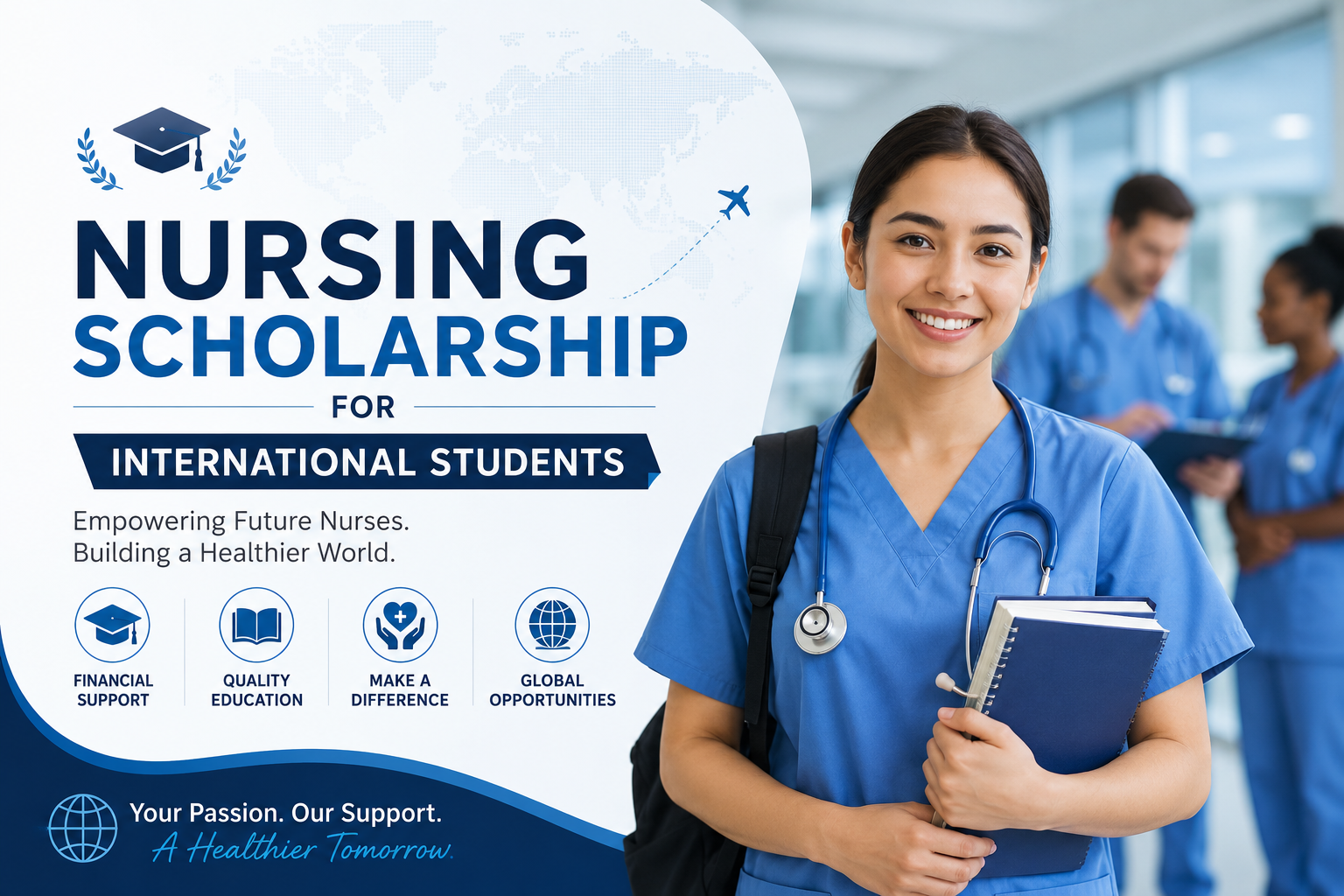
The challenge is not the absence of nursing scholarships for international students. The challenge is knowing where to find them, understanding exactly what each requires, and putting together an application that stands out from an increasingly competitive pool of candidates. Many qualified students miss out on scholarship opportunities not because they lack ability or academic strength but because they did not know the opportunity existed, applied too late, or submitted an application that failed to present their qualifications compellingly.
This guide covers the most significant nursing scholarships available to international students in 2025 — across the United States, United Kingdom, Canada, Australia, and through international organisations — with detailed information on eligibility requirements, award values, application processes, and practical tips for building the strongest possible application. Whether you are planning to study nursing abroad for the first time or are already enrolled and looking for funding to continue your studies, this guide will show you exactly where to look and how to apply.
Why International Students Should Consider Nursing Scholarships
Studying nursing abroad is a significant financial undertaking. International tuition fees at universities in the United States, United Kingdom, Canada, and Australia are substantially higher than domestic rates — often ranging from $15,000 to $45,000 per year — and living costs in major cities where many nursing programmes are located add significantly to the total investment. For most international students, self-funding this entire cost is not realistic, and student loans available to international students are limited and carry significant long-term financial burden.
Nursing scholarships for international students exist precisely to address this barrier. They are funded by governments, universities, private foundations, professional nursing organisations, and healthcare employers — each with their own motivations, which range from increasing workforce diversity to building bilateral healthcare relationships between countries to fulfilling corporate social responsibility commitments. Understanding the motivations behind different scholarship programmes helps you identify which ones you are genuinely competitive for and craft applications that speak directly to what each programme values.
Beyond the immediate financial relief, nursing scholarships carry professional and reputational benefits that extend well beyond graduation. Scholarship recipients gain access to professional networks, mentorship programmes, and career pathways that non-scholarship students do not. Many nursing scholarships include clinical placement opportunities, leadership development programmes, and connections to healthcare employers that significantly accelerate career development after graduation. The scholarship is not just money — it is an investment in your professional trajectory that pays dividends long after the funding ends.
Types of Nursing Scholarships Available to International Students
University-Based Scholarships
The most widely available nursing scholarships for international students are offered directly by universities — as merit awards, need-based grants, international student bursaries, or faculty-specific scholarships within nursing and health sciences departments. Every major university with a nursing programme has some form of international student scholarship, though the value, eligibility criteria, and application process vary significantly between institutions.
University-based scholarships have several advantages for international applicants. They are often automatically considered upon admission — meaning that applying for admission to the nursing programme simultaneously enters you into consideration for the scholarship without a separate lengthy application process. They are administered by the institution you are already in contact with, making the process more straightforward than applying to external foundations. And they are often renewable for the duration of your programme, providing multi-year funding rather than a one-time award.
The limitation of university scholarships is that they rarely cover the full cost of tuition and living expenses — they are more commonly partial awards that reduce your financial burden without eliminating it. Combining a university scholarship with other funding sources — government scholarships, professional organisation awards, and part-time work where permitted by your visa — is the realistic strategy for most international nursing students.
Government-Funded Scholarships
Several governments fund scholarships specifically designed to bring talented international students to their universities — including for nursing and health sciences programmes. These government scholarships are typically more competitive than university awards but are also more generous — often covering full tuition, living expenses, and travel costs. They are funded with specific policy objectives in mind: building educational and cultural ties between countries, attracting high-achieving students who may remain in the country after graduation, or fulfilling international development commitments.
Government scholarships for nursing students include programmes like the Chevening Scholarships in the UK, the Commonwealth Scholarships, the Fulbright Programme in the United States, and the Canadian Commonwealth Scholarship Programme. These are not exclusively for nursing — they are open to graduate students across disciplines — but nursing students are competitive applicants for most of them, particularly given the global recognition of nursing as a priority healthcare workforce need.
Professional Organisation Scholarships
Professional nursing organisations — both national and international — offer scholarships to support the development of nursing students and early-career nurses. These scholarships are funded by membership dues, donations, and endowments, and they are specifically designed to support students committed to advancing the nursing profession. They often carry lower competition levels than government scholarships because they are less widely publicised and have more specific eligibility criteria that reduce the overall applicant pool.
Hospital and Healthcare Employer Scholarships
Healthcare employers — hospitals, health systems, and nursing homes — in countries experiencing nursing shortages increasingly offer scholarships to international nursing students as a recruitment pipeline strategy. These scholarships come with an expectation — sometimes a formal obligation — of employment with the sponsoring employer for a defined period after graduation. For international students who are open to working in the scholarship-granting country after graduation, employer scholarships can provide both educational funding and a guaranteed post-graduation employment pathway simultaneously.
Top Nursing Scholarships for International Students in the United States
The Johnson & Johnson Nursing Scholarship
Johnson & Johnson, through its partnership with the American Association of Colleges of Nursing (AACN), funds nursing scholarships for students enrolled in accredited nursing programmes in the United States. The scholarship supports students at both undergraduate and graduate levels and is specifically aimed at addressing the nursing workforce shortage. International students enrolled at eligible US nursing schools can apply, though eligibility varies by programme year and funding cycle.
The scholarship awards vary but typically range from $5,000 to $10,000 per academic year. Beyond the financial award, Johnson & Johnson scholarship recipients gain access to a professional network within one of the world’s largest healthcare companies — an association that carries significant professional value. Check the AACN website for current application periods and eligibility requirements, as these change annually.
The Health Resources and Services Administration (HRSA) Scholarships
HRSA administers several federal scholarship and loan repayment programmes designed to address nursing shortages in the United States, including the Nursing Scholarship Program and the Nurse Corps Scholarship Program. These programmes primarily target students who commit to serving in Health Professional Shortage Areas (HPSAs) after graduation and are more accessible to students with permanent residency or specific visa categories than to international students on student visas. However, international students who have obtained certain immigration statuses may be eligible — and for those planning to remain in the United States after graduation, understanding these programmes is important.
University-Specific Nursing Scholarships in the US
Several major US universities with strong nursing programmes offer substantial scholarships specifically for international nursing students. Johns Hopkins University School of Nursing, the University of Pennsylvania School of Nursing, and New York University Rory Meyers College of Nursing all offer merit-based scholarships for which international students are eligible. The University of Michigan School of Nursing offers the International Student Fellowship, which provides partial tuition support for outstanding international graduate nursing students.
When applying to US nursing programmes, always check the financial aid and scholarships section of each school’s nursing department website specifically — not just the general university financial aid page, which often focuses on domestic student funding. Many nursing-specific scholarships are administered separately from general university financial aid and are not widely publicised beyond the nursing school’s own communications channels.
The American Association of Colleges of Nursing (AACN) Scholarships
The AACN maintains a comprehensive scholarship database covering awards available to nursing students at member institutions across the United States. Many of these scholarships are open to international students enrolled at AACN member schools. The database is searchable by student level (undergraduate, graduate, doctoral), specialty area, and eligibility criteria — making it one of the most useful single resources for identifying US nursing scholarships. Visit aacnnursing.org to access the scholarship database and set up alerts for new scholarship opportunities matching your profile.
Top Nursing Scholarships for International Students in the United Kingdom
The Chevening Scholarships
Chevening is the UK government’s flagship international scholarship programme, funded by the Foreign, Commonwealth and Development Office (FCDO) and partner organisations. It offers fully funded scholarships to outstanding students from eligible countries — including Nigeria — to pursue one-year Master’s degree programmes at UK universities. Nursing students pursuing postgraduate nursing qualifications are eligible to apply, and the scholarship covers full tuition fees, a monthly living allowance, return airfare, and additional grants for travel to Chevening events.
Chevening is highly competitive — the programme receives tens of thousands of applications annually and funds approximately 1,500 scholars each year from over 160 countries. Nigerian applicants have historically been among the larger cohorts of Chevening recipients, which reflects both the strength of Nigerian academic talent and the bilateral relationship between Nigeria and the UK. The key selection criteria are academic excellence, demonstrable leadership potential, and a clear plan to use the UK education to contribute to your home country. Applications open annually around August and close in November — visit chevening.org for current cycle details.
Commonwealth Scholarships
The Commonwealth Scholarship Commission in the UK (CSC) offers scholarships for students from Commonwealth countries — including Nigeria — to pursue postgraduate study at UK universities. The Commonwealth Distance Learning Scholarships and the Commonwealth Shared Scholarships are specifically targeted at students from lower and middle-income Commonwealth countries. Nursing and health sciences students are eligible, and the scholarships are specifically focused on supporting students whose studies will contribute to development in their home countries.
Commonwealth Scholarships cover tuition fees, living expenses, airfare, and additional allowances. They are administered through the nominating agency in each eligible country — in Nigeria, applications are typically channelled through the Federal Scholarship Board. Visit cscuk.fcdo.gov.uk for the current list of eligible institutions, subject areas, and application procedures.
UK University Nursing Bursaries and Scholarships
Several UK universities offer specific bursaries and scholarships for international nursing students. The University of Edinburgh, King’s College London, the University of Manchester, and the University of Southampton — all of which have highly regarded nursing programmes — offer international scholarships for which nursing students are competitive. These are typically merit-based partial awards ranging from £3,000 to £10,000 per year.
The Florence Nightingale Foundation, named after the founder of modern nursing, offers scholarships and travel grants to nursing and midwifery professionals who wish to pursue further education and leadership development in the UK. While these are primarily aimed at practising nurses rather than initial degree students, they are worth investigating for international nurses seeking postgraduate education in the UK.
NHS Funded Training for International Nurses
The National Health Service (NHS) in England has developed specific recruitment and training pathways for international nurses to address severe workforce shortages. While these are not traditional scholarships in the academic sense, they offer funded training, supported registration with the Nursing and Midwifery Council (NMC), and employment contracts that collectively provide a supported pathway for qualified international nurses to work and train in the UK. For Nigerian nurses who have already qualified at home and wish to pursue a UK career, investigating NHS international recruitment pathways alongside academic scholarships is worthwhile.
Top Nursing Scholarships for International Students in Canada
The Vanier Canada Graduate Scholarships
The Vanier Canada Graduate Scholarships programme awards $50,000 CAD per year for three years to doctoral students in health research — including nursing research — at Canadian universities. International students are eligible to apply through Canadian universities that have been allocated Vanier nominations. The selection criteria emphasise academic excellence, research potential, and leadership ability. For international nursing students pursuing doctoral research in Canada, the Vanier Scholarship is one of the most generous awards available.
Canadian Commonwealth Scholarship Programme
Canada participates in the Commonwealth Scholarship and Fellowship Plan, offering scholarships to students from Commonwealth countries including Nigeria. These scholarships support postgraduate study at Canadian universities across health sciences disciplines including nursing. Applications are typically submitted through the Commonwealth Scholarship agency in the applicant’s home country — in Nigeria, through the Federal Scholarship Board.
University of Toronto and University of British Columbia Nursing Scholarships
The University of Toronto Lawrence S. Bloomberg Faculty of Nursing and the University of British Columbia School of Nursing both offer international student awards for exceptional nursing students at the graduate level. These merit-based scholarships range from $5,000 to $20,000 CAD and are awarded based on academic achievement, research potential, and professional commitment to nursing. Check the specific nursing school scholarship pages at each institution for current award cycles and application requirements.
Province-Level Nursing Scholarships in Canada
Several Canadian provinces offer their own scholarship programmes for nursing students, reflecting the critical nursing shortage facing provincial healthcare systems. Ontario, British Columbia, Alberta, and Quebec have all introduced financial incentive programmes for nursing students — some of which are accessible to international students enrolled in provincial universities. These programmes change frequently in response to evolving workforce needs, so checking the current provincial health ministry website and individual university nursing department pages is essential for up-to-date information.
Top Nursing Scholarships for International Students in Australia
Australia Awards Scholarships
Australia Awards Scholarships are funded by the Australian government through the Department of Foreign Affairs and Trade (DFAT) and are one of the most prestigious and generous scholarship programmes available to students from developing countries including Nigeria. The scholarships cover full tuition fees, return airfare, establishment allowance, living expenses, and health insurance for the full duration of the award. Nursing and health sciences students are among the priority areas for Australia Awards in many eligible countries.
Australia Awards are highly competitive and are awarded based on academic merit, professional experience, leadership potential, and the likely impact of the study on the recipient’s home country upon return. Applications are made through the Australian Embassy or High Commission in the applicant’s home country — in Nigeria, through the Australian High Commission in Abuja. Visit australiaawardscholarships.dfat.gov.au for eligibility information, eligible countries, and application timelines.
Endeavour Postgraduate Scholarships
The Endeavour Scholarship and Fellowship programme supports high-achieving international students to undertake postgraduate study and research in Australia. Nursing students at the postgraduate level are eligible, and the scholarship covers tuition, living expenses, travel, and health insurance. The programme is managed by the Australian Government’s Department of Education and reflects Australia’s commitment to attracting top international talent in priority health workforce areas.
University of Sydney and Monash University Nursing Scholarships
The University of Sydney Susan Wakil School of Nursing and Midwifery and Monash University’s nursing faculty both offer international merit scholarships for outstanding nursing students at undergraduate and postgraduate levels. These institution-based awards are typically worth between AUD $5,000 and AUD $15,000 per year and are awarded competitively to the strongest international applicants. Contact the relevant nursing faculty directly and check their scholarship pages when applying for admission.
International and Regional Nursing Scholarships
The International Council of Nurses (ICN) Scholarships
The International Council of Nurses, through its foundation, offers grants and scholarships to nurses and nursing students from member countries for leadership development, postgraduate study, and professional advancement. These awards are specifically designed to support the development of nursing leadership globally and are available to students from developing countries including Nigeria. Visit icn.ch for current scholarship and grant opportunities.
WHO Fellowships and Training Grants
The World Health Organization offers fellowships and training grants to health professionals from member states — including nurses — for postgraduate training, specialised study, and research at institutions around the world. These are not traditional scholarships but funded training opportunities that serve a similar function for nurses seeking to build specialised skills. Fellowship opportunities in nursing are available in areas like public health nursing, community health, and health systems management. Applications are made through the WHO representative office in the applicant’s country.
The Aga Khan Foundation International Scholarship Programme
The Aga Khan Foundation offers partial scholarships to exceptional students from developing countries — including Nigeria — for postgraduate study at universities worldwide. The scholarships are structured as fifty percent grant and fifty percent loan, and are awarded across disciplines including health sciences and nursing. The programme specifically targets students who demonstrate strong academic ability and financial need and who have a commitment to returning to their home countries to contribute to development. Visit akdn.org for eligibility criteria and application information.
How to Find Nursing Scholarships You Have Not Heard Of
Use Scholarship Databases Systematically
Beyond the specific scholarships listed in this guide, thousands of smaller nursing scholarships exist that are not widely publicised. Systematic use of scholarship databases is the most reliable way to find these opportunities. Fastweb, Scholarships.com, and Chegg Scholarships maintain large searchable databases of scholarships available to international students. The AACN scholarship database covers US nursing-specific awards. The British Council’s study in UK portal covers UK funding opportunities. Each of these platforms allows you to create a profile and receive alerts when new scholarships matching your criteria are listed.
Contact University Financial Aid Offices Directly
University financial aid offices and nursing school scholarship coordinators know about funding opportunities that are not listed on public databases — alumni-funded awards, local foundation scholarships restricted to students at that specific institution, and emergency bursaries that supplement other funding. Contact the financial aid office and the nursing faculty directly at every university you are applying to and ask specifically: what funding is available for international nursing students, and is there anything that is not listed on the website? This proactive approach consistently surfaces opportunities that passive searching misses.
Join Nursing Professional Associations Early
Student membership of professional nursing associations — the Nigerian Nurses Association, the American Nurses Association, the Royal College of Nursing, and equivalents in your target country — provides access to members-only scholarship listings, professional networks that share funding information, and mentorship from established nurses who can point you toward opportunities. Many professional association scholarships have lower competition levels than publicly advertised awards because they are promoted primarily through member channels.
How to Write a Winning Nursing Scholarship Application
Start With Your Personal Statement
The personal statement is the most important component of almost every nursing scholarship application, and it is where most unsuccessful applications fall short — not because the candidate lacks qualification but because the statement fails to communicate their story, motivation, and potential compellingly. A strong nursing scholarship personal statement does three things: it explains why you want to study nursing specifically and why abroad specifically; it demonstrates what you have already done that shows your commitment to nursing and your potential to excel; and it articulates clearly what you intend to do with the qualification and how it will contribute to something beyond your personal career advancement.
Scholarship panels read hundreds of personal statements from qualified candidates. The ones that stand out are not the ones with the longest list of achievements — they are the ones that tell a coherent, specific, honest story about why this particular student, at this particular stage, pursuing this particular qualification, is the right investment for this particular scholarship. Generic statements that could have been written by any nursing student about any scholarship are passed over. Specific, personal, well-reasoned statements that could only have been written by you about this programme are remembered.
Address the Scholarship’s Specific Criteria
Every scholarship has specific selection criteria — academic excellence, financial need, leadership potential, commitment to a specific area of nursing, intention to return to your home country, or some combination. Read the selection criteria for each scholarship you apply to carefully and structure your application around them directly. If the scholarship values leadership, lead with your leadership experience. If it values community impact, foreground the community health work you have done or plan to do. If it values academic excellence, ensure your academic achievements are presented prominently and with context that helps the panel understand what they represent.
Failing to address the stated criteria — or addressing them only generically — is one of the most common reasons scholarship applications fail. Panels are looking for evidence that you meet their criteria, not a general overview of your qualifications. Give them that evidence, specifically and clearly.
Get Strong Reference Letters
Reference letters for nursing scholarship applications should come from people who can speak specifically to your academic ability, your professional character, and your potential in the nursing field — ideally with concrete examples rather than generic praise. A reference letter that says “this student is hardworking and dedicated” adds little to your application. A reference that says “I have supervised this student’s clinical placement for six months and observed specifically how she handles high-pressure patient situations with both technical competence and genuine compassion” adds substantial credibility.
Choose referees who know you well enough to be specific, who hold positions that lend authority to their endorsement, and who are willing to write a genuinely detailed letter rather than a perfunctory paragraph. Give your referees sufficient time — at least four to six weeks before the deadline — and provide them with your personal statement, your CV, and specific information about what the scholarship values, so their letter can reinforce rather than contradict or simply repeat the story you are telling in your other application materials.
Meet Every Deadline Without Exception
Scholarship applications have hard deadlines that are almost never extended. A single missed deadline eliminates an entire year’s opportunity — for scholarships that open annually, missing the deadline means waiting twelve months before the next cycle. Build a scholarship application calendar at the beginning of each academic year, listing every scholarship you plan to apply for and its deadline. Set reminders two weeks before each deadline to ensure all components are assembled and submitted with time to spare. Submit every application at least three to five days before the deadline to allow for technical problems with online submission systems — which are more common than they should be and entirely avoidable with adequate lead time.
Frequently Asked Questions
Can Nigerian students apply for nursing scholarships abroad?
Yes — Nigerian students are eligible for a wide range of nursing scholarships for international students in the United States, United Kingdom, Canada, and Australia. Several of the most prestigious scholarships — including Chevening, Commonwealth Scholarships, and Australia Awards — specifically list Nigeria as an eligible country and have historically awarded significant numbers of Nigerian scholars. Nigerian nursing students with strong academic records, relevant clinical or community experience, and a clear articulation of their goals are competitive applicants for many of these programmes.
Do nursing scholarships cover living expenses?
It depends on the scholarship. Government-funded scholarships like Chevening, Commonwealth Scholarships, and Australia Awards typically cover both tuition and living expenses — making them fully funded awards. University-based scholarships are more commonly tuition-only or partial tuition awards that do not cover living expenses. Professional organisation scholarships vary widely. When evaluating any nursing scholarship, check specifically whether it covers tuition only, living expenses only, or both — and budget accordingly for the gap between the award and your total costs.
What GPA do I need for a nursing scholarship?
Minimum GPA requirements vary by scholarship. Most competitive nursing scholarships for international students expect a minimum GPA equivalent to a UK 2:1 honours degree or a US GPA of 3.0 to 3.5 out of 4.0. The most prestigious fully-funded scholarships — Chevening, Vanier, Australia Awards — are highly competitive and typically attract candidates with GPAs well above the minimum. Beyond GPA, scholarship selection considers research experience, clinical experience, community involvement, leadership, and the quality of the personal statement and references.
Are there nursing scholarships for undergraduate international students?
Yes, though they are less common than postgraduate awards. University-based merit scholarships are the most accessible for undergraduate international nursing students. Some professional organisations offer undergraduate nursing awards. The Johnson and Johnson nursing scholarship programme has historically included undergraduate students. For undergraduate nursing students, university scholarships combined with part-time work (where permitted by visa conditions) and family support are typically the realistic funding combination, with more extensive scholarship opportunities becoming available at the postgraduate level.
How competitive are nursing scholarships for international students?
Competition levels vary significantly by scholarship. Government-funded fully scholarships like Chevening receive tens of thousands of applications for approximately 1,500 awards globally — making them highly competitive. University-based departmental scholarships receive far fewer applications and are more accessible. Professional organisation awards with specific eligibility criteria — nursing specialisation, country of origin, career stage — have the lowest competition because the eligible pool is smallest. A strategic approach focuses on applying to multiple scholarships across all three categories rather than concentrating effort on the most prestigious awards alone.
Final Thoughts
The nursing scholarship landscape for international students is broader, more generous, and more accessible than most students realise. The barrier is almost never eligibility — there are scholarships for students at every academic level, from every country, pursuing every nursing specialisation. The barrier is usually awareness and application quality — students who do not know the opportunities exist, or who know they exist but submit applications that fail to present their qualifications compellingly.
The strategies in this guide address both barriers directly. You now know where the opportunities are. You understand what scholarship panels are looking for and how to present your application in the terms that resonate with each programme’s specific criteria. You know the deadlines to watch, the databases to search, and the contacts to make.
What remains is the work — researching the specific scholarships most aligned with your profile, assembling strong application materials, requesting reference letters well in advance, and submitting every application on time. That work is entirely within your control. And for the students who do it thoroughly and consistently, a funded nursing education abroad is not a distant aspiration. It is a realistic, achievable goal.
Start your scholarship search today. The next application cycle is already open somewhere in the world — and your opportunity is waiting in it.