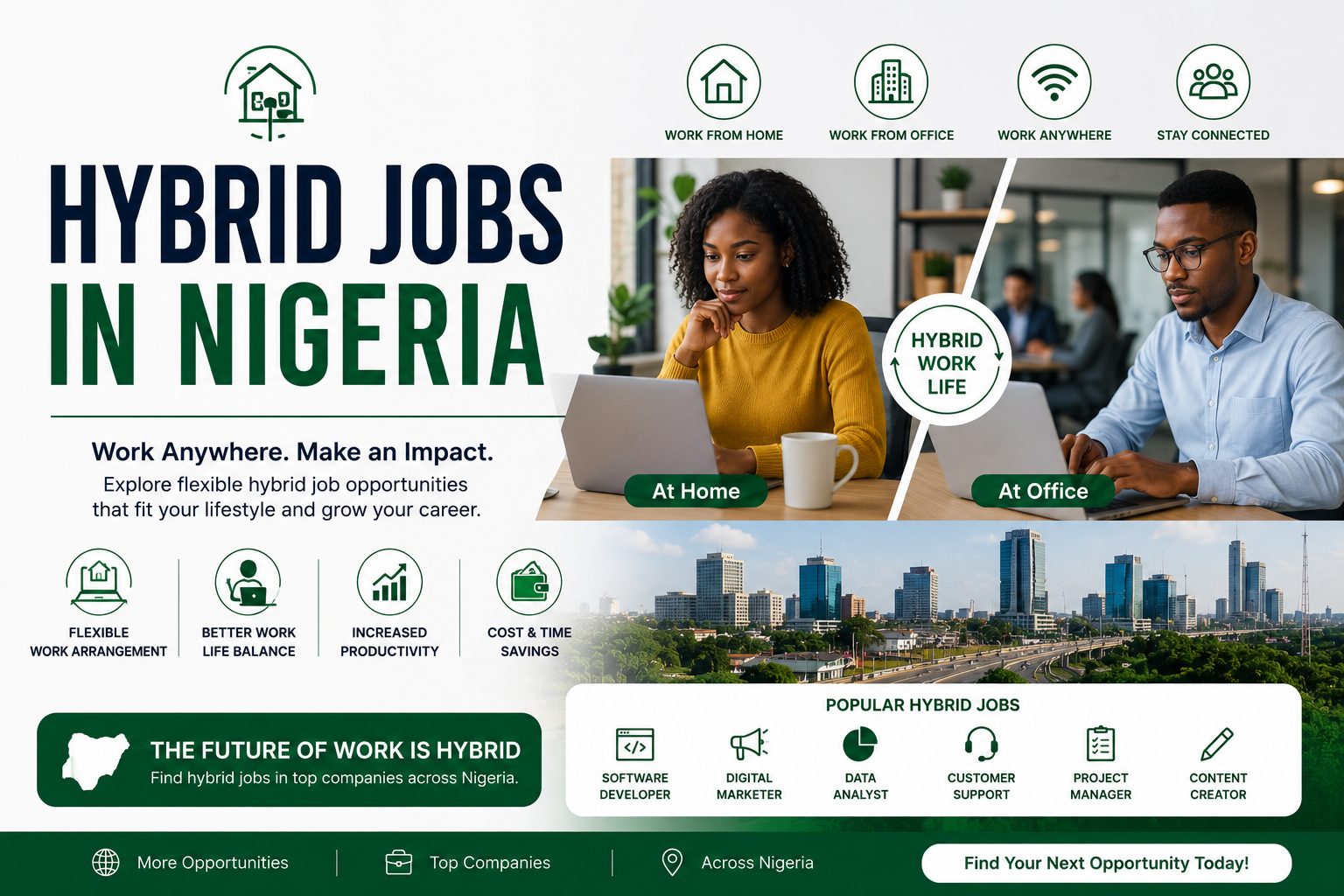
The way people work has changed dramatically over the last few years, and Nigeria is no exception to that shift. More companies are now offering flexible work arrangements that allow employees to split their time between working from home and showing up physically at the office. These arrangements are what most people now refer to as hybrid jobs in Nigeria, and they have become increasingly common across several industries.
If you have been seeing the term “hybrid” pop up in job listings and you are not entirely sure what it means, or if you already understand it but want to know how to actually find and land one, this guide covers everything you need to know — from what hybrid jobs actually involve, to the industries offering them, the benefits and challenges, and practical steps for finding one in Nigeria.
What Is a Hybrid Job?
A hybrid job is a work arrangement where an employee splits their working time between two locations — typically, the office and a remote location such as their home. Unlike fully remote jobs where you never need to come into the office, and unlike fully on-site jobs where you are expected in the office every day, hybrid jobs combine both.
The exact split varies depending on the employer. Some companies require employees to come into the office three days a week and work remotely for the remaining two. Others may ask for two office days and three remote days. Some companies give employees the freedom to choose which days they come in, as long as they meet attendance requirements. The specific arrangement depends entirely on the company’s policy and the nature of the role.
The important thing to understand is that “hybrid” is not a single fixed arrangement — it is an umbrella term for any work model that blends in-office and remote work in some form.
How Hybrid Work Came to Nigeria
While hybrid work arrangements existed before 2020, they became far more mainstream globally after the COVID-19 pandemic forced millions of workers to work from home. Nigerian companies, particularly those in tech, finance, and professional services, adapted quickly and discovered that many roles could be performed effectively outside of a traditional office setting.
As the pandemic subsided, many of these companies chose not to return to a fully in-office model. Instead, they settled on hybrid arrangements as a middle ground — maintaining some level of in-person collaboration while retaining the flexibility that employees had come to appreciate during the remote work period.
Today, hybrid work is increasingly being offered as a benefit to attract and retain talent, particularly among younger professionals who prioritize flexibility in their careers.
Industries Offering Hybrid Jobs in Nigeria
Hybrid work arrangements are not available in every sector, as some roles by their nature require physical presence. However, several industries in Nigeria have adopted hybrid models fairly widely.
Technology and Startups
The Nigerian tech ecosystem, centered around hubs like Lagos and Abuja, has been one of the earliest adopters of hybrid work. Tech companies, from large multinationals to local startups, frequently offer hybrid arrangements for roles such as software development, product management, data analysis, UX design, and digital marketing. Many of these roles involve work that can be done effectively on a laptop from anywhere, making hybrid arrangements a natural fit.
Banking and Financial Services
Several Nigerian banks and fintech companies have introduced hybrid work policies, particularly for roles that do not require daily customer interaction. Back-office roles such as financial analysis, compliance, risk management, IT support, and human resources are areas where hybrid arrangements have become more common within the financial sector.
Telecommunications
Telecom companies in Nigeria have also embraced hybrid work, particularly for corporate functions and roles that do not require employees to be physically present at technical sites or customer-facing locations every day. Departments such as marketing, finance, legal, and strategy often operate on hybrid schedules within these organizations.
Consulting and Professional Services
Management consulting firms, accounting firms, and legal firms operating in Nigeria have moved toward hybrid models, with consultants and professionals often working remotely when not required at client sites or for specific in-person meetings. This has made the sector attractive for professionals who value flexibility without fully giving up the collaborative aspects of office work.
Media and Content Creation
Digital media companies, advertising agencies, and content production firms often offer hybrid arrangements, particularly for roles like content writing, graphic design, video editing, and social media management. These roles lend themselves naturally to remote work, while occasional in-office time allows for team collaboration and creative sessions.
Multinational Companies
Large multinational companies with Nigerian offices, particularly those in consumer goods, pharmaceuticals, and professional services, have generally been among the more progressive adopters of hybrid work policies, often following global company standards that allow for flexible work arrangements.
Benefits of Hybrid Jobs in Nigeria
For employees, hybrid jobs offer several advantages that have made them increasingly desirable, particularly among professionals in urban areas like Lagos and Abuja where commuting can be a significant daily challenge.
Reduced Commute Stress and Cost
Anyone who has experienced Lagos traffic during rush hour understands how much time and money daily commuting consumes. A hybrid arrangement that allows even two or three days of remote work per week can significantly reduce the daily stress, time lost, and transportation costs associated with commuting in Nigerian cities.
Better Work-Life Balance
Having the flexibility to work from home on certain days allows employees to better manage personal responsibilities alongside work demands. Whether it is being available for a family need, avoiding the exhaustion of a long commute, or simply working in a quieter environment, hybrid work can make it easier to maintain a healthier balance between professional and personal life.
Increased Productivity for Many Workers
Many employees find that they are more productive when working from home, free from office distractions and the interruptions of a busy open-plan workspace. At the same time, in-office days provide opportunities for collaboration, brainstorming, and building relationships with colleagues — something that is harder to replicate fully in a remote setting.
Access to a Wider Range of Opportunities
Hybrid jobs sometimes allow professionals to take on roles with companies in cities they do not live in, as long as they can come in for the required in-office days. This can open up opportunities that would previously have required relocation.
Challenges of Hybrid Jobs in Nigeria
While the benefits are real, hybrid work in Nigeria also comes with its own set of challenges that are worth being aware of before actively seeking this type of arrangement.
Inconsistent Internet Connectivity
Reliable, fast internet is not uniformly available across all parts of Nigeria. For professionals in areas where connectivity is inconsistent or expensive, working from home effectively can be challenging. This is something to factor in when considering a hybrid role, as poor internet connection can affect your productivity and how you are perceived during video calls and virtual meetings.
Unclear Boundaries Between Work and Home Life
One of the most common challenges of any remote or hybrid work arrangement is the difficulty of mentally switching off from work when your home is also your office. Without clear boundaries, it can be easy to end up working longer hours than you would in a traditional office setting.
Not All Companies Are Truly Hybrid
Some companies use the word “hybrid” in job listings but in practice expect employees to come in almost every day, or have policies that make it difficult to actually work remotely. It is important to ask specific questions about what the hybrid arrangement actually looks like in practice before accepting a job offer.
Career Visibility Concerns
In some organizations, employees who are in the office more frequently may have greater visibility with managers and decision-makers, which can sometimes influence promotion decisions. Navigating this dynamic is something hybrid workers need to be mindful of, particularly in more traditional organizational cultures.
How to Find Hybrid Jobs in Nigeria
Now that you understand what hybrid jobs are and what they involve, here is how to actively search for them in Nigeria.
Use Job Listing Platforms and Filter by Work Type
Several job listing platforms allow candidates to filter by work arrangement, making it possible to search specifically for hybrid roles. When using these platforms, look for filters or keywords like “hybrid,” “flexible work,” or “partially remote” to narrow your search.
Check Company Career Pages Directly
Many companies that offer hybrid arrangements mention this on their official career pages or within individual job descriptions. Researching companies known for flexible work policies and going directly to their career pages can surface opportunities that may not be listed on third-party job boards.
Use LinkedIn Effectively
LinkedIn allows job seekers to filter job searches by work arrangement, including hybrid. Beyond job listings, LinkedIn is also useful for following companies of interest, connecting with professionals in your target field, and getting a sense of which organizations have adopted hybrid work models based on what employees share about their work experience.
Network Within Your Industry
Many hybrid job openings, especially in smaller companies and startups, are filled through referrals before they are ever publicly advertised. Building relationships within your industry, whether through professional events, online communities, or direct outreach, can put you in a position to hear about opportunities early.
Ask During the Interview Process
If you are applying for a role and the work arrangement is not clearly stated in the job description, it is perfectly reasonable to ask about it during the interview process. Ask specifically how many days per week employees are expected in the office and whether this is flexible, so you have a clear picture before accepting any offer.
How to Stand Out When Applying for Hybrid Roles
Beyond finding hybrid jobs, landing one requires showing employers that you can be trusted to work effectively both in and out of the office.
- Highlight Remote Work Skills: Skills like self-discipline, time management, and proficiency with remote collaboration tools such as Slack, Zoom, Google Meet, and project management platforms like Trello or Asana are increasingly valued by employers offering hybrid arrangements.
- Demonstrate Results-Oriented Work Habits: Employers offering hybrid roles want to know that you can deliver results without needing constant supervision. In your CV and during interviews, focus on outcomes you have achieved rather than just listing tasks.
- Show Familiarity With Digital Tools: Being comfortable with the kinds of tools used in remote collaboration — video conferencing, cloud-based document sharing, instant messaging platforms — signals that you can handle the technical side of hybrid work smoothly.
- Be Specific About Your Setup: Some employers may want to know that you have a reliable internet connection and a suitable workspace at home. Being upfront about your setup can reassure employers that you are prepared for the remote component of a hybrid role.
Frequently Asked Questions About Hybrid Jobs in Nigeria
Are hybrid jobs available outside Lagos and Abuja?
While the majority of hybrid job opportunities in Nigeria are currently concentrated in Lagos and Abuja, where most large companies and tech firms are based, some roles are genuinely location-flexible, particularly within fully digital industries. As hybrid work continues to grow, availability in other cities is likely to expand.
Do hybrid jobs pay less than fully on-site roles?
Not necessarily. Compensation for hybrid roles is generally determined by the same factors as any other role — the industry, the company, your experience, and the specific responsibilities of the position. The hybrid arrangement itself does not typically mean a lower salary.
Can fresh graduates get hybrid jobs in Nigeria?
Yes, though it may be more common for graduates with some experience or specific in-demand skills. Some tech companies and startups do offer hybrid arrangements to fresh graduates, particularly in roles like software development, content creation, and digital marketing where skills matter more than years of experience.
How do I know if a company’s hybrid policy is genuine?
Ask specific questions during your interview, such as how many days per week employees currently come into the office, whether the policy has been consistent, and whether individual managers have discretion over attendance expectations. Speaking to current or former employees through platforms like LinkedIn can also give you an honest picture of how the policy works in practice.
Final Thoughts
Hybrid jobs in Nigeria represent a meaningful shift in how the country’s workforce operates, and for many professionals, they offer a genuinely better way of working — one that combines the structure and collaboration of office life with the flexibility and convenience of working from home.
Whether you are a fresh graduate exploring your options or an experienced professional looking for more flexibility in your next role, understanding how hybrid work operates, which industries offer it, and how to position yourself as a strong candidate can go a long way in helping you land the kind of role that works for your life and your career goals.
If this guide helped you understand hybrid jobs better, feel free to share it with someone else navigating the Nigerian job market. And if you have any questions about hybrid work or the job search process, drop them in the comments below.