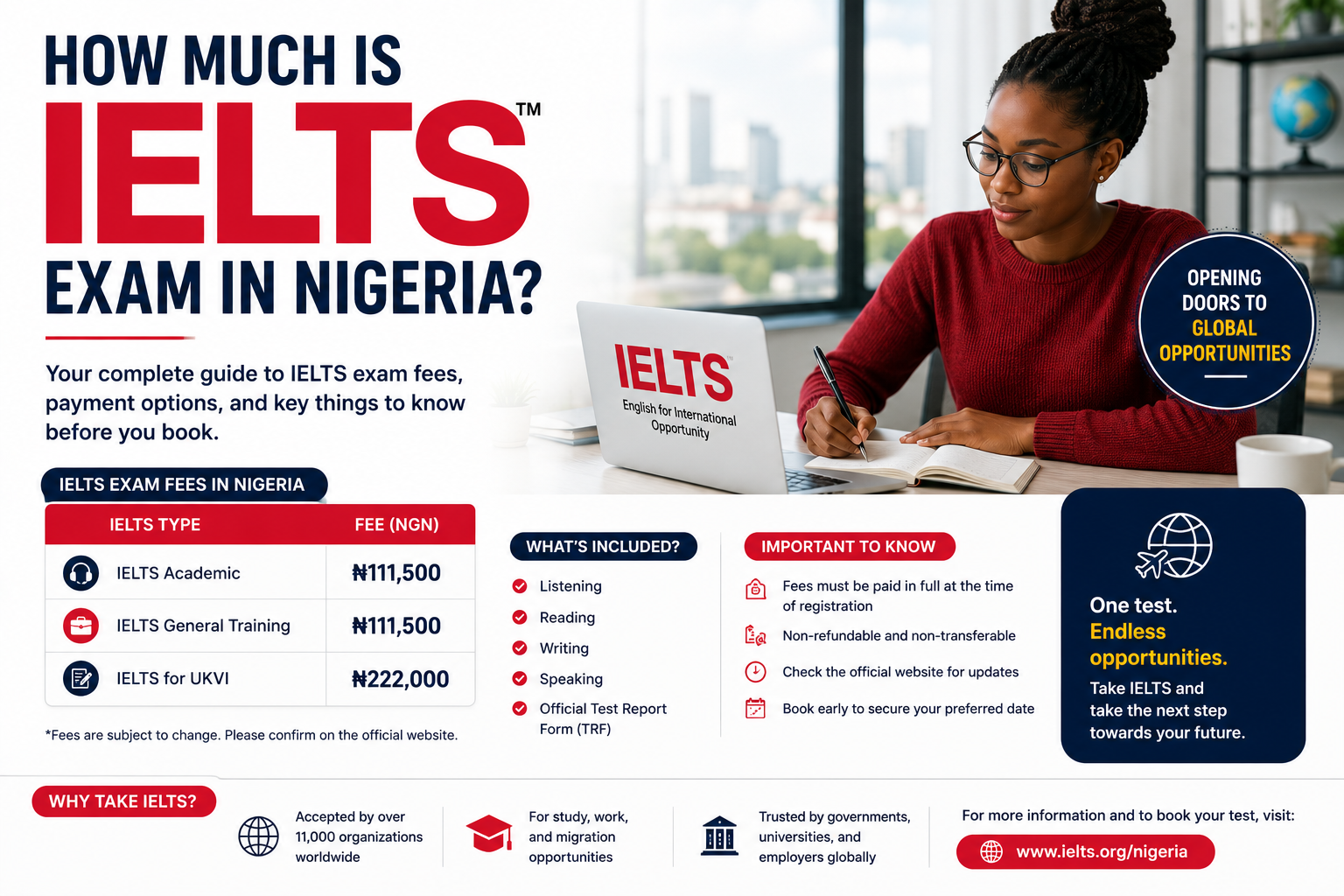
If you are planning to study abroad, migrate, or apply for a job that requires proof of English proficiency, there is a good chance IELTS is already on your radar. But before you book a test date, one of the first questions on your mind is probably the most practical one — how much is IELTS exam in Nigeria right now?
IELTS fees are not fixed forever. They get reviewed periodically, are tied to currency exchange rates, and can differ slightly depending on the type of test you are taking and which authorized provider you register through. This guide breaks down the current cost of IELTS in Nigeria, the different test types and what they are used for, the band score you actually need, the registration process, and a few money-saving tips to help you avoid losing your fee to a simple mistake.
What Is IELTS?
IELTS, which stands for International English Language Testing System, is an English language proficiency test recognized by universities, employers, immigration authorities, and professional bodies around the world. It is the world’s most popular English language test for work, study, and migration purposes.
In Nigeria, IELTS is jointly administered by two official bodies — the British Council and IDP Education. Both are authorized to register candidates and conduct the test, and the test format, content, and pricing structure are largely standardized across both providers, though specific promotions and discounts may differ.
How Much Is IELTS Exam in Nigeria?
This is the question most people are searching for, so let’s get straight to it. The current IELTS exam fee in Nigeria is 299,000 naira for both IELTS Academic and IELTS General Training, while IELTS for UKVI costs 315,500 naira. These fees are set by the British Council and IDP and are paid directly to them at the point of registration.
Other sources reviewing pricing around the same period reflect similar figures, with some slight variation depending on when the data was checked. One detailed breakdown found that the standard IELTS examination, available in both Academic and General Training formats, was priced between 279,500 naira and 299,000 naira for test dates in early 2026. Earlier in the year, there were also reports of IELTS fees being increased to around 266,000 naira at one point in March 2026, which illustrates just how frequently this pricing can shift.
It is worth noting that IELTS fees in Nigeria are linked to the GBP exchange rate and may be updated periodically, so candidates are always advised to confirm the current fee directly on the official British Council Nigeria or IDP Nigeria website before registering, rather than relying solely on previously published figures, including the ones in this article.
IELTS Life Skills Pricing
For candidates who specifically need to demonstrate English speaking and listening abilities, rather than sitting the full four-skill exam, a separate and shorter test option exists. IELTS Life Skills, available at A1 and B1 levels, is priced between 285,200 naira and 298,500 naira. This test format assesses only speaking and listening skills, making it shorter and more focused than the full IELTS examination, and it is commonly used for family, spouse, and partner visa applications to the United Kingdom, where applicants need to prove basic English communication abilities without the reading and writing components.
Understanding the Different Types of IELTS Tests
Part of understanding the cost of IELTS is understanding that “IELTS” is not just one single test. There are several versions, and choosing the right one for your specific purpose matters just as much as knowing the price.
IELTS Academic
IELTS Academic is designed for undergraduate, postgraduate, and doctoral programme applicants. If you are applying to a university abroad, this is generally the version you will be required to take, as it assesses the kind of English used in academic environments — lecture comprehension, academic reading passages, and formal essay writing.
IELTS General Training
IELTS General Training is for work, migration, and secondary education purposes. Both Academic and General Training cost the same amount and test the same four skills — listening, reading, writing, and speaking — but the Reading and Writing sections differ slightly between the two versions. If you are applying for a work visa or general migration rather than university admission, this is typically the version required.
IELTS for UKVI
IELTS for UKVI (UK Visas and Immigration) is a version of the test specifically approved for UK visa and immigration purposes. It costs more than the standard test, at 315,500 naira, and is required specifically when an applicant’s visa category calls for a UKVI-approved English test rather than the standard IELTS Academic or General Training versions.
Many UK universities do accept the standard IELTS Academic test, but applicants on certain visa categories, such as a Student visa, may specifically require the UKVI version, so it is important to confirm exactly which version your institution or visa category requires before booking, to avoid paying for and sitting the wrong test entirely.
IELTS Life Skills
As mentioned earlier, this version focuses only on speaking and listening and is typically used for UK family and partner visa applications rather than for study or general migration purposes.
What’s Included When You Pay for IELTS
When you pay the IELTS exam fee in Nigeria, your payment covers more than just sitting the test itself. Each test taker is issued one IELTS Test Report Form (TRF) free of charge, and up to five copies of the TRF will be sent electronically to the institutions listed on the application form, also free of charge. If you need physical copies sent by post or courier, including overseas postage, there may be additional charges, so it is best to contact your test centre directly for specifics on this.
What IELTS Band Score Do You Actually Need?
Since the test is not cheap, it makes sense to understand exactly what score you are aiming for before you spend money preparing and registering. An IELTS result is a number between 1 and 9, but that number means very different things depending on where you are applying, which pathway you are pursuing, and which institution or immigration authority is evaluating your application.
Undergraduate Requirements
Most universities across countries like the UK, Ireland, other parts of Europe, Canada, and New Zealand require an overall band of 6.0 to 6.5 for undergraduate programmes, with no individual skill score below 5.5 to 6.0, depending on the specific institution. More broadly, most universities typically require an overall IELTS score between 6.0 and 7.5, depending on the course, institution, and level of competition, with highly selective programmes such as medicine, law, nursing, and engineering often asking for stronger scores because those fields demand advanced communication and technical understanding.
Postgraduate Requirements
For postgraduate programmes, most universities prefer an overall IELTS band of 6.5 to 7.0, with at least 6.0 required in each individual skill area, covering listening, reading, writing, and speaking.
Foundation and Pathway Programmes
If your overall band score is currently below what your target university requires, you are not necessarily out of options. Foundation or pathway programmes typically accept lower overall scores, ranging from 4.5 to 5.5, depending on the country and institution. These programmes are designed to help students build up their academic and language skills before progressing into a full degree programme.
Why Sectional Scores Matter Just as Much as the Overall Band
One of the most common and costly misunderstandings among IELTS candidates is focusing only on the overall band score while ignoring individual section requirements. Many institutions and immigration authorities set minimum requirements for individual sections, not just the overall band score. A candidate who achieves a 7.0 overall band with only a 5.5 in Writing can be disqualified from a programme requiring a minimum of 6.5 in each component, even though their overall band technically meets the stated threshold.
For the current admissions cycle, many top-tier institutions are becoming stricter about these sectional minimums, meaning an impressive overall score may still not be enough if even one component falls just below the stated requirement. This is exactly why understanding your target institution’s full requirement, not just the headline overall band number, is so important before you book your test.
How the Overall Band Score Is Calculated
Your overall IELTS band score is determined by calculating the mean of your four individual section scores — Listening, Reading, Writing, and Speaking — with all four components carrying equal weight in the calculation. Scores are then rounded according to standard IELTS rounding rules, which is why two candidates with very similar raw performance can sometimes end up with different overall bands depending on exactly where their average falls.
IELTS Requirements for Scholarships
If you are applying for a scholarship alongside your university application, it helps to know that scholarship bodies often set their own separate requirements. Most competitive scholarships require a minimum overall band score of 6.5 or 7.0, with some prestigious awards demanding scores of 7.5 or higher. Many scholarship programmes also set minimum requirements for each individual section, typically ranging from 6.0 to 7.5, to ensure balanced proficiency across all language skills.
While meeting the minimum requirement qualifies you for consideration, exceeding it significantly improves your competitiveness, since selection committees often use IELTS scores as part of their initial screening criteria, and a stronger score can give an edge between otherwise similar candidates.
How to Register for IELTS in Nigeria
Now that pricing and score requirements are clear, here is a step-by-step look at how the registration process typically works.
Step 1: Decide Which Test Version You Need
Before registering, confirm with your university, employer, or immigration authority exactly which version of IELTS they require — Academic, General Training, UKVI, or Life Skills — and what their minimum overall and sectional score requirements are. This decision affects both your fee and your test format, so it should be settled before you do anything else.
Step 2: Choose an Official Registration Platform
You can register through either the British Council Nigeria website or the IDP Nigeria website, as both are official, authorized providers of the test in the country. Some private test preparation companies also act as official partners and can assist with registration, though the test itself is always ultimately delivered through British Council or IDP infrastructure.
Step 3: Prepare Your Identification Documents
The registration process has strict identification requirements. Only two forms of identification are accepted — a valid International Passport or a National e-ID card. Other identification documents, including driver’s licenses, voter cards, or birth certificates, are not accepted for IELTS registration in Nigeria. Make sure your chosen ID is valid and not close to expiry before you book your test date.
Step 4: Select Your Test Date and Centre
IELTS in Nigeria is now fully computer-based in most locations, with sittings available most days of the week and results typically released in three to five days. Test centres are available in major cities, and it is advisable to book a date that gives you enough preparation time, as popular dates can fill up quickly, particularly close to university application deadlines.
Step 5: Make Payment
Payment is made directly to the British Council or IDP at the point of registration, based on the test type you have selected. Be sure to use the official payment channels provided on their websites to avoid falling victim to unofficial agents claiming to offer registration at a discount.
IELTS Result Timelines
How quickly you get your result depends on whether you sat the test on paper or on computer. For IELTS taken on paper, results and the Test Report Form are released 13 days after completing the test. For IELTS taken on computer, results are typically available three to five days after the test. This same three to five day timeline also applies to the computer-delivered UKVI version, while the paper-based UKVI test follows the same 13-day timeline as the standard paper test.
Given how widely computer-based testing has been adopted, most candidates in Nigeria today can expect to receive their results well within a week of completing the exam.
IELTS Cancellation and Rescheduling Fees
Life happens, and sometimes candidates need to cancel or move their test date. It helps to know the rules before that situation arises so you are not caught off guard.
If you cancel your IELTS application more than five weeks before the test date, you will receive a refund minus a 25 percent administrative fee. If you cancel less than five weeks before the test date, you will not receive any refund at all. Failing to appear for the test without cancelling is also treated as a cancellation, meaning no refund will be issued in that case either.
If you want to change your test date instead of cancelling outright, you can request a test day transfer, but this must also be done at least five weeks before your originally booked test date, after deducting the applicable cancellation or postponement fee. The new test date you choose must also fall within three months of your original test date, and candidates are required to pay an administrative charge, inclusive of all applicable taxes, for the transfer.
This makes it clear that booking your test date thoughtfully, with enough preparation time built in, is far more cost-effective than booking too early and needing to make changes later.
Tips to Avoid Wasting Your IELTS Exam Fee
Given how significant the IELTS exam fee in Nigeria currently is, it makes sense to take every reasonable step to avoid having to pay it more than once. Here are some practical tips.
- Confirm the Correct Test Type Before Booking: Double-check with your university or visa category whether you need Academic, General Training, or UKVI before you register, since booking the wrong version means you may need to register and pay again.
- Know Both Your Overall and Sectional Targets: Find out your target institution’s exact requirement for each individual skill, not just the overall band, so you know precisely what to aim for in preparation rather than discovering a sectional shortfall only after your results arrive.
- Only Register Through Official Channels: Always register directly through the British Council Nigeria or IDP Nigeria website, or through a verified official partner. Avoid sending payment to unofficial agents promising discounted rates, as this can put both your money and personal information at risk.
- Bring the Correct Identification: Since only an international passport or National e-ID card is accepted, make sure your chosen document is valid and matches the details on your registration exactly. Turning up with an unaccepted form of ID can mean missing your test slot entirely.
- Prepare Adequately Before Booking a Date: Because rescheduling and cancellation come with significant fees if done too close to your test date, it is far more cost-effective to spend adequate time preparing before you book, rather than booking early and needing to push your date back later.
- Watch Out for Currency-Linked Price Changes: Since IELTS pricing in Nigeria is tied to the GBP exchange rate, fees can change with little notice. If you know your test date is approaching, it can help to register sooner rather than later once you are fully prepared, to lock in the current rate.
How to Prepare for IELTS Without Overspending
Beyond the exam fee itself, many candidates also spend money on preparation classes and materials. While professional preparation courses can be genuinely useful, especially for candidates who need a high band score for a specific institution or visa category, there are also free and low-cost ways to prepare effectively.
- Use Official Practice Materials: The British Council and IDP both provide free sample tests and practice materials on their official websites, which closely reflect the actual test format and question types.
- Practice All Four Skills Separately: Set aside dedicated time to practice listening, reading, writing, and speaking individually, rather than only focusing on the skills you feel most confident in, since a weak sectional score can disqualify you even with a strong overall band.
- Time Yourself During Practice: Since IELTS is a timed test, practicing under realistic time constraints helps you build the pacing skills needed to complete each section within the allotted time on test day.
- Get Feedback on Your Writing and Speaking: These two sections are scored more subjectively than reading and listening, so getting feedback from a teacher, tutor, or knowledgeable friend can help you identify and correct weaknesses before the actual exam.
Final Thoughts
If you came here simply wondering how much is IELTS exam in Nigeria, the short answer is that the standard test currently costs around 299,000 naira, with the UKVI version priced higher at 315,500 naira, and these figures can shift over time due to currency fluctuations and periodic reviews by the British Council and IDP. Beyond the headline price, understanding the different test types, the band score your specific institution or scholarship requires, registration requirements, and cancellation policies can save you from costly mistakes along the way.
Before you book your test date, take the time to confirm exactly which version of IELTS you need, understand both your overall and sectional score targets, register only through official channels, and prepare adequately so that your first attempt counts. Given how significant the investment is, getting these details right from the start makes the entire process far less stressful.
If you found this guide helpful, share it with someone else preparing for IELTS. And if you have questions about fees, registration, or test preparation, feel free to drop them in the comments below.