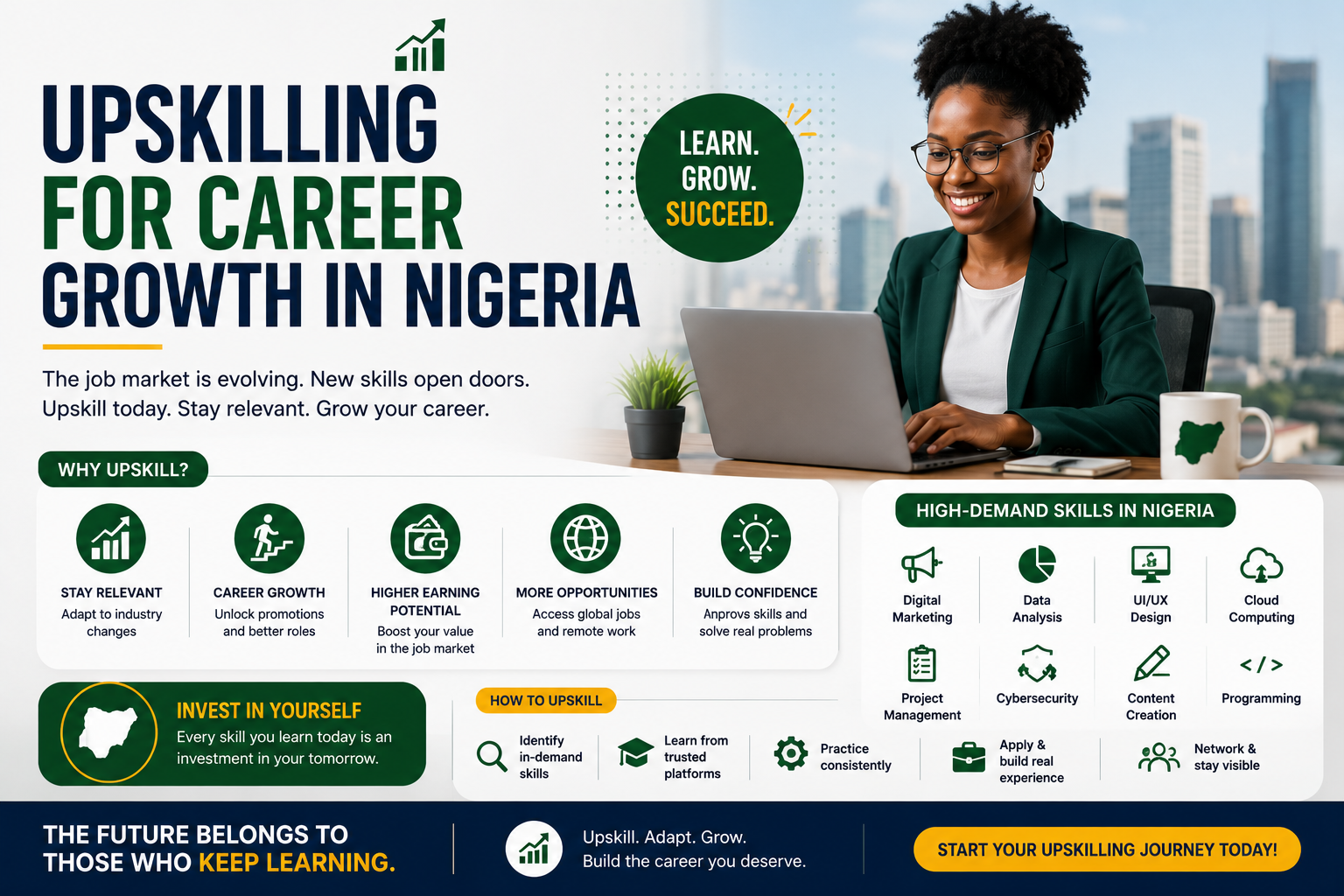
The Nigerian job market is changing fast. Industries that were stable a decade ago are being disrupted by technology, automation, and shifting economic conditions. New roles are emerging that did not exist five years ago, and employers across virtually every sector are raising the bar on what they expect from candidates and employees alike. In the middle of all this change, one thing has become increasingly clear — professionals who invest in upskilling for career growth in Nigeria are consistently better positioned to advance, adapt, and thrive than those who do not.
But what does upskilling actually mean in practical terms? Which skills are most worth developing? And where can you actually go to learn them, especially if you are working with a limited budget or a busy schedule? This guide answers all of those questions in a straightforward, actionable way.
What Is Upskilling?
Upskilling refers to the process of learning new skills or deepening existing ones in order to improve your performance in your current role or prepare yourself for more advanced opportunities. Unlike changing careers entirely, upskilling is about becoming more capable, more valuable, and more competitive within your existing professional direction.
Think of it this way — if you are a marketing professional who learns data analytics to better measure the performance of campaigns, that is upskilling. If you are an accountant who takes a course in financial modeling to qualify for more senior finance roles, that is upskilling. If you are a fresh graduate who learns a programming language to make yourself more attractive to tech-adjacent employers, that is also upskilling.
The common thread is deliberate, intentional learning aimed at improving your professional value. In today’s fast-moving job market, upskilling is no longer something only ambitious people do — it is something every professional needs to take seriously to stay relevant.
Why Upskilling Matters for Nigerian Professionals
Nigeria has one of the largest and youngest workforces in Africa, which means competition for good jobs is significant. At the same time, the country’s tech ecosystem is growing rapidly, remote work opportunities are expanding, and many industries are digitizing their operations in ways that are changing what skills employers actually need.
In this environment, professionals who rely solely on their university degree and early work experience to carry them through their career will increasingly find themselves at a disadvantage. Here is why upskilling matters specifically for professionals navigating the Nigerian career landscape:
- The Skills Gap Is Real: Many Nigerian employers report difficulty finding candidates with the right combination of technical and soft skills for the roles they are trying to fill. Professionals who proactively close this gap through upskilling become far more attractive to these employers.
- Technology Is Changing Every Industry: From banking and healthcare to agriculture and logistics, technology is reshaping how work gets done across the board. Understanding how to use digital tools relevant to your industry is no longer optional — it is increasingly a baseline expectation.
- Remote Work Has Opened Global Opportunities: Nigerian professionals now have access to remote job opportunities with international companies. But competing for these roles requires skills and certifications that meet global standards, which often means going beyond what was covered in a local university curriculum.
- Salary Growth Is Tied to Skill Development: In most organizations, professionals who bring demonstrably more skills and knowledge to the table have stronger grounds for salary negotiations and promotions than those who have simply accumulated years of experience without growing.
How to Identify Which Skills to Develop
Before jumping into any course or learning platform, the most important step is figuring out which skills are actually worth your time and money to develop. Here is a practical framework for making that decision.
Look at Job Descriptions in Your Target Role
One of the most direct ways to identify skills worth developing is to look at job descriptions for roles you aspire to in the next two to three years. Pay attention to the skills and qualifications listed repeatedly across multiple postings — these are the ones employers in your field are currently prioritizing. Any gap between what those postings require and what you currently have is a clear upskilling opportunity.
Pay Attention to Industry Trends
Follow news, publications, and conversations within your industry to understand which technologies, methodologies, and competencies are gaining traction. Skills that are emerging now are often the ones that will be in high demand in the next few years, so getting ahead of the curve gives you a significant advantage.
Ask for Feedback from Mentors and Managers
People who have observed your work closely often have valuable insights into areas where developing further could have the greatest impact on your career. Asking a trusted manager or mentor directly — “What skills do you think would most help me advance from where I am?” — can give you targeted, personalized guidance that no job board or course platform can replicate.
Assess Your Own Strengths and Gaps Honestly
Beyond what the market wants, it helps to have an honest picture of where your own strengths and weaknesses currently lie. Identifying the areas where you feel least confident or least capable in your current role often reveals the most impactful upskilling opportunities.
Most In-Demand Skills for Nigerian Professionals in 2026
While the right skills to develop depend on your specific field and goals, certain skill areas are consistently in high demand across multiple industries in Nigeria right now.
Digital and Technology Skills
Digital literacy has become a baseline expectation across most professional roles, but going beyond the basics — into areas like data analysis, digital marketing, software development, cloud computing, and cybersecurity — significantly expands career opportunities. These skills are sought after by employers in banking, telecoms, consulting, healthcare, and many other sectors.
Data Analysis and Data Science
The ability to collect, analyze, and draw meaningful insights from data is one of the most valued skills in today’s job market, cutting across industries from finance and marketing to healthcare and agriculture. Even a foundational understanding of data tools like Excel, SQL, or Python can open new doors for professionals in many fields.
Project Management
Project management skills — knowing how to plan, execute, and deliver work on time and within budget — are valued across virtually every industry. Professional certifications in project management, such as PMP or PRINCE2, are recognized globally and can significantly strengthen a candidate’s profile for senior roles.
Communication and Presentation Skills
Strong written and verbal communication remains one of the most consistently cited skills gaps in the Nigerian workforce. The ability to communicate ideas clearly, write professional reports, and deliver compelling presentations is valued at every level of seniority and in every industry.
Financial Literacy and Analysis
Understanding financial statements, budgeting, and financial modeling is valuable not just for accountants and finance professionals, but for anyone in a management or decision-making role. Developing stronger financial literacy can be a meaningful differentiator for professionals in non-finance fields who want to advance into leadership.
Leadership and Management Skills
As professionals progress in their careers, technical skills alone are rarely sufficient to advance into senior roles. Leadership, team management, conflict resolution, and strategic thinking become increasingly important, and investing in developing these competencies early can accelerate career progression significantly.
Digital Marketing and SEO
With more businesses moving their operations and customer acquisition online, digital marketing skills — including social media management, search engine optimization, email marketing, and paid advertising — are in growing demand. These skills are also highly accessible to learn independently through online platforms.
Best Platforms for Upskilling in Nigeria
One of the most practical questions about upskilling is where to actually go to learn. The good news is that there are now more high-quality, accessible learning platforms than ever before, many of which are either free or offer affordable pricing. Here are some of the best options available to Nigerian professionals.
Coursera
Coursera is one of the world’s leading online learning platforms, offering courses, specializations, and professional certificates from top universities and companies including Google, IBM, Meta, and many others. Many courses on Coursera can be audited for free, though you need to pay to receive a certificate. Financial aid is available for eligible learners who cannot afford the fees.
Google Digital Skills for Africa
Google’s Digital Skills for Africa programme offers free online training in digital marketing, data analysis, and other digital skills specifically designed for African professionals. The programme includes certificates that are recognized by employers and is completely free to access.
ALX Africa
ALX Africa is a continent-specific learning platform offering intensive programmes in software engineering, data science, cloud computing, and leadership. It has gained significant traction among young African professionals and is known for its rigorous, project-based approach to learning.
LinkedIn Learning
LinkedIn Learning offers thousands of courses across business, technology, and creative fields, with the added benefit that completed courses appear directly on your LinkedIn profile, making your upskilling visible to potential employers. A monthly subscription gives access to the full course library.
Udemy
Udemy is a popular platform offering a vast range of courses across virtually every skill area imaginable, often at very affordable prices, particularly during frequent promotional sales. Courses are self-paced, making them easy to fit around a busy work schedule.
HubSpot Academy
For professionals interested in marketing, sales, and customer service skills, HubSpot Academy offers a range of free certifications that are widely recognized in the marketing and business world. The digital marketing and inbound marketing certifications are particularly valuable for Nigerian professionals looking to build credibility in these areas.
NITDA and Federal Government Initiatives
The National Information Technology Development Agency (NITDA) and various federal government digital economy initiatives have launched free and subsidized training programmes for Nigerian professionals, particularly in technology-related fields. Keeping an eye on announcements from these bodies can surface free upskilling opportunities that are specifically designed for the Nigerian market.
Semicolon Africa
Semicolon Africa is a Lagos-based tech training institution that offers intensive software development and technology programmes. It is known for producing job-ready tech professionals and has placed graduates in roles at local and international companies.
How to Make Upskilling Work Around a Busy Schedule
One of the most common reasons professionals give for not upskilling is simply not having enough time. Here is how to make learning fit into a schedule that is already full.
- Commit to Small, Consistent Blocks of Time: You do not need to dedicate hours every day to learning. Even 30 minutes a day, done consistently, adds up to meaningful progress over weeks and months. The key is consistency rather than intensity.
- Use Commute Time Productively: If your commute involves time on public transport, use it to listen to educational podcasts, watch course videos on your phone, or read industry-related content.
- Choose Self-Paced Courses: Most online platforms offer self-paced learning, meaning you can progress at whatever speed works for your schedule without the pressure of fixed class times or deadlines.
- Set Specific Learning Goals: Rather than vaguely trying to “learn more,” set specific goals — for example, completing a particular certification within three months. Having a clear target makes it easier to stay motivated and track your progress.
- Apply What You Learn Immediately: The best way to reinforce new knowledge is to apply it in real situations as soon as possible. Look for opportunities to use new skills in your current role, in side projects, or in volunteer work so that learning translates into practical capability.
How to Show Your Upskilling to Employers
Investing time and effort into upskilling only pays off fully if employers can see what you have learned. Here are some ways to make your upskilling visible and credible to the people who make hiring and promotion decisions.
- Add Certifications to Your CV and LinkedIn Profile: Every course or certification you complete should be added to your CV and LinkedIn profile. This gives employers and recruiters a clear picture of your commitment to professional development.
- Build a Portfolio of Work: For practical skills like coding, design, digital marketing, or data analysis, building a portfolio of real projects that demonstrate what you can do is far more compelling to employers than a certificate alone.
- Talk About It in Interviews: When asked about your professional development or why you are a strong candidate, being able to speak specifically about skills you have developed, courses you have completed, and how you have applied new knowledge in your work demonstrates initiative and self-awareness.
- Share Knowledge With Your Team: One often-overlooked way to demonstrate upskilling is to share what you have learned with colleagues. This not only reinforces your own understanding but also signals to your manager that you are invested in the growth of the team, not just your own advancement.
Final Thoughts
In a rapidly changing job market, upskilling for career growth in Nigeria is one of the most powerful investments a professional can make in themselves. Whether you are a fresh graduate trying to stand out, a mid-level professional aiming for a senior role, or someone looking to transition into a new area of work, deliberately developing the right skills — through the right platforms and with a consistent, structured approach — can genuinely transform your career trajectory.
The resources are available, many of them for free or at very low cost. The question is whether you are willing to make the time and commitment to use them. Start with one skill, one course, one platform — and build from there.
If you found this guide helpful, share it with a colleague or friend who is also working on their career development. And if you have questions about specific courses, platforms, or upskilling strategies, drop them in the comments below.