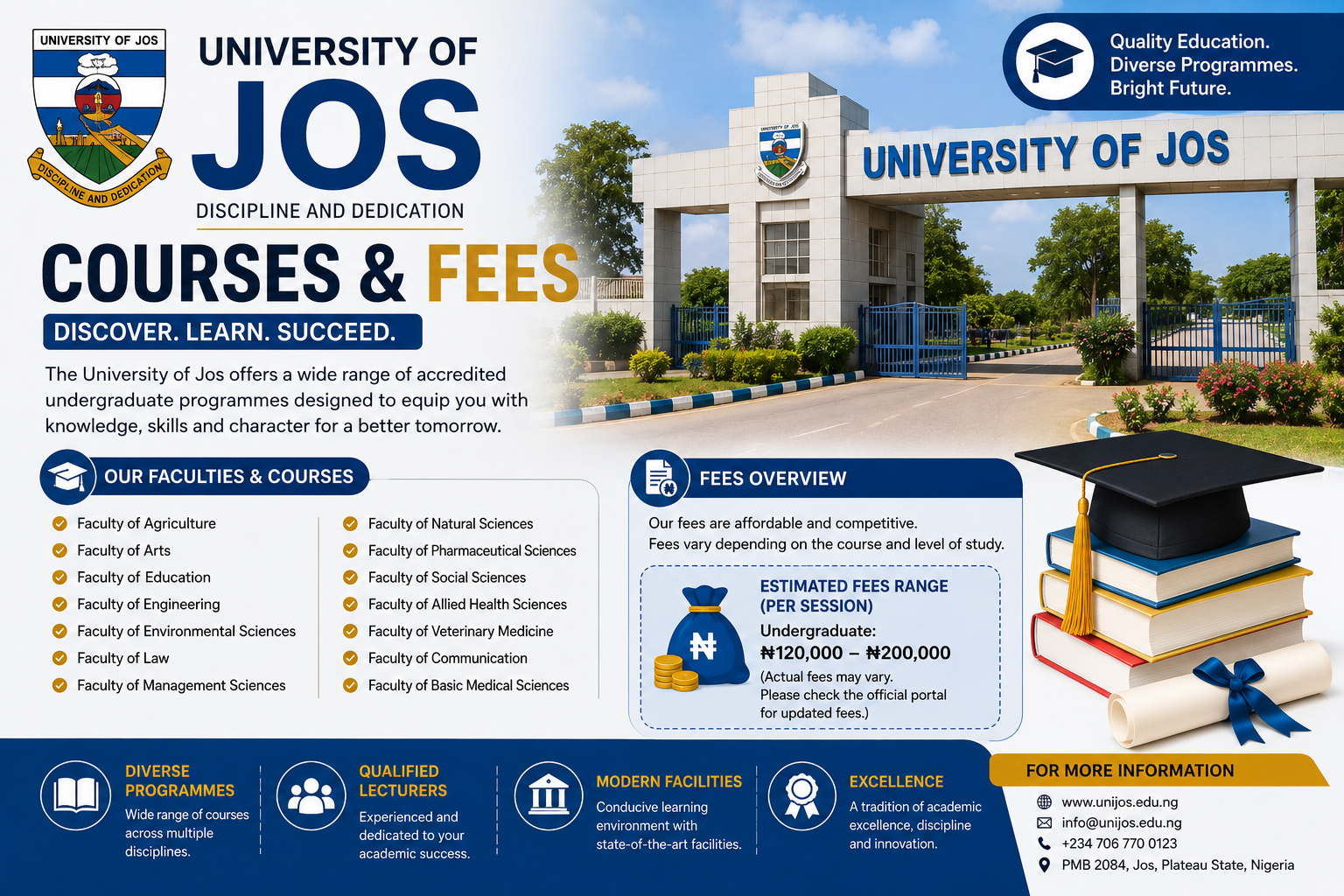
If you are looking for a comprehensive, reliable breakdown of University of Jos courses and fees for 2025/2026, you have come to the right place. The University of Jos — widely known as UNIJOS — is one of Nigeria’s most distinguished federal universities, with a rich academic tradition, a diverse student population drawn from across the country, and a campus environment that has long been regarded as one of the most intellectually stimulating in northern Nigeria. Whether you are a JAMB candidate weighing your institution options, a parent planning ahead for your child’s university education, or a newly admitted student trying to understand what lies ahead financially and academically, this guide covers everything you need to know.
From the full list of faculties and departments to the current school fees structure, JAMB cut-off requirements, O’Level requirements, scholarship opportunities, student life, and the step-by-step application process — this is the most complete resource on the University of Jos available in one place.
About the University of Jos
History and Background
The University of Jos was established in 1975, growing out of what was previously a campus of the University of Ibadan that had been operating in Jos since 1971. It is a federal university located in Jos, the capital of Plateau State — a city that sits on the Jos Plateau at an elevation of approximately 1,200 metres above sea level, giving it one of the most temperate climates of any Nigerian city. This unique climate — cool and pleasant by Nigerian standards — is one of the features that makes Jos and by extension the University of Jos a distinctive and attractive destination for students from across the country.
Over its five decades of existence, the University of Jos has grown into a comprehensive research and teaching university with multiple faculties, a well-regarded teaching hospital, a dental school, a veterinary teaching hospital, and postgraduate programmes across disciplines. It has produced graduates who have gone on to distinguished careers in medicine, law, academia, government, business, and the arts — contributing significantly to Nigeria’s professional and intellectual landscape.
The university is governed by a university council and senate, operates under the supervision of the Federal Ministry of Education, and is fully funded as a federal institution — which keeps its tuition fees considerably lower than those of private universities while maintaining a standard of education that is recognised nationally and internationally.
Accreditation and Recognition
All programmes at the University of Jos are accredited by the National Universities Commission (NUC). Professional programmes carry additional accreditation from their respective regulatory bodies — the Medical and Dental Council of Nigeria (MDCN) accredits Medicine, Surgery, and Dentistry; the Veterinary Council of Nigeria (VCN) accredits Veterinary Medicine; the Pharmacists Council of Nigeria (PCN) accredits Pharmacy; the Nursing and Midwifery Council of Nigeria (NMCN) accredits Nursing Science; and the Council for the Regulation of Engineering in Nigeria (COREN) covers the Engineering programmes. These accreditations ensure that degrees from the University of Jos are recognised by employers, professional bodies, and academic institutions in Nigeria and internationally.
University of Jos Faculties and Courses
The University of Jos organises its undergraduate programmes across a wide range of faculties and colleges. Understanding the complete University of Jos courses and fees structure helps you identify the right programme for your background, interests, and career goals. Below is a thorough breakdown of every faculty and the programmes available within each.
Faculty of Agriculture
The Faculty of Agriculture at UNIJOS trains students in the science and practice of agricultural production, resource management, and agribusiness — disciplines that are critically important for Nigeria’s food security and economic diversification agenda. The faculty offers the following programmes:
- Agricultural Economics and Extension
- Animal Science
- Crop Production and Horticulture
- Food Science and Technology
- Forestry and Wildlife Management
- Soil Science
JAMB Subject Combination: English Language, Biology, Chemistry, and either Mathematics or Physics depending on the specific programme. Minimum JAMB cut-off is typically 180. O’Level requirements include five credits in English Language, Mathematics, Biology, Chemistry, and Agricultural Science or Physics.
Faculty of Arts
The Faculty of Arts is one of UNIJOS’s oldest and most celebrated faculties — known for its strong humanities tradition and its contribution to Nigerian literature, linguistics, and cultural studies. The faculty offers:
- Arabic and Islamic Studies
- English and Literary Studies
- Film and Multimedia Arts
- French
- History and Diplomatic Studies
- Linguistics
- Music
- Philosophy
- Religion and Philosophy
- Theatre and Film Arts
JAMB Subject Combination: English Language, Literature in English or any two relevant Arts subjects depending on the programme. Minimum cut-off is typically 180. O’Level requirements include credits in English Language and relevant Arts subjects.
Faculty of Education
The Faculty of Education at UNIJOS is one of the largest and most impactful in northern Nigeria — producing thousands of qualified teachers and education administrators who serve in schools and educational institutions across Plateau State, the North-Central zone, and beyond. Programmes include:
- Adult Education and Community Development
- Education and Biology
- Education and Chemistry
- Education and Computer Science
- Education and Economics
- Education and English
- Education and French
- Education and History
- Education and Integrated Science
- Education and Mathematics
- Education and Physics
- Education and Religious Studies
- Educational Administration and Planning
- Guidance and Counselling
- Health and Physical Education
- Home Economics Education
- Library and Information Science
- Special Education
JAMB Subject Combination: Varies by teaching specialisation. Science education combinations require Mathematics and relevant science subjects; Arts and Social Science education combinations require relevant Arts subjects. Minimum cut-off is typically 180.
Faculty of Environmental Sciences
The Faculty of Environmental Sciences addresses the growing demand for professionals who understand the built environment, urban systems, and natural resource management. Given Jos’s unique environmental setting and the broader Nigerian context of rapid urbanisation, this faculty’s programmes are highly relevant to contemporary professional needs. Programmes include:
- Architecture
- Building Technology
- Estate Management
- Geography and Planning
- Quantity Surveying
- Urban and Regional Planning
JAMB Subject Combination: English Language, Mathematics, Physics, and one other relevant subject — Geography, Chemistry, or Fine Art depending on the programme. Architecture typically requires a JAMB score of 200 and above. O’Level requirements include credits in Mathematics, Physics, and English Language as a minimum.
Faculty of Law
The Faculty of Law at the University of Jos offers the LL.B (Bachelor of Laws) degree and is one of the most competitive and prestigious faculties at the institution. The five-year programme is accredited by the Council of Legal Education, and graduates are eligible for admission to the Nigerian Law School for the Bar Part Two programme. UNIJOS Law has produced distinguished legal practitioners, judges, and academics who have made significant contributions to Nigerian jurisprudence.
JAMB Subject Combination: English Language, Literature in English, Government or History, and one other Arts or Social Science subject. Law at UNIJOS typically requires a JAMB score of 240 and above for realistic consideration. O’Level requirements include credits in English Language and Literature in English as non-negotiable requirements, alongside at least three other relevant subjects.
Faculty of Management Sciences
The Faculty of Management Sciences at UNIJOS prepares graduates for careers in business, finance, public administration, and entrepreneurship. The faculty’s programmes are consistently among the most popular at the university given the broad employment prospects they offer across public and private sectors. Programmes include:
- Accounting
- Banking and Finance
- Business Administration
- Entrepreneurship and Business Management
- Insurance
- Marketing
- Public Administration
JAMB Subject Combination: English Language, Mathematics, Economics, and one other Social Science subject such as Government, Commerce, or Literature. Minimum cut-off is typically 180 to 200. O’Level requirements include credits in English Language, Mathematics, and Economics.
Faculty of Medical Sciences
The Faculty of Medical Sciences is one of the most distinguished faculties at the University of Jos and one of the primary reasons the institution commands such national recognition. It houses programmes in Medicine and Surgery, Dentistry, and related clinical disciplines, with clinical training conducted at the University of Jos Teaching Hospital (JUTH) — one of the foremost teaching hospitals in northern Nigeria.
- Medicine and Surgery (MBBS) — six years
- Dental Surgery (BDS) — six years
- Medical Rehabilitation
- Radiography
JAMB Subject Combination: English Language, Biology, Chemistry, and Physics or Mathematics. Medicine and Surgery and Dental Surgery at UNIJOS are among the most competitive programmes in Nigeria — JAMB scores of 280 and above are typically required, alongside exceptional O’Level results including credits in English Language, Mathematics, Biology, Chemistry, and Physics at one sitting. The Post-UTME screening for Medicine and Dentistry at UNIJOS is rigorous and demands thorough preparation.
The University of Jos Teaching Hospital (JUTH) is a major federal tertiary hospital that provides not only clinical training for UNIJOS medical students but also serves as one of the most important referral hospitals for Plateau State and the surrounding North-Central states. Medical graduates from UNIJOS are highly regarded in the Nigerian healthcare system and have gone on to distinguished careers in clinical medicine, academic medicine, and public health both in Nigeria and internationally.
Faculty of Natural Sciences
The Faculty of Natural Sciences covers the core science disciplines — providing both theoretical and practical training for students pursuing careers in research, industry, healthcare support, and technology. Programmes offered include:
- Biochemistry
- Biology
- Biotechnology
- Chemistry
- Computer Science
- Geology
- Mathematics
- Microbiology
- Physics
- Statistics
JAMB Subject Combination: Varies by department. Most science programmes require English Language, Mathematics, Physics or Biology, and Chemistry. Computer Science requires Mathematics, Physics, and one other science subject. Cut-off scores range from 180 to 220 depending on programme competitiveness. O’Level requirements include credits in Mathematics, English Language, and relevant science subjects.
Faculty of Pharmaceutical Sciences
The Faculty of Pharmaceutical Sciences at UNIJOS offers the Bachelor of Pharmacy (B.Pharm) degree — a five-year programme accredited by the Pharmacists Council of Nigeria. UNIJOS Pharmacy is one of the well-regarded pharmacy programmes in northern Nigeria, with graduates finding employment in hospital pharmacy, community pharmacy, pharmaceutical manufacturing, and regulatory bodies.
JAMB Subject Combination: English Language, Biology, Chemistry, and Physics or Mathematics. Pharmacy is competitive — JAMB scores of 220 and above are typically required. O’Level requirements include credits in English Language, Mathematics, Biology, Chemistry, and Physics.
Faculty of Social Sciences
The Faculty of Social Sciences provides rigorous training in the disciplines that examine society, governance, economy, and human behaviour. Its programmes produce graduates equipped for careers in government, international organisations, financial institutions, NGOs, media, and research. Programmes include:
- Criminology and Security Studies
- Economics
- International Relations
- Mass Communication
- Political Science
- Psychology
- Sociology and Anthropology
JAMB Subject Combination: English Language, Mathematics or Literature, and two relevant Social Science subjects. Mass Communication requires English Language, Literature, and two Arts or Social Science subjects. Cut-off scores are typically between 180 and 200.
Faculty of Veterinary Medicine
The Faculty of Veterinary Medicine is one of UNIJOS’s most distinctive offerings — one of only a handful of veterinary faculties in Nigeria. The five-year Doctor of Veterinary Medicine (DVM) programme is accredited by the Veterinary Council of Nigeria and trains graduates for careers in animal health, public health, food safety, wildlife management, and veterinary research. The faculty operates a Veterinary Teaching Hospital that provides hands-on clinical training and services to the Jos farming and livestock-keeping community.
JAMB Subject Combination: English Language, Biology, Chemistry, and Physics or Mathematics. Veterinary Medicine is a competitive programme requiring JAMB scores of 220 and above. O’Level requirements include credits in English Language, Mathematics, Biology, Chemistry, and Physics.
College of Health Sciences
In addition to the Faculty of Medical Sciences and Faculty of Pharmaceutical Sciences, UNIJOS has a College of Health Sciences that houses allied health programmes:
- Nursing Science
- Medical Laboratory Science
- Physiotherapy
- Human Anatomy
- Human Physiology
JAMB Subject Combination: English Language, Biology, Chemistry, and Physics or Mathematics. These programmes require JAMB scores of 200 and above and strong O’Level results in science subjects.
Faculty of Engineering
The Faculty of Engineering at UNIJOS offers COREN-accredited engineering programmes that prepare graduates for careers across Nigeria’s infrastructure, energy, and manufacturing sectors. Departments include:
- Civil Engineering
- Computer Engineering
- Electrical and Electronics Engineering
- Mechanical Engineering
- Mining Engineering
JAMB Subject Combination: English Language, Mathematics, Physics, and Chemistry. Engineering requires JAMB scores of 200 and above, with Computer and Electrical Engineering typically attracting scores of 220 and above. O’Level credits must include Mathematics, Physics, Chemistry, and English Language.
University of Jos School Fees for 2025/2026
Understanding the Fee Structure
As a federal university, the University of Jos operates under federal government university fee guidelines — keeping tuition costs significantly lower than private universities in Nigeria. The total fees payable each session include tuition, registration, development levies, faculty-specific charges, and various administrative fees. The amounts vary between new and returning students and across faculties — with science, health sciences, engineering, and professional programmes attracting higher fees than Arts, Education, and Social Sciences.
The figures below represent the best available information for the 2025/2026 academic session. Students are strongly advised to verify current figures directly with the UNIJOS bursary department or through the official university website at unijos.edu.ng before making any payments, as fee schedules are subject to revision.
Acceptance Fee for Newly Admitted Students
All newly admitted students at the University of Jos are required to pay a non-refundable acceptance fee to confirm their admission offer. The acceptance fee for the 2025/2026 session is approximately ₦50,000 for Nigerian students. This fee must be paid within the deadline specified in the admission letter — forfeiture of the admission offer is the consequence of missing the payment deadline. The acceptance fee is paid separately from and in addition to the regular session school fees.
School Fees for New Students (100 Level) — 2025/2026
New students pay a higher total in their first year because of one-time charges including the matriculation fee, sports levy, and other first-year administrative charges. The approximate breakdown for new UNIJOS students in 2025/2026 is as follows:
- Tuition Fee: ₦45,000 — ₦90,000 (varies by faculty — Medicine, Pharmacy, Veterinary Medicine, and Engineering attract the highest fees)
- Registration Fee: ₦15,000
- Development Levy: ₦20,000
- Library Fee: ₦5,000
- Student Union Fee: ₦5,000
- Medical Fee: ₦10,000
- Matriculation Fee (first year only): ₦10,000
- Examination Fee: ₦10,000
- Sports Levy: ₦5,000
- ICT Levy: ₦5,000
Total estimated first-year school fees for new students: approximately ₦130,000 — ₦175,000 depending on faculty — excluding acceptance fee and accommodation costs. Medicine, Dental Surgery, Veterinary Medicine, and Pharmacy attract fees at the higher end of this range due to the clinical and laboratory infrastructure costs associated with these programmes.
School Fees for Returning Students (200 Level and Above) — 2025/2026
Returning students pay lower fees as the one-time first-year charges no longer apply. The approximate total for returning UNIJOS students in 2025/2026 is:
- Tuition Fee: ₦45,000 — ₦90,000 (faculty-dependent)
- Registration Fee: ₦15,000
- Development Levy: ₦20,000
- Library Fee: ₦5,000
- Student Union Fee: ₦5,000
- Medical Fee: ₦10,000
- Examination Fee: ₦10,000
- Sports Levy: ₦5,000
- ICT Levy: ₦5,000
Total estimated annual school fees for returning students: approximately ₦120,000 — ₦165,000 depending on faculty.
Accommodation Fees at UNIJOS
The University of Jos has student hostels on campus, though — as is the case at most Nigerian federal universities — hostel spaces are limited and demand consistently exceeds supply. Students who secure on-campus accommodation pay hostel fees of approximately ₦30,000 — ₦60,000 per session depending on the hostel and room type.
The majority of UNIJOS students live off campus in the surrounding Jos communities — Naraguta, Angwan Rogo, Tudun Wada, and other neighbourhoods close to the university. Jos is generally considered an affordable city in terms of accommodation, and students can find decent off-campus housing within a reasonable commute of the university at annual costs ranging from approximately ₦80,000 to ₦300,000 depending on the type and location of the accommodation. The pleasant climate of Jos makes the overall living experience more comfortable than in most other Nigerian university cities.
JAMB Cut-Off Marks for University of Jos 2025/2026
The JAMB institutional cut-off mark for the University of Jos is 180. As with all federal universities in Nigeria, this is the minimum threshold — not an admission guarantee. The actual cut-off for any specific programme is determined by the competition among qualified applicants and varies from year to year.
For the most competitive programmes — Medicine and Surgery, Dental Surgery, Law, Pharmacy, and Veterinary Medicine — practical admission cut-offs are significantly higher, typically between 250 and 300. For programmes in Engineering and Computer Science, scores of 220 and above are generally required for competitive consideration. For Arts, Education, Social Sciences, and Agriculture programmes, scores closer to the institutional minimum are more likely to be sufficient.
Candidates should research the specific historical cut-off trends for their target programme at UNIJOS and aim well above the institutional minimum to improve their chances of admission. The University of Jos conducts a Post-UTME screening exercise that combines with the JAMB score for admission ranking — thorough preparation for the Post-UTME is as important as strong JAMB preparation.
O’Level Requirements for the University of Jos
Candidates for admission to the University of Jos must have a minimum of five O’Level credits from WAEC, NECO, or NABTEB in subjects relevant to their intended programme. English Language is a compulsory credit requirement for all programmes without exception. Mathematics is required for all science, engineering, management, and most social science programmes.
Credits must be obtained in not more than two sittings for most programmes. Medicine, Dental Surgery, Pharmacy, and Veterinary Medicine at UNIJOS require all required credits at one sitting — this is a strict requirement that eliminates candidates with split sittings from consideration for these programmes. Always verify the specific O’Level requirements for your target programme in the JAMB brochure and on the official UNIJOS admissions page before submitting your application.
University of Jos Teaching Hospital (JUTH)
The Jos University Teaching Hospital — commonly called JUTH — is one of the most important federal tertiary hospitals in northern Nigeria and a central pillar of UNIJOS’s health sciences education. Established alongside the university, JUTH has grown into a major referral hospital serving Plateau State and the surrounding North-Central states, with specialist departments covering virtually every major clinical discipline.
For UNIJOS medical, dental, nursing, pharmacy, and allied health students, JUTH is the primary clinical training environment — the place where the theoretical knowledge acquired in the preclinical years is translated into practical clinical competence through ward rounds, outpatient clinics, surgical theatre exposure, and emergency medicine rotations. The hospital’s depth of clinical material — the volume and variety of cases it manages — gives UNIJOS health science students exposure to a range of conditions and presentations that comprehensively prepares them for independent professional practice.
JUTH also offers housemanship and residency training for graduate doctors and health professionals. House officers completing their mandatory internship at JUTH receive MDCN-accredited training in an environment that combines the rigour of a major teaching hospital with the mentorship of experienced consultants across multiple specialties. Residency training at JUTH leads to fellowship qualifications through the West African College of Physicians and Surgeons and the National Postgraduate Medical College of Nigeria.
Scholarships and Financial Support at UNIJOS
Students at the University of Jos have access to a range of scholarship and financial support opportunities. The Federal Government of Nigeria provides bursaries to students at federal universities through the Federal Scholarship Board — register with your state scholarship board early in your first year and apply for available federal and state bursaries before application deadlines close.
Plateau State Government offers scholarships and bursaries specifically for Plateau State indigenes studying at UNIJOS and other institutions. Students from Benue, Nasarawa, and other North-Central states should check their respective state scholarship board for available funding for UNIJOS students. The Niger Delta Development Commission (NDDC) provides bursaries for students from Niger Delta states studying at any Nigerian federal university including UNIJOS.
The Tertiary Education Trust Fund (TETFund) supports infrastructure, research, and scholarship programmes at federal universities including UNIJOS. International scholarships from organisations like the Mastercard Foundation, the African Development Bank, and various bilateral scholarship programmes between Nigeria and other countries are also available to outstanding UNIJOS students who meet the eligibility criteria. Proactively researching all available scholarship opportunities at the beginning of each academic year significantly increases the likelihood of accessing financial support.
Student Life at the University of Jos
Campus Environment and Climate
The University of Jos campus is one of the most distinctive in Nigeria — not just academically but environmentally. The campus sits on the Jos Plateau at over 1,200 metres elevation, giving it a climate that is genuinely cool and refreshing compared to the heat that characterises most Nigerian cities. Temperatures in Jos rarely exceed 30 degrees Celsius and can drop significantly at night and during the harmattan season — making the city and the university one of the most comfortable physical environments for studying in Nigeria.
The campus itself is spacious, green, and well-maintained — with lecture halls, laboratories, libraries, student hostels, a sports complex, a chapel, a mosque, restaurants, banks, and various commercial outlets. The natural beauty of the surrounding Plateau landscape — rocky hills, scenic viewpoints, and the occasional waterfall within driving distance — gives Jos a quality of environment that students consistently describe as one of the most memorable aspects of their university experience.
Academic Culture and Intellectual Environment
UNIJOS has a well-earned reputation as a university with a genuinely serious academic culture. The institution has produced scholars, researchers, and professionals of national and international distinction across virtually every field it teaches. Its faculty includes experienced academics with PhDs from leading Nigerian and international universities, and its research output — in agriculture, medicine, social sciences, and the humanities — contributes meaningfully to Nigeria’s knowledge base.
The diversity of the UNIJOS student population — drawn from virtually every state in Nigeria and reflecting the North-Central zone’s rich ethnic and cultural complexity — creates an environment of genuine cultural exposure and interpersonal learning that supplements the formal academic curriculum. Students from Yoruba, Igbo, Hausa, Fulani, Tiv, Berom, Ngas, and dozens of other ethnic backgrounds coexist and interact on the UNIJOS campus, creating a microcosm of Nigeria’s extraordinary diversity that shapes how students understand their country and their place in it.
Student Associations and Extracurricular Life
UNIJOS has an active student union government and a wide range of student associations covering academic, professional, cultural, religious, and recreational interests. Faculty-based associations — the UNIJOS Medical Students Association, the Law Students Association, the Engineering Students Association — provide professional networking, peer learning, and career development opportunities alongside the formal academic programme. Cultural associations representing different ethnic and regional groups on campus celebrate diversity and provide social support networks for students far from home. Religious organisations — Christian fellowships, Muslim student associations, and interfaith groups — are active and well-attended. Sports clubs, debate societies, and creative arts groups round out the extracurricular landscape.
How to Apply to the University of Jos
Step One: Register for JAMB and Choose UNIJOS
The UNIJOS admission process begins with the JAMB UTME. Register at jamb.gov.ng during the annual registration window — typically between January and March. Select the University of Jos as your first-choice institution and choose your intended programme. Verify that your JAMB subject combination matches the requirements for your target department as published in the JAMB brochure. Your NIN is required for JAMB registration — obtain it from a NIMC enrolment centre before the registration window opens if you do not already have it.
Step Two: Prepare Thoroughly and Sit Your JAMB
Prepare for your JAMB examination using the JAMB syllabus for each of your four subjects, past JAMB questions across multiple years, and regular CBT practice on the JAMB practice application or third-party simulation platforms. Aim for a score well above the UNIJOS institutional minimum of 180 — the higher your score, the more competitive your application, particularly for UNIJOS’s most sought-after programmes. Check your result on the JAMB portal as soon as it is released.
Step Three: Register for and Sit the UNIJOS Post-UTME
Candidates who meet the JAMB minimum cut-off and selected UNIJOS as their first-choice institution are eligible to register for the Post-UTME screening. Monitor the official UNIJOS website at unijos.edu.ng and UNIJOS official social media channels for the Post-UTME registration announcement. Register within the specified period and prepare thoroughly — use UNIJOS Post-UTME past questions and CBT practice tools. Post-UTME performance is combined with your JAMB score for admission ranking purposes.
Step Four: Check Your Admission Status on CAPS
After Post-UTME results are processed, admission offers are released through the JAMB Central Admissions Processing System (CAPS). Log in to your JAMB profile regularly to check your admission status. Accept your offer through CAPS within the stipulated deadline and proceed to UNIJOS for physical screening and registration upon acceptance.
Step Five: Pay Your Fees and Complete Registration
Once your admission is confirmed, pay your acceptance fee and school fees through the UNIJOS payment portal. Complete all required registrations — departmental, faculty, and university-wide. Obtain your student identity card and matriculation number. Attend the UNIJOS matriculation ceremony as scheduled — a formal and significant milestone that marks the beginning of your academic journey at one of Nigeria’s most respected federal universities.
Frequently Asked Questions
What are the school fees for the University of Jos in 2025/2026?
The estimated total school fees for new students at the University of Jos in 2025/2026 is approximately ₦130,000 to ₦175,000 per session depending on the faculty, excluding the acceptance fee and accommodation. Returning students pay approximately ₦120,000 to ₦165,000 per session. Medicine, Dental Surgery, Pharmacy, Veterinary Medicine, and Engineering attract fees at the higher end of the range. Always verify current figures directly with the UNIJOS bursary department or through the official website at unijos.edu.ng before making any payments.
What is the JAMB cut-off for the University of Jos?
The institutional JAMB cut-off for the University of Jos is 180. However, the practical admission cut-off for competitive programmes like Medicine, Dental Surgery, Law, Pharmacy, and Veterinary Medicine is significantly higher — typically between 250 and 300. Candidates should research the specific historical cut-off trends for their target programme and aim well above the minimum cut-off for a realistic chance of admission into competitive departments.
Does UNIJOS have a teaching hospital?
Yes — the Jos University Teaching Hospital (JUTH) is one of the foremost federal tertiary hospitals in northern Nigeria and serves as the primary clinical training facility for UNIJOS medical, dental, nursing, pharmacy, and allied health students. JUTH also offers housemanship and residency training for graduate doctors. It is a major referral hospital serving Plateau State and the surrounding North-Central states, providing UNIJOS health science students with excellent clinical exposure across a wide range of medical conditions and specialties.
What courses are offered at the University of Jos?
The University of Jos offers over 80 undergraduate degree programmes across faculties including Agriculture, Arts, Education, Engineering, Environmental Sciences, Law, Management Sciences, Medical Sciences, Natural Sciences, Pharmaceutical Sciences, Social Sciences, Veterinary Medicine, and the College of Health Sciences. The full list of currently accredited programmes is available on the official UNIJOS website at unijos.edu.ng and in the current JAMB brochure.
Is the University of Jos a good university?
Yes — the University of Jos is consistently ranked among Nigeria’s top federal universities and is particularly well regarded for its programmes in Medicine and Surgery, Law, Veterinary Medicine, and the Natural Sciences. Its unique climate, diverse and intellectually stimulating campus environment, strong academic tradition, JUTH teaching hospital, and the professional opportunities that come with studying in Plateau State’s capital city make it one of the most compelling federal university options for Nigerian students across all disciplines.
Where is the University of Jos located?
The University of Jos is located in Jos, the capital of Plateau State in north-central Nigeria. The campus sits on the Jos Plateau at an elevation of approximately 1,200 metres above sea level — giving Jos one of the most temperate and pleasant climates of any Nigerian city. The university’s main campus is in the Naraguta area of Jos, and the Jos University Teaching Hospital (JUTH) is located adjacent to the campus, providing direct clinical training access for health science students.
Final Thoughts
The University of Jos is one of Nigeria’s genuinely distinguished federal universities — an institution with a proud academic tradition, a diverse and stimulating campus environment, a world-class teaching hospital, and a track record of producing graduates who have made significant contributions to Nigerian professional and intellectual life across every generation since the institution’s founding.
Understanding the complete picture of University of Jos courses and fees for 2025/2026 — as laid out in this guide — gives you the foundation for a well-informed application and realistic financial planning. Use the official UNIJOS website at unijos.edu.ng as your primary reference for current fee schedules, admission requirements, and programme availability. Follow UNIJOS official social media channels for real-time updates during the admission season.
Prepare thoroughly for your JAMB. Take the Post-UTME seriously. Present the strongest possible application. And if you are admitted — embrace everything that UNIJOS and Jos have to offer. The academic rigour, the cultural richness, the unique environment, and the professional opportunities that flow from a UNIJOS degree are real and lasting. Go after them with everything you have.