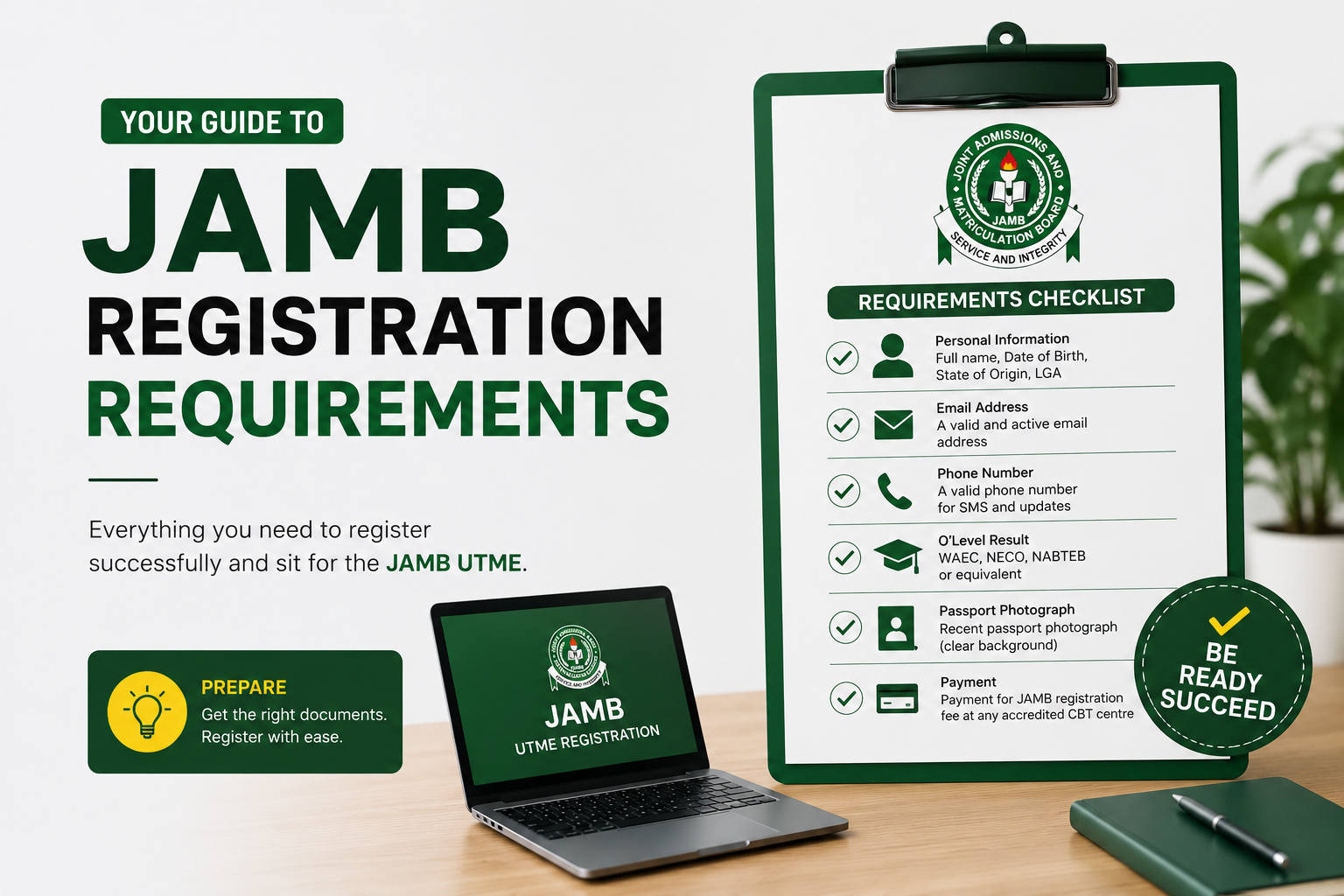
Understanding the JAMB registration requirements for 2025/2026 before you begin the process is the difference between a smooth, stress-free registration and the kind of last-minute scrambling that costs you time, money, and mental energy you need for exam preparation. This guide covers everything — the documents you need, the steps to follow in the correct order, the fees involved, the subject combination rules, the biometric data process, and the most common mistakes candidates make so you can avoid every one of them.
Whether you are registering for JAMB for the first time or you are a returning candidate who did not achieve your target score in a previous sitting, this guide gives you the complete, accurate picture of what JAMB registration requires in 2025/2026.
What Is JAMB and Why Does Registration Matter?
The Role of JAMB in Nigerian University Admissions
The Joint Admissions and Matriculation Board is the federal government agency responsible for conducting the Unified Tertiary Matriculation Examination (UTME) — the standardised entrance examination that determines eligibility for admission into Nigerian universities, polytechnics, colleges of education, and other tertiary institutions. Established in 1978, JAMB has administered millions of examinations and remains the single most important academic gateway for Nigerian secondary school leavers seeking tertiary education.
Your JAMB score — combined with your Post-UTME score and O’Level results — determines which institutions and programmes you can be considered for admission into. Without a valid JAMB registration and a qualifying score, no Nigerian university can legally admit you through the normal admissions process. This is why understanding the JAMB registration requirements thoroughly and completing your registration correctly is one of the most consequential academic administrative tasks you will undertake as a secondary school leaver.
JAMB UTME vs. Direct Entry
JAMB administers two distinct examination pathways. The UTME — Unified Tertiary Matriculation Examination — is the standard pathway for secondary school leavers applying for 100 level admission at tertiary institutions. The Direct Entry examination is a separate pathway for candidates who already hold a National Diploma, National Certificate in Education, A-Levels, or a first degree and are seeking 200 level admission to a university. The registration requirements, processes, and fees differ between UTME and Direct Entry. This guide focuses primarily on the UTME process — which applies to the vast majority of JAMB candidates — while noting key differences for Direct Entry candidates where relevant.
JAMB Registration Requirements for 2025/2026 — Documents You Need
1. National Identification Number (NIN)
The National Identification Number is the single most important prerequisite for JAMB registration in 2025/2026. JAMB made NIN a mandatory requirement for all candidates several years ago, and this requirement has been strictly enforced — candidates without a valid NIN cannot complete their JAMB registration. If you do not yet have your NIN, obtaining it is the very first step in your JAMB preparation — everything else comes after.
Your NIN is a unique eleven-digit number issued by the National Identity Management Commission (NIMC) that serves as your primary national identity credential. To obtain your NIN, visit any NIMC enrolment centre with a valid means of identification — your birth certificate, school ID, or any government document confirming your identity. The enrolment process involves biometric capture (fingerprints and photograph) and is free of charge at official NIMC centres. Your NIN is typically available immediately upon enrolment, either as a printed slip or through the NIMC mobile app.
Do not register your NIN through unofficial channels or pay anyone to register it for you — NIMC enrolment is free and straightforward at official centres. Fraudulent NIN registration services have been widely reported in Nigeria and should be avoided entirely.
2. O’Level Result — WAEC, NECO, or NABTEB
Your O’Level result is a required document for JAMB registration in 2025/2026. Candidates who have obtained their O’Level results must upload them as part of the registration process. The O’Level result serves to confirm that you have the foundational academic qualifications required for tertiary education and that your subject combination at O’Level is consistent with the course you are applying for at the tertiary level.
Candidates who are yet to obtain their O’Level results — typically SS3 students who have not yet sat for WAEC or NECO — can still register for JAMB. JAMB allows candidates awaiting their results to register and sit the UTME, with the understanding that their O’Level results will be uploaded when they become available. These candidates select “awaiting result” during the registration process. However, an O’Level result will be required before any institution can process your admission offer — so obtaining your results and uploading them to your JAMB profile as soon as they are released is essential.
3. Birth Certificate or Age Declaration
Proof of date of birth is required for JAMB registration. Your date of birth is used to verify your age eligibility for UTME — candidates must typically be at least fifteen years old at the time of examination, though there is no strict upper age limit for UTME registration. The accepted proof of age documents are an NPC birth certificate or a sworn affidavit of age declaration from a court of law. The date of birth you provide during JAMB registration must match the date on your proof of age document — inconsistencies will cause problems during verification.
4. Recent Passport Photograph
A recent passport-sized photograph is required during the JAMB registration process. This photograph is captured as part of your biometric registration at the JAMB-accredited CBT centre or through the JAMB registration portal, and it appears on your JAMB examination slip and other official JAMB documents. The photograph must be recent — taken within the past six months — and must clearly show your face against a plain background. Follow the specific photograph specifications provided at your registration point.
5. Valid Email Address
A valid, functional email address is required to create your JAMB profile and complete your registration. This email address is where JAMB will send important communications — registration confirmations, examination slip notifications, result notifications, and CAPS admission processing updates. Use an email address that you own, that you check regularly, and that you will continue to have access to throughout the admissions cycle. Do not use someone else’s email address — all communications from JAMB about your registration will go to this address, and losing access to it can cause serious problems during the admissions process.
If you do not have an email address, create one before beginning your JAMB registration. Gmail accounts are free, straightforward to create, and widely accepted. Choose an email address that includes your actual name — it presents more professionally and is easier to remember than a random combination of numbers and letters.
6. Active Phone Number
An active Nigerian phone number is required for JAMB registration. Your phone number is used for OTP (One-Time Password) verification during profile creation and for SMS notifications about your registration and examination. Use a phone number that you have consistent access to and that is active on a reliable network. Do not use a phone number belonging to someone else — OTP codes sent to your registered number are time-sensitive and require immediate access to the device.
JAMB Registration Fees for 2025/2026
UTME Registration Fee
The JAMB UTME registration fee for the 2025/2026 examination cycle is ₦5,700. This amount is broken down as follows: ₦3,500 as the examination fee payable to JAMB, and an additional reading material fee of approximately ₦700 for the compulsory JAMB novel, along with a service charge for the registration centre. The total amount payable at registration is ₦5,700 — confirm the exact breakdown at the point of payment as JAMB occasionally adjusts fee components between cycles.
The registration fee must be paid through official JAMB-approved channels — specifically through the JAMB e-Facility portal at efacility.jamb.gov.ng or at designated banks. Do not pay your registration fee to any individual, at any unaccredited registration centre, or through any unofficial payment channel. JAMB registration fee fraud is one of the most common scams targeting candidates during the registration period — protect yourself by using only the official payment channels listed on the JAMB website at jamb.gov.ng.
Direct Entry Registration Fee
Candidates registering for Direct Entry rather than UTME pay a separate registration fee. The Direct Entry registration fee is approximately ₦3,500 for the 2025/2026 cycle. Direct Entry candidates do not sit the standard UTME examination — they are assessed based on their existing qualifications — but must still register through the JAMB portal and pay the applicable fee before their Direct Entry application can be processed.
JAMB Registration Steps for 2025/2026 — The Correct Order
Step One: Create Your JAMB Profile
Before you can register for the 2025/2026 UTME, you must create a JAMB profile on the official JAMB e-Facility portal at efacility.jamb.gov.ng. Profile creation requires your NIN, a valid email address, and an active phone number. The portal will send an OTP to your registered phone number to verify your identity during profile creation — have your phone with you and ensure it has network coverage before beginning this step.
During profile creation, you will set up your JAMB profile code — a unique code associated with your profile that you will need for the subsequent steps of the registration process. Store your profile code, login credentials, and all registration details securely — in a notebook or a secure digital note — as you will need them throughout the registration and admissions process.
Step Two: Obtain Your JAMB Profile Code
After creating your profile, you will receive your JAMB profile code. This code is essential for the payment step — you cannot make your registration fee payment without it. The profile code is sent to your registered email address and phone number after successful profile creation. If you do not receive it within a reasonable time, check your spam or junk mail folder before assuming there is a problem.
Step Three: Pay Your Registration Fee
Pay the JAMB registration fee of ₦5,700 through one of the following official channels: at any branch of a JAMB-designated bank by presenting your profile code to the bank teller; through the JAMB e-Facility portal using a debit card or bank transfer; or through the USSD banking code of your bank where available. Obtain and keep your payment receipt or transaction reference number — you will need this to complete the registration at the CBT centre.
Do not make payment until you have your profile code — payment without a profile code cannot be linked to your registration and will be difficult to reconcile. If payment is made in error or a duplicate payment occurs, report it immediately to the bank and to JAMB through the official help channels on the JAMB website.
Step Four: Visit a JAMB-Accredited CBT Centre for Biometric Capture
Physical biometric data capture — fingerprints and facial photograph — is a mandatory component of JAMB registration and must be done in person at a JAMB-accredited Computer-Based Test centre. You cannot complete your JAMB registration remotely or online without this biometric step. Visit the JAMB website to find the list of accredited CBT centres in your state and choose a centre that is accessible and well-reviewed by other candidates.
Bring the following to the CBT centre: your NIN slip or NIMC card, your payment receipt, your profile code, and your O’Level result (or evidence that you are awaiting results). At the centre, your biometric data will be captured, your documents will be verified, you will select your examination subject combination and institution preferences, and your registration will be finalised. You will receive your JAMB examination slip at the end of this process — print it and keep it safely.
Step Five: Select Your Subject Combination and Institution Preferences
During the in-centre registration process, you will select your JAMB subject combination — the four subjects you will be examined in during the UTME — and your institution and course preferences. These selections are critical and must be made carefully. Your subject combination must include English Language (compulsory for all candidates) and three other subjects that match the entry requirements for your intended course of study. Your institution preference must match a university that offers your intended course.
Take time to research your subject combination and institution preferences before going to the CBT centre — do not make these selections on the spot without prior thought. Errors in subject combination or institution selection can affect your eligibility for admission into your target programme and are difficult to correct after registration is finalised.
Step Six: Collect and Print Your Examination Slip
After completing all registration steps, download and print your JAMB examination slip from the JAMB portal. Your examination slip contains your examination number, your examination date and time, your examination centre address, your photograph, and your registered subject combination. Verify all details on the slip carefully — if any information is incorrect, report it to JAMB through the official correction channel before your examination date. Bring your examination slip to the examination centre on the day of your UTME — entry without it is not permitted.
JAMB Subject Combinations for 2025/2026
The General Rule
Every JAMB UTME candidate sits four subjects. English Language is compulsory for all candidates regardless of course of study or institution preference. The remaining three subjects are determined by the candidate’s intended course of study and must align with the entry requirements published in the JAMB brochure for the specific course and institution. Selecting the wrong subject combination — even a combination that seems close to the correct one — can disqualify your application for your intended course, so this selection requires careful attention.
Subject Combinations by Course Category
The following subject combinations apply to the most common course categories for JAMB 2025/2026. Always cross-reference with the current JAMB brochure at jamb.gov.ng for the authoritative combination for your specific course and institution, as some institutions have specific requirements that differ from the general category guidelines.
Medicine and Surgery, Dentistry, Pharmacy, Nursing, Medical Laboratory Science: English Language, Biology, Chemistry, and Physics or Mathematics. Most medical and health science programmes require all four of Biology, Chemistry, Physics, and Mathematics — check the specific institutional requirement for your target university.
Engineering (Civil, Mechanical, Electrical, Chemical, Computer): English Language, Mathematics, Physics, and Chemistry.
Computer Science, Information Technology, Cybersecurity: English Language, Mathematics, Physics, and Chemistry or Biology depending on the institution.
Law: English Language, Literature in English, Government or History, and one other Arts or Social Science subject.
Accounting, Banking and Finance, Business Administration, Marketing, Economics: English Language, Mathematics, Economics, and one other Social Science or Arts subject such as Government, Commerce, or Literature.
Mass Communication, Journalism, Public Relations: English Language, Literature in English or Government, and two other Arts or Social Science subjects depending on the institution.
Education (Science options): English Language, Mathematics, and two relevant science subjects matching the teaching specialisation.
Education (Arts options): English Language, Literature in English, and two relevant Arts subjects matching the teaching specialisation.
Agriculture: English Language, Biology, Chemistry, and either Mathematics or Physics depending on the institution.
Architecture, Quantity Surveying, Estate Management: English Language, Mathematics, Physics, and one other subject — Chemistry, Geography, or Fine Art depending on the institution.
How to Confirm Your Subject Combination
The JAMB brochure is the authoritative reference document for subject combinations for every course at every institution in Nigeria. It is updated annually and is available for download on the JAMB website. Before finalising your subject selection during registration, look up your specific course at your specific target institution in the brochure and confirm the required combination. Do not rely on advice from friends, social media, or this guide alone — the brochure is the definitive source, and it is specific to your institution and programme in a way that general guidance cannot be.
JAMB Institution and Course Selection — What You Need to Know
First Choice and Second Choice Institutions
During JAMB registration, you select a first choice institution and course and a second choice institution and course. Your first choice institution is the primary target for your admission application — the JAMB score you achieve is primarily evaluated against the cut-off requirements of this institution. Your second choice serves as a fallback if your score or other factors make admission to your first choice institution unlikely.
Choose both your first and second choice institutions based on honest assessment of your likely JAMB score, your O’Level results, and the historical cut-off scores at each institution for your intended programme. Setting a realistic first choice — one where your expected score gives you a genuine chance of admission — is more productive than setting an aspirational first choice at an extremely competitive institution when your preparation suggests a score significantly below their historical cut-off.
Changing Your Institution or Course After Registration
JAMB provides a change of institution and course window after the UTME results are released — allowing candidates who scored lower than expected to adjust their institution preference to one whose cut-off is more aligned with their actual score, or to change their course if their result makes their original course preference unrealistic. This change window is also available to candidates who scored higher than expected and want to upgrade to a more competitive institution. Use this window strategically based on your actual result rather than pre-committing to an institution change before you know your score.
JAMB Registration for Direct Entry Candidates
Direct Entry registration at JAMB follows a broadly similar process to UTME registration but with important differences. Direct Entry is for candidates applying for 200 level admission based on existing qualifications — National Diploma, National Certificate in Education, A-Level results, or a first degree. Direct Entry candidates do not sit the standard four-subject UTME examination — instead, their admission is processed based on their existing qualifications and the Direct Entry requirements of their target institution.
The documents required for Direct Entry registration include the NIN, valid email address, active phone number, and evidence of the qualifying qualification — ND certificate or result, NCE certificate, A-Level result, or first degree certificate. Direct Entry candidates must also confirm that their qualifying qualification meets the specific Direct Entry requirements of their target institution and programme — which are published in the JAMB brochure. The registration fee for Direct Entry is approximately ₦3,500 and the process follows similar steps to UTME registration.
JAMB Registration Timeline for 2025/2026
JAMB registration for the 2025/2026 academic session typically opens in January and runs through to March, with the UTME examinations conducted between March and April. The exact registration opening and closing dates for the 2025/2026 cycle are announced officially by JAMB through the JAMB website at jamb.gov.ng and through official JAMB social media channels. Monitor these channels regularly from November onwards to ensure you do not miss the registration opening announcement.
Register as early as possible once registration opens. CBT centre slots — particularly at well-located, well-equipped centres in major cities — fill up quickly during the peak of the registration period. Early registrants have a wider choice of centres and examination dates. Candidates who register late in the window are often assigned to less convenient centres or examination time slots and face longer queues and more chaotic processing conditions. Early registration is in every candidate’s interest.
Common JAMB Registration Mistakes and How to Avoid Them
Registering Without a NIN
Attempting to begin JAMB registration without a NIN is the most fundamental and most avoidable registration error. The NIN is the prerequisite for everything that follows — profile creation, payment, biometric capture, and finalisation. If you do not have your NIN, stop everything else and obtain it first. Visit the nearest NIMC enrolment centre with your birth certificate or any valid ID and complete enrolment immediately. Do not wait until registration opens to start this process — NIMC centres are sometimes overwhelmed during JAMB registration periods and processing times can increase.
Using the Wrong Email Address
Registering with someone else’s email address, a misspelled email address, or an email address you cannot reliably access is a mistake that creates problems throughout the entire admissions cycle — from missing examination slip notifications to missing CAPS admission processing communications. Use your own, regularly checked email address and verify that it is correctly entered before submitting your profile creation.
Selecting the Wrong Subject Combination
Selecting a subject combination that does not match the requirements for your intended course of study is one of the most consequential registration errors — it can disqualify your application for your target programme regardless of how high your score is. Research your correct subject combination from the JAMB brochure before registration and confirm it with your school or a knowledgeable adviser before finalising your selection at the CBT centre.
Paying Through Unofficial Channels
Paying your JAMB registration fee to an individual, at an unaccredited centre, or through any channel not listed on the official JAMB website exposes you to fraud and may result in your payment not being registered against your profile. Use only the official payment channels — JAMB-designated banks or the e-Facility portal — and obtain a receipt for every transaction.
Not Printing and Keeping Your Examination Slip
Your JAMB examination slip is your entry document for the UTME examination. Candidates who do not have their slip on examination day are denied entry — there are no exceptions. Print your examination slip as soon as it is available, keep multiple copies, and store at least one copy in a safe location separate from the one you will carry to the examination centre.
What Happens After JAMB Registration
Preparing for the UTME
Completing your registration is the administrative beginning of your JAMB journey — the academic preparation is the substance of it. From the moment your registration is complete, your focus should shift entirely to examination preparation. Use the JAMB syllabus for each of your four subjects as your study guide. Work through past JAMB questions extensively. Practice CBT examinations regularly using the JAMB CBT practice app and third-party CBT simulation platforms. Manage your study time with a structured timetable that allocates sufficient preparation time across all four subjects.
Checking Your UTME Result
JAMB UTME results are typically released within a few days to two weeks after the examination. Results are checked through the JAMB portal using your examination number and date of birth, or through the JAMB result checker on the JAMB website. You will also receive an SMS notification to your registered phone number when your result is available. Check your result as soon as it is released and plan your next steps — institution change, Post-UTME registration, or scholarship applications — based on the score you achieved.
The CAPS Admission Process
After results are released, admission processing moves to the JAMB Central Admissions Processing System (CAPS). Institutions use CAPS to offer admission to qualifying candidates, and candidates use it to accept, reject, or request changes to their admission offers. Monitor your CAPS status regularly after results are released — admission offers that are not accepted within the stipulated period may be forfeited. The CAPS process completes the admissions cycle that begins with JAMB registration and ends with your formal acceptance of an admission offer.
Frequently Asked Questions
What are the requirements for JAMB registration in 2025/2026?
The core requirements for JAMB registration in 2025/2026 are: a valid National Identification Number (NIN) from NIMC, a valid email address, an active Nigerian phone number, a recent passport photograph, your O’Level result or evidence that you are awaiting results, and your birth certificate or age declaration. The registration fee of ₦5,700 must be paid through official JAMB-approved payment channels before your registration can be finalised at the CBT centre.
Can I register for JAMB without my O’Level result?
Yes — candidates who are awaiting their O’Level results can register for JAMB and sit the UTME. During registration, you select “awaiting result” to indicate that your result is not yet available. You must however upload your O’Level result to your JAMB profile as soon as it is released, as it is required before any institution can process your admission offer through CAPS.
How much is JAMB registration fee for 2025/2026?
The JAMB UTME registration fee for 2025/2026 is ₦5,700, which includes the examination fee, the JAMB compulsory novel reading material fee, and the registration centre service charge. Direct Entry registration is approximately ₦3,500. All fees must be paid through official JAMB-designated payment channels — banks or the e-Facility portal. Do not pay anyone who approaches you outside official channels claiming to offer JAMB registration services.
What is the JAMB registration deadline for 2025/2026?
The exact registration opening and closing dates for JAMB 2025/2026 are announced officially by JAMB through the JAMB website at jamb.gov.ng and official JAMB social media channels. Registration typically opens in January and closes in March, with examinations in March and April. Monitor the official channels from November onwards and register as early as possible once registration opens to secure your preferred CBT centre and examination slot.
Can I change my course or institution after JAMB registration?
Yes — JAMB provides a change of institution and course window after UTME results are released. This window allows candidates to change their first choice institution or course based on their actual examination score. The change is made through the JAMB portal and is subject to the availability of the new course at the new institution and the cut-off requirements for that course. Use this window strategically based on your actual result rather than making changes speculatively before results are known.
Is the NIN compulsory for JAMB registration?
Yes — the National Identification Number is mandatory for JAMB registration in 2025/2026. Candidates without a NIN cannot create a JAMB profile and therefore cannot complete any other part of the registration process. If you do not have your NIN, visit your nearest NIMC enrolment centre immediately to obtain it. The enrolment process is free at official centres and your NIN is typically available the same day.
Final Thoughts
Meeting all the JAMB registration requirements for 2025/2026 is entirely within every candidate’s reach — none of the requirements are unreasonable, and all of them can be prepared for well in advance of the registration window. The candidates who register smoothly, without errors or delays, are almost always the ones who prepared their documents in advance, understood the process before they began, and followed the correct steps in the correct order.
Start your preparation today. Obtain your NIN if you do not yet have one. Set up your email address. Research your correct subject combination from the JAMB brochure. Gather your O’Level result and birth certificate. When the registration window opens, you will be ready to complete your registration in a single, stress-free visit to your chosen CBT centre.
Your JAMB registration is the first step on the road to university admission. Get it right, and everything that follows becomes easier. Prepare thoroughly, follow the official process, and walk into your UTME examination with the confidence that comes from knowing you did everything correctly from the very beginning.