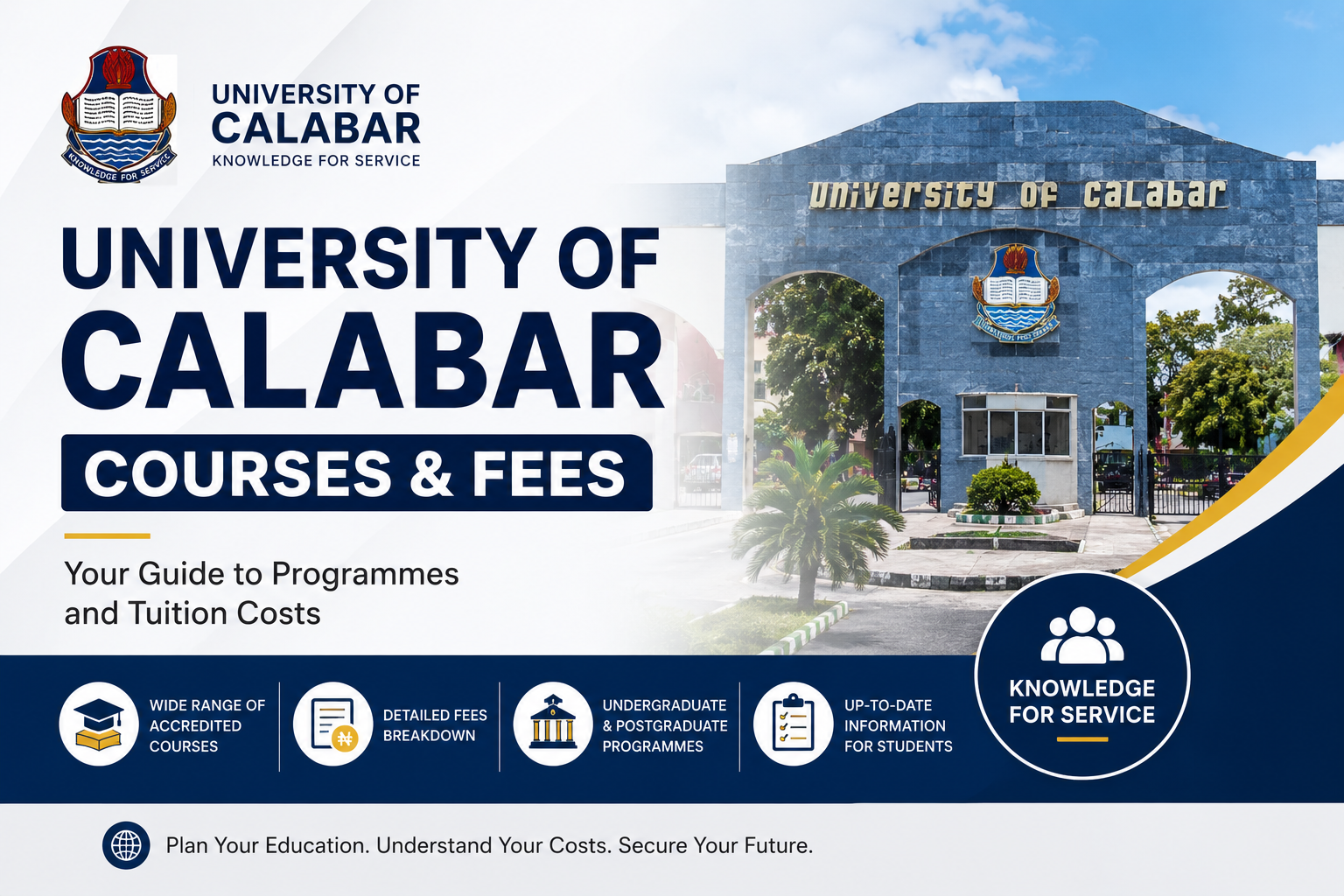
UNICAL is accredited by the National Universities Commission (NUC) and consistently ranks among Nigeria’s top federal universities. Its serene campus environment, strong academic culture, and wide range of programmes across the sciences, arts, law, medicine, and social sciences make it a competitive destination for students from across Nigeria. Whether you are preparing for JAMB, have already received an offer of admission, or are a parent trying to understand the financial commitment involved, this guide gives you the complete, accurate picture.
About the University of Calabar
History and Background
The University of Calabar was established in 1975 as a full-fledged federal university, having previously operated as a campus of the University of Nigeria, Nsukka from 1973. It is situated on a sprawling campus in Calabar — the capital of Cross River State and one of Nigeria’s most historically and culturally rich cities. The university operates under the supervision of the Federal Ministry of Education and is fully funded as a federal institution, which keeps its tuition fees significantly lower than those of private universities in Nigeria.
Over the decades, UNICAL has built a strong reputation in several academic disciplines — particularly in Law, Medicine and Surgery, Pharmacy, and the natural sciences. Its teaching hospital, the University of Calabar Teaching Hospital (UCTH), is one of the foremost referral hospitals in the South-South geopolitical zone and provides clinical training for medical, nursing, and pharmacy students. The university’s law faculty has produced some of Nigeria’s most distinguished legal minds, and its research output across disciplines continues to grow.
Accreditation and Recognition
All programmes offered at the University of Calabar are accredited by the National Universities Commission (NUC). Professional programmes — including Medicine and Surgery, Law, Pharmacy, Nursing, and Engineering — are additionally accredited by their respective professional regulatory bodies: the Medical and Dental Council of Nigeria (MDCN), the Council of Legal Education (CLE), the Pharmacists Council of Nigeria (PCN), the Nursing and Midwifery Council of Nigeria (NMCN), and the Council for the Regulation of Engineering in Nigeria (COREN). Graduating from an NUC-accredited programme at UNICAL means your degree is nationally and internationally recognised.
University of Calabar Faculties and Departments
The University of Calabar organises its academic programmes across multiple faculties, each housing several departments. Understanding the faculty structure helps you identify exactly where your programme of interest sits and what the admission requirements are for that specific faculty.
Faculty of Agriculture
The Faculty of Agriculture at UNICAL offers programmes designed to develop skilled agricultural professionals capable of addressing Nigeria’s food security challenges and contributing to the country’s agricultural transformation agenda. The faculty houses the following departments and programmes:
- Agricultural Economics and Extension
- Animal Science
- Crop Science
- Forestry and Wildlife Management
- Soil Science
JAMB subject combination for Agriculture programmes: English Language, Biology, Chemistry, and either Mathematics or Physics, depending on the specific programme. The minimum JAMB cut-off for Agriculture at UNICAL is typically 180, though actual admission cut-offs vary by year and programme.
Faculty of Allied Medical Sciences
This faculty trains healthcare professionals in specialised fields that support the broader medical and health system. It is one of the more competitive faculties at UNICAL given the strong demand for health-related programmes. Departments include:
- Medical Laboratory Science
- Physiotherapy
- Radiography and Radiological Sciences
- Human Nutrition and Dietetics
JAMB subject combination for Allied Medical Sciences: English Language, Biology, Chemistry, and Physics or Mathematics. Minimum JAMB cut-off is typically 200 and above for most programmes in this faculty.
Faculty of Arts
The Faculty of Arts is one of UNICAL’s largest and most diverse faculties, offering a wide range of humanities and language programmes. It is particularly well regarded for its Theatre Arts and Linguistics programmes. Departments include:
- English and Literary Studies
- French
- History and International Studies
- Linguistics and Communication Studies
- Music
- Religious and Cultural Studies
- Theatre and Film Studies
JAMB subject combination for Arts programmes: English Language, Literature in English, and two other Arts subjects depending on the specific programme. Minimum JAMB cut-off is typically 180.
Faculty of Basic Medical Sciences
This faculty handles the preclinical training of medical and dental students at UNICAL, as well as standalone degree programmes in basic medical science disciplines. Departments include:
- Anatomy
- Biochemistry
- Physiology
JAMB subject combination: English Language, Biology, Chemistry, and Physics or Mathematics. These programmes are highly competitive with cut-off scores typically above 220.
Faculty of Business Administration
The Faculty of Business Administration prepares students for careers in management, accounting, finance, and entrepreneurship. It is one of the most popular faculties at UNICAL given the broad employment prospects of its graduates. Departments include:
- Accounting
- Banking and Finance
- Business Management
- Marketing
- Public Administration
JAMB subject combination: English Language, Mathematics, and two other relevant subjects — Economics, Commerce, or Government. Minimum JAMB cut-off is typically 180 to 200.
Faculty of Education
The Faculty of Education at UNICAL trains teachers and educational administrators for both primary and secondary school levels. It offers education degree programmes combined with subject specialisations across arts, sciences, and social sciences. Key programmes include:
- Education and Biology
- Education and Chemistry
- Education and Economics
- Education and English
- Education and Mathematics
- Education and Physics
- Guidance and Counselling
- Library and Information Science
- Physical and Health Education
- Early Childhood and Primary Education
JAMB subject combination varies by specialisation — science education combinations require Mathematics, Physics or Biology, and Chemistry; arts education combinations require Literature and relevant arts subjects. Minimum cut-off is typically 180.
Faculty of Engineering
The Faculty of Engineering at UNICAL is COREN-accredited and offers undergraduate engineering programmes across several disciplines. Engineering remains one of the most competitive faculties at UNICAL, with strong demand from JAMB candidates each year. Departments include:
- Civil Engineering
- Computer Engineering
- Electrical and Electronic Engineering
- Mechanical Engineering
- Chemical Engineering
JAMB subject combination: English Language, Mathematics, Physics, and Chemistry. Engineering is one of the most competitive faculties at UNICAL — JAMB scores of 220 and above are typically required for serious consideration, with the most competitive programmes requiring 240 and above.
Faculty of Law
The Faculty of Law at the University of Calabar is one of its most prestigious faculties and has produced some of Nigeria’s leading legal practitioners, academics, and jurists. The faculty offers the LL.B (Bachelor of Laws) degree, which is the prerequisite for admission to the Nigerian Law School for those wishing to be called to the Bar. Law at UNICAL is highly competitive — it consistently attracts JAMB candidates with high scores from across Nigeria.
JAMB subject combination: English Language, Literature in English, Government or History, and one other Arts or Social Science subject. Law at UNICAL typically requires a JAMB score of 240 and above, and candidates must also perform well in the Post-UTME screening exercise.
Faculty of Medicine and Dentistry
Medicine and Surgery at UNICAL is the most competitive programme in the university and one of the most competitive in Nigeria. The programme runs for six years, including a one-year housemanship, and is fully accredited by the Medical and Dental Council of Nigeria (MDCN). The University of Calabar Teaching Hospital (UCTH) serves as the primary clinical training ground for medical students.
Dentistry is offered separately and follows a similar six-year structure with MDCN accreditation. Both Medicine and Dentistry at UNICAL require a JAMB score of 280 and above for realistic consideration, along with very strong O’Level results — minimum of five credits including English, Mathematics, Biology, Chemistry, and Physics at one sitting or a maximum of two sittings depending on the year’s requirements.
Faculty of Pharmacy
The Faculty of Pharmacy at UNICAL runs a five-year B.Pharm degree programme accredited by the Pharmacists Council of Nigeria. It is one of the strongest pharmacy faculties in southern Nigeria and its graduates are sought after by pharmaceutical companies, hospitals, and regulatory agencies. JAMB combination: English Language, Biology, Chemistry, and Physics or Mathematics. Cut-off scores are typically 220 and above.
Faculty of Science
The Faculty of Science is one of the largest at UNICAL and offers a wide range of pure and applied science programmes. Departments include:
- Botany
- Chemistry
- Computer Science
- Fisheries and Aquaculture
- Geology
- Mathematics
- Microbiology
- Physics
- Statistics
- Zoology
JAMB combinations vary by department but generally require English Language, Mathematics, and two relevant science subjects. Cut-off scores range from 180 to 220 depending on the specific programme.
Faculty of Social Sciences
The Faculty of Social Sciences covers disciplines at the intersection of society, economy, and governance. It is a popular faculty at UNICAL with strong graduate employment outcomes across the public and private sectors. Departments include:
- Economics
- Geography and Environmental Science
- Political Science
- Psychology
- Sociology
JAMB combination: English Language, Mathematics or Literature, and two relevant Social Science subjects. Minimum cut-off is typically 180 to 200.
College of Medical Sciences
In addition to the Faculty of Medicine and Dentistry, UNICAL has a College of Medical Sciences that houses nursing and other health-related programmes. The Department of Nursing Science offers the Bachelor of Nursing Science (B.N.Sc) degree, accredited by the Nursing and Midwifery Council of Nigeria. Nursing at UNICAL is in high demand and requires Biology, Chemistry, Physics or Mathematics, and English Language at the JAMB level.
University of Calabar School Fees for 2025/2026
Understanding UNICAL’s Fee Structure
As a federal university, the University of Calabar operates under the federal government’s university fee guidelines, which keep tuition costs significantly lower than private universities. However, it is important to understand that the fees students pay at UNICAL — as at most Nigerian federal universities — cover a range of charges beyond basic tuition, including acceptance fees, registration fees, development levies, and faculty-specific charges. The total amount payable varies between new students and returning students, and between faculties.
The figures provided below reflect the most current available information for the 2025/2026 academic session. Students are strongly advised to verify the exact figures directly with the UNICAL bursary department or through the official UNICAL website at unical.edu.ng, as fee schedules can be updated at the beginning of each academic session.
Acceptance Fee for Newly Admitted Students
Newly admitted students are required to pay a non-refundable acceptance fee to secure their admission. The acceptance fee at UNICAL for the 2025/2026 academic session is approximately ₦50,000 for Nigerian students. This fee must be paid within the stipulated deadline after receiving your admission letter — failure to pay within the deadline may result in forfeiture of the admission offer. The acceptance fee is separate from and in addition to the school fees payable for the first session.
School Fees for New Students (100 Level) — 2025/2026
New students at UNICAL pay a higher fee in their first year due to the inclusion of one-time charges such as the matriculation fee, student union dues, library levy, and other first-year administrative charges. The approximate breakdown for new students in the 2025/2026 session is as follows:
- Tuition Fee: ₦45,000 — ₦75,000 (varies by faculty; Science, Engineering, Medicine, and Pharmacy faculties attract higher charges)
- Registration Fee: ₦15,000
- Development Levy: ₦20,000
- Library Fee: ₦5,000
- Student Union Fee: ₦5,000
- Medical Fee: ₦10,000
- Matriculation Fee (first year only): ₦10,000
- Examination Fee: ₦10,000
Total estimated first-year school fees for new students: approximately ₦120,000 — ₦150,000 depending on faculty, excluding the acceptance fee and accommodation costs.
School Fees for Returning Students (200 Level and Above) — 2025/2026
Returning students pay slightly lower fees because the one-time first-year charges no longer apply. The approximate total for returning students in the 2025/2026 session is:
- Tuition Fee: ₦45,000 — ₦75,000 (faculty-dependent)
- Registration Fee: ₦15,000
- Development Levy: ₦20,000
- Library Fee: ₦5,000
- Student Union Fee: ₦5,000
- Medical Fee: ₦10,000
- Examination Fee: ₦10,000
Total estimated annual school fees for returning students: approximately ₦110,000 — ₦140,000 depending on faculty.
Faculty-Specific Fee Differences
It is important to note that school fees at UNICAL are not uniform across all faculties. Science-based, technology-based, and health-related faculties — Engineering, Medicine, Pharmacy, Allied Medical Sciences, and Basic Medical Sciences — typically attract higher fees than Arts, Social Sciences, Education, and Business Administration faculties. This reflects the higher cost of laboratory equipment, clinical training resources, and specialised facilities required for these programmes.
Students in Medicine and Dentistry should also anticipate additional clinical training-related charges in their later years of study as they transition from preclinical to clinical training at the University of Calabar Teaching Hospital. These additional charges vary by year and are announced by the faculty at the beginning of each academic session.
Accommodation Fees
UNICAL has on-campus accommodation available for students, though — as at most Nigerian federal universities — demand far exceeds supply and not all students who apply for hostel accommodation will be successful. Students who secure on-campus accommodation pay hostel fees in addition to their school fees. Hostel fees at UNICAL range from approximately ₦30,000 to ₦60,000 per session depending on the specific hostel and room type.
Students who do not secure on-campus accommodation typically rent private accommodation in the surrounding Calabar communities. Off-campus accommodation costs vary widely — from approximately ₦100,000 to ₦400,000 per year depending on the type of accommodation and its distance from campus. Calabar is generally considered an affordable city by Nigerian standards, and off-campus student accommodation is available at reasonable rates in communities close to the UNICAL campus.
JAMB Cut-Off Marks for University of Calabar 2025/2026
The JAMB cut-off mark for the University of Calabar, as set by the Joint Admissions and Matriculation Board, is 180 as the institutional minimum. However, it is critical to understand that this is a minimum threshold — not a guarantee of admission. The actual cut-off for admission into any specific programme at UNICAL is determined by the competition among applicants who chose that programme, and it varies significantly from year to year based on the number and quality of applicants.
For highly competitive programmes — Medicine and Surgery, Law, Pharmacy, Computer Engineering, and Electrical Engineering — actual admission cut-offs are typically between 240 and 300. For less competitive programmes in Agriculture, Arts, Education, and some Social Sciences, the practical cut-off may be closer to the institutional minimum of 180 to 200. Candidates should research the historical cut-off scores for their specific programme at UNICAL to set realistic score targets rather than simply aiming for the institutional minimum.
UNICAL also conducts a Post-UTME screening exercise for JAMB candidates who meet the minimum cut-off threshold. The Post-UTME score is combined with the JAMB score for admission ranking purposes. Performing well in both the JAMB examination and the Post-UTME screening is essential for competitive admission into oversubscribed programmes.
O’Level Requirements for University of Calabar
In addition to a qualifying JAMB score, candidates for admission to the University of Calabar must have a minimum of five O’Level credits — obtained at WAEC, NECO, or NABTEB — in relevant subjects for their intended programme. English Language is a compulsory credit requirement for all programmes. Mathematics is required for all science, engineering, business, and social science programmes.
The specific O’Level subject requirements vary by programme and faculty — check the UNICAL admission requirements section on the official website or the JAMB brochure for the exact requirements for your target programme. Credits must be obtained in not more than two sittings for most programmes, though the one-sitting requirement applies specifically to Medicine, Dentistry, and Pharmacy at most competitive universities including UNICAL.
Post-UTME Screening at UNICAL
What to Expect
The UNICAL Post-UTME screening exercise is conducted after the JAMB examination and is open to candidates who chose UNICAL as their first choice institution and meet the JAMB cut-off threshold. The screening typically involves a Computer-Based Test (CBT) covering the candidate’s JAMB subjects, as well as an aptitude component. Candidates must register for the Post-UTME screening separately from the JAMB registration — registration details are announced on the UNICAL website and through the official UNICAL social media channels.
How to Prepare
Preparation for the UNICAL Post-UTME follows the same principles as JAMB preparation — focusing on past questions, mastering the core topics in your JAMB subjects, and practising under timed CBT conditions. UNICAL Post-UTME past questions are available in bookshops in Calabar and through various online platforms. Familiarising yourself with the format and topic patterns of the UNICAL Post-UTME specifically — rather than relying solely on general JAMB preparation — gives you a meaningful competitive advantage.
Scholarships and Bursaries Available at UNICAL
Students at the University of Calabar have access to several scholarship and bursary opportunities that can significantly reduce the financial burden of their education. The Federal Government of Nigeria offers bursaries to students at federal universities through the Federal Scholarship Board — Nigerian students from certain states and with demonstrated financial need should investigate eligibility through their state scholarship board as well.
The Cross River State government offers bursaries and scholarships specifically for Cross River indigenes studying at UNICAL and other institutions. UNICAL itself has a limited number of merit-based scholarships for exceptionally performing students, typically awarded at the end of the first year based on first-year examination results. External scholarships from organisations like the Niger Delta Development Commission (NDDC) are available to students from Niger Delta states studying at Nigerian universities including UNICAL.
Students are encouraged to register with their state scholarship board as early as possible in their first year — many scholarship opportunities have annual application deadlines that new students miss simply because they were not aware of them in time.
Student Life at the University of Calabar
Beyond academics and fees, understanding what student life looks like at UNICAL helps prospective students make a fully informed decision. The UNICAL campus is widely considered one of the most beautiful and serene university campuses in Nigeria — a reputation that students and alumni consistently affirm. Its lush green environment, well-maintained facilities, and relatively orderly campus culture distinguish it from some of the more chaotic environments at other large Nigerian federal universities.
Calabar itself is one of Nigeria’s most liveable cities — clean, relatively safe by Nigerian urban standards, culturally vibrant, and home to the famous Calabar Carnival, which runs annually in December and is the largest street party in Africa. The city’s relatively modest size means that students can navigate it affordably and safely, and the cost of living — food, transport, accommodation — is lower than in Lagos, Abuja, or Port Harcourt.
UNICAL has a range of student organisations, cultural associations, religious bodies, and sports clubs that provide social, professional, and personal development opportunities alongside the academic programme. The student union government is active and represents student interests within the university administration. The campus has a functional sports complex, a university health centre, a well-stocked library, and several banks and ATMs within the campus perimeter.
How to Apply to the University of Calabar
Step One: Register for JAMB and Choose UNICAL
The admission process at UNICAL begins with the Joint Admissions and Matriculation Board Unified Tertiary Matriculation Examination (JAMB UTME). Register for JAMB through the JAMB website at jamb.gov.ng during the annual registration window — typically between January and March. Choose the University of Calabar as your first choice institution and select your intended programme and JAMB subject combination carefully, ensuring they match the requirements for your target department.
Step Two: Sit for JAMB and Check Your Results
After sitting for the JAMB examination, check your results on the JAMB portal. If your score meets or exceeds the UNICAL institutional cut-off of 180 — and ideally the programme-specific cut-off for your target department — you are eligible to proceed to the Post-UTME screening stage.
Step Three: Register for and Sit the UNICAL Post-UTME
Monitor the UNICAL website and official social media channels for the announcement of the Post-UTME registration window. Register within the specified period, pay the registration fee, and sit the screening examination on the specified date. Prepare thoroughly using UNICAL Post-UTME past questions and CBT practice tools.
Step Four: Check Your Admission Status
Admission offers are released through the JAMB Central Admissions Processing System (CAPS) portal. Log in to your JAMB profile and check your admission status regularly after the Post-UTME results are processed. If offered admission, accept it through CAPS within the stipulated period and proceed to UNICAL for physical screening and registration.
Step Five: Pay Your Fees and Complete Registration
Once your admission is confirmed, pay your acceptance fee and school fees through the UNICAL payment portal. Complete all required registrations — departmental registration, faculty registration, and the university-wide registration — and obtain your matriculation number. You are then officially a student of the University of Calabar.
Frequently Asked Questions
What is the school fees for University of Calabar in 2025/2026?
The estimated total school fees for new students at the University of Calabar in 2025/2026 is approximately ₦120,000 to ₦150,000 per session, depending on the faculty. Returning students pay approximately ₦110,000 to ₦140,000 per session. Science, Engineering, Medicine, and Pharmacy faculties attract slightly higher fees than Arts, Social Sciences, and Education faculties. These figures exclude the acceptance fee and accommodation costs. Always verify the current figures directly with the UNICAL bursary department before making payments.
What is the JAMB cut-off for University of Calabar?
The institutional JAMB cut-off for the University of Calabar is 180. However, the practical admission cut-off for competitive programmes like Medicine, Law, Pharmacy, and Engineering is significantly higher — typically between 240 and 300. Candidates should aim well above the institutional minimum for competitive programmes and should check the historical cut-off trends for their specific target programme.
Does UNICAL offer part-time programmes?
Yes — the University of Calabar offers part-time and distance learning programmes through its Centre for Continuing Education (CCE) and Institute for Distance and e-Learning Education (IDEL). These programmes are designed for working professionals and mature students who cannot attend full-time. The available programmes, fee structures, and entry requirements for part-time study differ from the full-time programmes — contact the relevant centre directly for current details.
Is UNICAL a good university?
Yes — the University of Calabar is consistently ranked among Nigeria’s top federal universities and is particularly well regarded for its programmes in Law, Medicine, Pharmacy, and the Sciences. Its NUC accreditation, UCTH teaching hospital, serene campus environment, and strong graduate employment outcomes make it one of the more attractive federal university options for Nigerian students. Its relatively affordable school fees — compared to private universities — combined with its strong academic reputation represent excellent value for Nigerian students and their families.
What courses are offered at the University of Calabar?
The University of Calabar offers over 70 undergraduate degree programmes across faculties including Agriculture, Allied Medical Sciences, Arts, Basic Medical Sciences, Business Administration, Education, Engineering, Law, Medicine and Dentistry, Pharmacy, Science, Social Sciences, and the College of Medical Sciences (Nursing). A full list of currently accredited programmes is available on the official UNICAL website at unical.edu.ng and in the current JAMB brochure.
Can I get a scholarship to study at UNICAL?
Yes — several scholarship opportunities are available to UNICAL students. These include Federal Government bursaries, Cross River State government scholarships for state indigenes, NDDC bursaries for Niger Delta students, UNICAL internal merit scholarships, and external scholarships from private foundations and corporate organisations. Students should register with their state scholarship board in their first year and actively research all available scholarship opportunities — many are missed simply due to lack of awareness.
Final Thoughts
The University of Calabar remains one of Nigeria’s most compelling federal university options — combining a strong academic reputation, a wide range of accredited programmes, an affordable fee structure, and a campus environment that genuinely supports student wellbeing and academic focus. Whether you are targeting the highly competitive Medicine and Law programmes or the more accessible Agriculture, Education, and Arts offerings, UNICAL has a pathway for serious, committed students at every academic level.
Understanding the full picture of University of Calabar courses and fees for 2025/2026 — as covered in this guide — positions you to make an informed decision about your application and to plan your finances realistically before you arrive on campus. Use the official UNICAL website at unical.edu.ng as your primary reference for the most current information on fees, admission requirements, and programme availability, and follow UNICAL’s official social media channels for real-time updates during the admission season.
If UNICAL is your target institution, prepare thoroughly for JAMB, take the Post-UTME seriously, and present the strongest possible application. The competition is real — but so is the opportunity. Thousands of students build remarkable careers on the foundation of a UNICAL degree every year. Yours could be next.