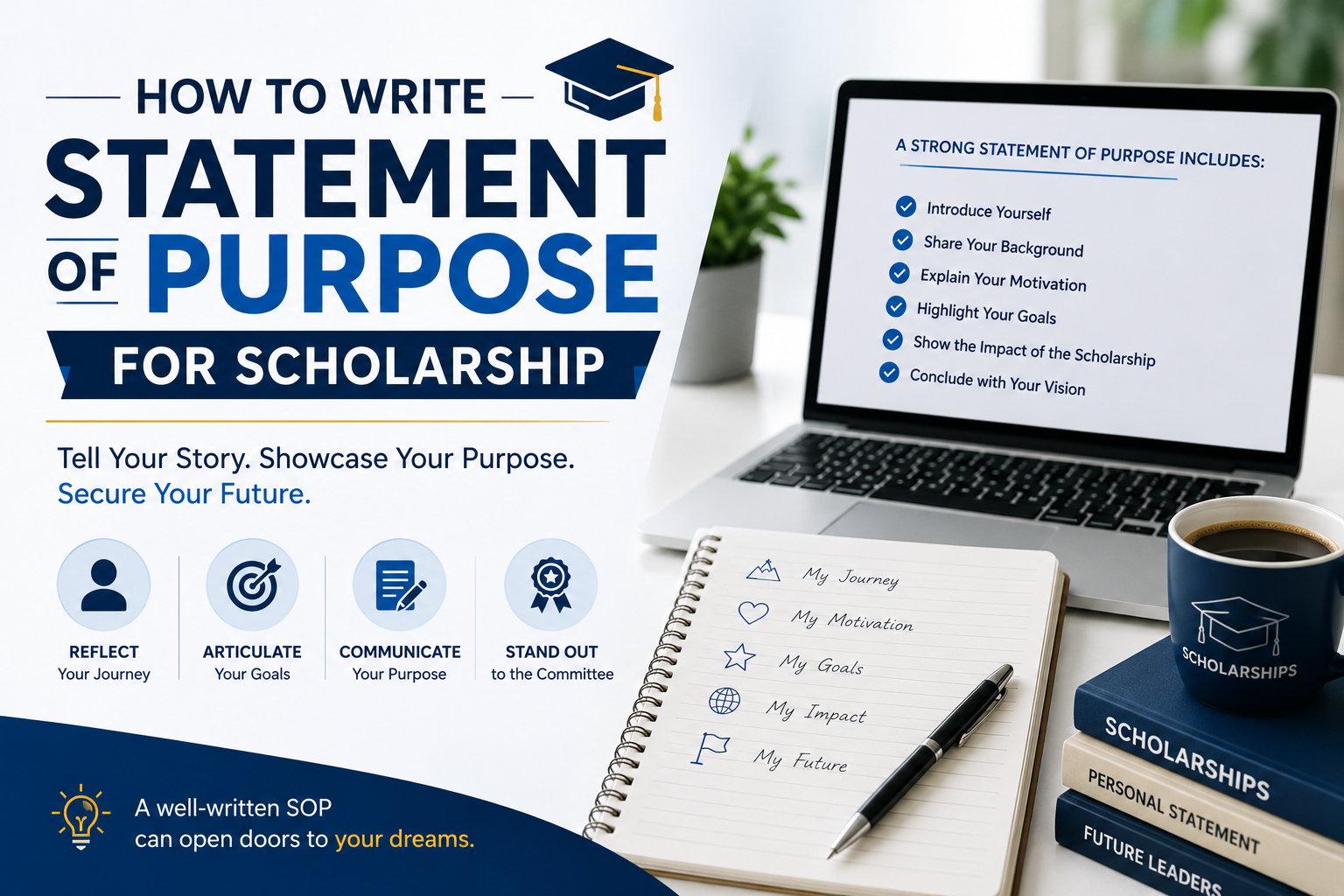
Your statement of purpose for scholarship is your one real chance to speak directly to the scholarship committee. It is where you tell them who you are, what drives you, and why you — out of hundreds of applicants — deserve their support.
In this guide, you will learn exactly how to write a statement of purpose for scholarship applications that is compelling, well-structured, and most importantly, one that gets results.
What Is a Statement of Purpose for Scholarship?
A Statement of Purpose (SOP) is a written essay that scholarship applicants submit alongside their application. It is different from a personal statement, though many people confuse the two. If you want to understand the full academic definition of an SOP, Scholars4Dev has a detailed breakdown that is worth reading.
While a personal statement tends to focus more on your life story and character, a statement of purpose for scholarship is more academic and goal-oriented. It answers specific questions like:
- What are your academic and career goals?
- Why do you need this scholarship?
- How will this scholarship help you achieve those goals?
- What makes you a strong candidate?
Think of it as your pitch to the committee. And like any good pitch, it has to be clear, honest, and persuasive.
Why Your Statement of Purpose Matters More Than You Think
Here is something most students do not realise — scholarship committees often receive thousands of applications from students with similar grades and qualifications. What separates the winners from the rest? Almost always, it is the quality of their statement of purpose.
A strong SOP can make up for a slightly lower GPA. A weak one can disqualify an otherwise brilliant candidate. So yes, this document carries serious weight.
Key Elements of a Strong Statement of Purpose for Scholarship
Before you start writing, you need to understand what every good SOP must contain. These are the building blocks:
1. A Strong Opening
Your first paragraph needs to grab attention. Do not start with something generic like “My name is John and I want to apply for this scholarship.” That is forgettable.
Instead, open with something meaningful — a defining experience, a challenge you overcame, or a moment that shaped your academic direction. The goal is to make the reader want to keep going.
2. Your Academic Background
This section gives the committee a clear picture of where you are coming from academically. Talk about your course of study, any achievements, and areas where you have excelled. Keep it relevant and avoid simply repeating your transcript.
3. Your Career Goals
One of the most important things any statement of purpose for scholarship must address is your future plans. Where do you see yourself in five to ten years? What career path are you pursuing, and how does your current education align with that?
Be specific here. Saying “I want to make a difference” is too vague. Saying “I plan to practise environmental law and focus on policy reform for industrial waste management in Nigeria” — that is specific, memorable, and shows real direction.
4. Why You Need the Scholarship
This is where many students feel uncomfortable, but you have to be honest. Whether the financial need is real, or whether the scholarship will open doors that would otherwise be closed to you — say it clearly and genuinely. Committees appreciate honesty over polished exaggeration.
5. Why You Chose This Particular Scholarship
Scholarship bodies want to know that you understand what they stand for. Research the organisation offering the scholarship. What are their values? What kind of students have they supported in the past? Connecting your goals to their mission shows that you have done your homework — and that you are serious.
6. What You Bring to the Table
This is not the place to be modest. Talk about your skills, your leadership experiences, your community involvement, or any projects you have worked on. The committee wants to invest in someone who will make an impact. Show them that person is you.
7. A Memorable Closing
End your statement of purpose with a confident and forward-looking closing paragraph. Express genuine gratitude for the opportunity, reaffirm your commitment to your goals, and leave the reader with a clear impression of who you are.
How to Write a Statement of Purpose for Scholarship: Step-by-Step
Now that you know the key elements, here is how to actually put it all together.
Step 1 — Read the Scholarship Requirements Carefully
This sounds obvious, but many students skip it. Before you write a single word, go back to the scholarship guidelines. Some organisations give you specific prompts or questions to answer. Others leave it open-ended. Knowing what is expected helps you structure your writing correctly from the start.
Also take note of the word limit. Most scholarships ask for 500 to 1,000 words. Going significantly over or under that range can hurt your chances.
Step 2 — Brainstorm Before You Write
Do not sit down and just start typing. Take some time to brainstorm first. Grab a sheet of paper and write down answers to questions like:
- What experience first sparked my interest in this field?
- What challenges have I faced academically or personally?
- What have I achieved that I am genuinely proud of?
- What do I want to do with my degree?
- Why this scholarship, and why now?
This exercise helps you identify the most powerful and authentic stories to include.
Step 3 — Write a Rough Draft Without Editing
When you write your first draft, just write. Do not stop to correct your grammar or rearrange sentences. The goal at this stage is to get your ideas down. You will clean it up later.
A lot of students produce their worst SOPs because they try to make every sentence perfect as they write. That puts unnecessary pressure on the process and often leads to stiff, unnatural writing.
Step 4 — Structure It Properly
Once you have your rough draft, organise it into clear sections. A well-structured statement of purpose for scholarship typically follows this pattern:
- Introduction — hook and brief overview of who you are
- Academic background — your field, achievements, and academic strengths
- Career goals — where you are headed and why
- Why this scholarship — how it fits into your plans
- What you offer — your skills, experiences, and values
- Conclusion — gratitude, reaffirmation, and a strong finish
You do not need to use headings in your actual SOP unless the scholarship explicitly allows it. The structure should flow naturally through your paragraphs.
Step 5 — Use Clear, Honest Language
Your SOP should sound like you — not like a robot, and not like you swallowed a dictionary. Write the way an intelligent, thoughtful person would speak. Use clear sentences. Avoid jargon unless it is relevant to your academic field.
Also, be honest. Scholarship committees review hundreds of applications. They can tell when something feels fabricated or overly rehearsed. Authenticity is more persuasive than performance.
Step 6 — Proofread, Then Proofread Again
Grammatical errors and typos in a scholarship SOP are a red flag. They suggest carelessness — which is not a quality any scholarship body wants to invest in. After finishing your draft, proofread it multiple times. Better still, have someone else — a lecturer, a mentor, or a trusted friend — read it and give you feedback.
Tools like Grammarly can also help catch errors, but do not rely on them alone.
Common Mistakes to Avoid
Being too generic. Phrases like “I have always been passionate about learning” or “I want to give back to society” tell the committee nothing specific about you. Replace them with real stories and concrete examples.
Focusing too much on hardship. While it is okay to mention challenges you have faced, do not let your entire SOP become a story of suffering. The committee wants to see your resilience and vision — not just your pain.
Copying someone else’s SOP. This one should go without saying, but it happens. Scholarship bodies often check for plagiarism. Beyond that, a copied SOP will never reflect your true voice and story.
Ignoring the word limit. Submitting an SOP that is twice the required length does not show thoroughness — it shows you cannot follow instructions.
Leaving it until the last minute. A rushed SOP is a weak SOP. Give yourself at least two to three weeks to write, revise, and polish your statement of purpose for scholarship.
Quick Tips to Make Your SOP Stand Out
- Start strong — your opening line sets the tone for everything that follows
- Be specific — real details are more convincing than broad generalisations
- Show growth — demonstrate how your experiences have shaped your thinking
- Connect your goals to the scholarship’s mission
- Keep your language active and direct
- Do not exceed the word limit
- Always write a fresh SOP for each scholarship — never recycle without editing
Final Thoughts
Writing a great statement of purpose for scholarship is not about being the most eloquent writer in the room. It is about being honest, intentional, and strategic with your words. The committee wants to understand who you are, what you want, and why you are worth investing in.
If you follow the steps and guidelines in this article, you are already ahead of most applicants who either rush the process or treat their SOP as an afterthought.
Take your time, tell your truth, and write with purpose — because that is exactly what a Statement of Purpose is meant to be.
Have questions about your scholarship application? Drop them in the comment section below and we will be happy to help.