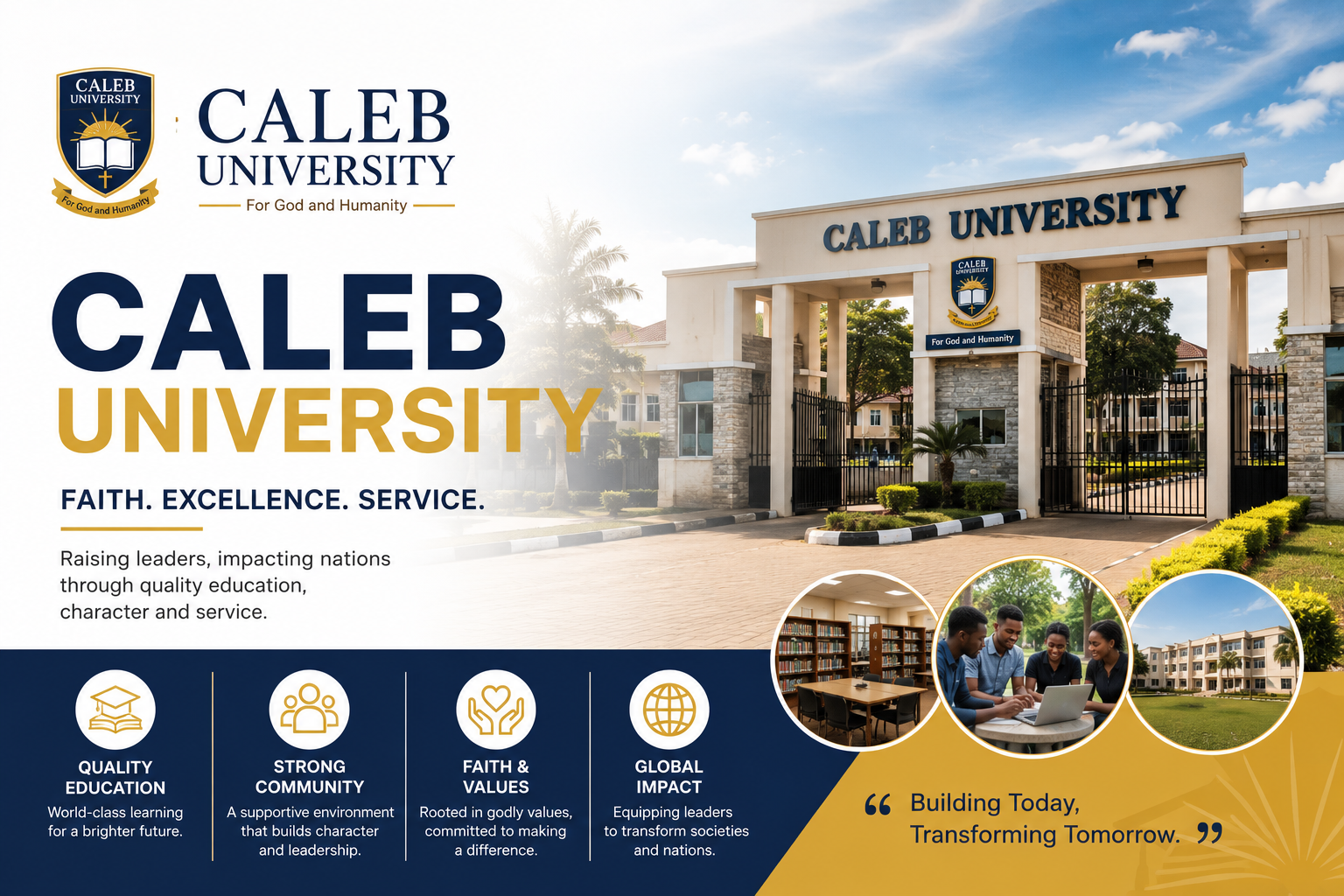
If you are considering Caleb University as your next academic destination — or you simply want to know more about one of Lagos State’s notable private universities — this guide covers everything in one place. From where the university is located and how it started, to the faculties it runs, the programs it offers, the fees you should expect, and what it takes to get admitted, you will find everything you need here.
Where Is Caleb University Located?
Caleb University is located in Imota, Lagos State, Nigeria. More specifically, the main campus sits along the Ikorodu-Itoikin Road in the Imota district of Lagos — an area that, while not in the heart of the city, is well connected to the wider Lagos metropolis.
In addition to the main campus in Imota, Caleb University operates a City Campus situated at the Magodo axis of Ketu, Lagos. This city campus primarily hosts the College of Law and is more centrally located for students in that part of Lagos. There are also affiliated centres in Abijo GRA and Surulere where certain admission interviews and activities take place.
The official address of Caleb University is:
Caleb University
Ikorodu-Itoikin Road, Imota
Lagos State, Nigeria
The university’s official website is www.calebuniversity.edu.ng. Prospective students can access the admission portal, check fees, and find contact information through this site.
History of Caleb University
Caleb University did not emerge from nowhere. Its roots trace back to 1986, when educationist Oladega Adebogun established the Caleb International School. That school became the foundation of what would eventually grow into a full university. The Caleb Group of Schools developed from this initial institution over the years, building a track record in education long before the university was formally established.
The university itself was licensed by the Federal Government of Nigeria in May 2007 and began academic activities in January 2008. This makes it a relatively young institution compared to Nigeria’s federal universities, but it has grown significantly in a short period of time.
Since its establishment, Caleb University has produced over 10,000 graduates across its various programs — graduates who are now contributing to different sectors of the Nigerian economy and beyond. The university has been ranked among the top private universities in Nigeria on multiple occasions and won the Best Private University in Nigeria award in 2024 at the African Education Monitor Magazine Awards, a recognition of the progress it has made since opening its doors.
The university’s motto is “For God and Humanity” — a statement that reflects its faith-based identity and commitment to producing graduates who contribute meaningfully to society.
Ownership and Accreditation
Caleb University is a private, faith-based, co-educational institution. It is non-denominational in its Christian orientation, meaning it is not tied to a specific church or religious body in the way that some other Nigerian private universities are, but it maintains a faith-driven culture across its operations.
The university is officially recognised and accredited by the National Universities Commission (NUC), which is the statutory body responsible for regulating university education in Nigeria. NUC accreditation confirms that Caleb’s programs meet the required national standards and that degrees issued by the institution are valid and recognised.
Caleb University has also gained international visibility through its rankings. It appeared in the Times Higher Education (THE) 2024 Impact Rankings, placing it among universities that have demonstrated measurable social and environmental impact — a recognition not every Nigerian university has achieved.
Faculties and Colleges at Caleb University
Caleb University organises its academic programs through several colleges and faculties. With over 43 undergraduate programmes, the university covers a broad range of disciplines. Here is an overview of its main academic divisions:
College of Management and Social Sciences
This college houses some of the university’s most popular programs including Accounting, Banking and Finance, Business Administration, Economics, and Mass Communication. It is one of the larger colleges in terms of student enrollment and caters to students with interests in commerce, media, and social sciences.
College of Science and Technology
This division covers science-based undergraduate programs including Biochemistry, Computer Science, Information Technology, Mathematics, Physics, and Zoology and Aquaculture. It serves students pursuing careers in research, technology, and the natural sciences.
College of Law
The Caleb University College of Law is housed primarily at the Magodo City Campus and offers the LLB degree program. Law remains one of the more competitive programs at the university and has been building a strong reputation in Nigerian legal education circles. The College of Law has recently been active in academic collaborations and competitions at the national level.
College of Environmental Sciences
This college offers programs in Architecture, Estate Management, and related fields. It caters to students who want to pursue careers in the built environment, urban planning, and property management sectors.
College of Education and Humanities
Programs here include Christian Religious Studies, History and Diplomatic Studies, and Education-related courses. This college serves students interested in teaching, history, religious studies, and the humanities broadly.
College of Nursing and Basic Medical Sciences (CONBAMS)
This is one of Caleb University’s newer but growing colleges. It has two faculties — the Faculty of Nursing Sciences and the Faculty of Basic Medical Sciences, which offers programs in Human Anatomy and Physiology. Caleb University began sending its nursing students for clinical posting in March 2025, marking a significant step in building its health sciences capacity. The university does not currently offer a Bachelor of Medicine and Surgery (MB ChB) degree, but its health sciences offerings continue to expand.
Postgraduate Programs
Beyond undergraduate studies, Caleb University offers Master’s degrees, Postgraduate Diplomas (PGD), and other advanced programs across several disciplines. Students interested in postgraduate education can explore these options through the university’s postgraduate school.
JUPEB and Pre-Degree Programs
For students who did not write JAMB or who want an alternative pathway into Caleb University’s undergraduate programs, the university offers the Joint Universities Preliminary Examinations Board (JUPEB) program. Successful JUPEB candidates gain direct entry admission into the 200 level of their chosen undergraduate course, bypassing the UTME route entirely.
This is a useful option for students who want to start university earlier or who are looking for a structured foundation program before proceeding to degree-level studies.
Caleb University Admission Requirements
Getting into Caleb University requires meeting a combination of JAMB, O’Level, and university-specific requirements. Here is what you need to know for the 2025/2026 session:
JAMB Cut-Off Mark
The official JAMB UTME cut-off mark for Caleb University is 160. This is the minimum score required to be considered for admission across all undergraduate programs. Scoring 160 or above qualifies you to proceed to the university’s post-UTME screening — it does not guarantee admission on its own.
Some more competitive courses may require higher JAMB scores in practice. It is advisable to aim for at least 180 and above to remain competitive, especially for programs in Law, Nursing, and Engineering-related fields.
O’Level Requirements
Candidates must have a minimum of five credit passes in relevant subjects obtained in not more than two sittings. The five credits must include English Language and Mathematics, with the remaining three credits in subjects relevant to the chosen course of study. Accepted O’Level qualifications include WAEC, NECO, NABTEB, and their equivalents.
For Nursing specifically, the five required credits must include English, Mathematics, Biology, Physics, and Chemistry.
Post-UTME Screening
Unlike many Nigerian universities that conduct written post-UTME tests, Caleb University takes a different approach. Candidates who meet the JAMB cut-off are invited for a physical admission interview held at the Imota campus, the Magodo City Campus, or affiliated centres in Abijo GRA and Surulere. There is no stressful written examination — the process is interview-based, which is generally more accessible for most candidates.
Direct Entry
Candidates applying through Direct Entry — those with A’Level results, JUPEB, NCE, OND, HND, or equivalent qualifications — can apply for admission into 200 level. The specific entry requirements vary by course and qualification type.
Caleb University School Fees
School fees at Caleb University vary depending on the faculty and program. As a private university, fees are higher than what you would pay at a federal or state institution, but the university offers flexible payment options to ease the burden.
Based on publicly available information for the 2025/2026 academic session:
- Tuition fees generally range from approximately ₦250,000 to ₦350,000 per semester depending on the faculty. More technical or specialised programs typically fall at the higher end of this range.
- Total session fees for freshers — including tuition, acceptance fee, ICT charges, library fees, medical fees, and other compulsory levies — typically range from around ₦450,000 to over ₦1,000,000 depending on the course. Some highly technical programs can exceed this range.
- Acceptance fee for newly admitted students is approximately ₦125,000, payable once upon admission.
One of the more student-friendly aspects of Caleb University’s fee structure is its installment payment option. Students can pay their fees in three tranches — typically 50% at the beginning of the semester, 25% midway through, and the remaining 25% before examinations. This reduces the financial pressure of paying a large sum all at once.
Always check the official Caleb University website or contact the Bursary directly for the most current and course-specific fee schedule, as figures are updated each session.
How to Apply for Admission into Caleb University
The admission process at Caleb University is relatively straightforward. Here is how it works:
- Sit for JAMB UTME and choose Caleb University as your first or second choice institution. Score a minimum of 160.
- Visit the Caleb University admission portal at www.calebuniversity.edu.ng to complete your application or apply directly through the JAMB CAPS system.
- Attend the post-UTME interview at the Imota campus, Magodo City Campus, or any of the designated screening centres. Come with your JAMB result slip, O’Level certificate, and a valid ID.
- Check your admission status on JAMB CAPS and the university’s portal after the screening exercise.
- Pay the acceptance fee of ₦125,000 upon being offered admission. This must be done within the specified period to avoid losing your slot.
- Submit all required documents — birth certificate, state of origin certificate, JAMB result slip, O’Level results, and passport photographs.
- Pay your tuition and other fees and register for your courses on the student portal.
- Attend the orientation program for new students and begin lectures as scheduled.
Campus Life and Facilities
Life on the Caleb University campus in Imota is shaped by a combination of academic focus and faith-based values. The university has a range of facilities on campus including lecture halls, a library, science laboratories, a health and wellness centre, sports facilities, and hostel accommodation.
Hostel accommodation is available but optional — students who prefer to live off campus can do so. For those who choose to stay on campus, hostels are available for both male and female students.
The university also encourages an active student life. There is a Creativity Centre, an art gallery, performing arts events, cycling paths, a free campus shuttle, and various student clubs and societies. Study abroad programs are also available through Caleb’s partnerships with international universities, giving students exposure beyond the Nigerian classroom.
Final Thoughts
Caleb University has come a long way from the Caleb International School that Oladega Adebogun founded in 1986. Today it is a fully accredited, internationally recognised private university sitting in Imota, Lagos — producing graduates across more than 40 programs and building a reputation that extends well beyond its campus gates.
Whether you are drawn by its Lagos location, its flexible fees structure, its broad program offering, or its faith-based values, Caleb University is worth serious consideration for any prospective Nigerian undergraduate or postgraduate student. Meet the JAMB cut-off, prepare your documents, and take the interview seriously — those three steps are the foundation of a successful Caleb University application.
If this guide was helpful, share it with a friend or classmate who is also exploring university options. And if you have specific questions about Caleb University’s programs or admission process, drop them in the comments section below.