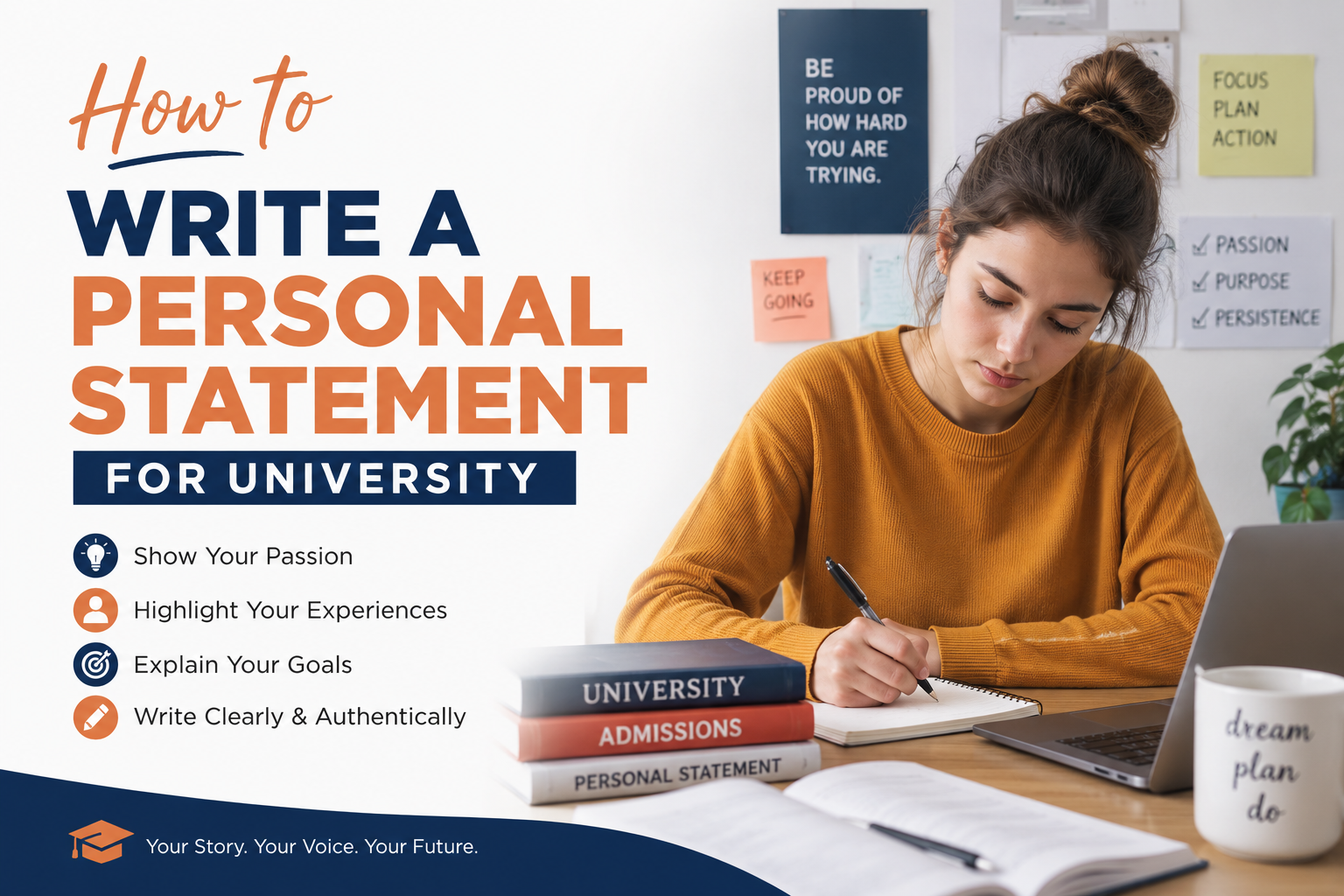
But here is the truth — a personal statement is not as complicated as most people make it. It is simply your chance to speak directly to the admissions panel and tell them who you are, why you want to study your chosen course, and why they should pick you over the hundreds of other applicants submitting similar grades and results.
Whether you are applying to a Nigerian university, writing for a JUPEB or pre-degree program, or preparing for an international application, this guide will walk you through everything you need to know about how to write a personal statement for university — from understanding what it is to putting together a final draft that actually works.
What Is a Personal Statement?
A personal statement is a short essay or written piece that you submit as part of your university application. It gives the admissions committee a picture of you beyond your exam scores and certificates. It tells them about your academic interests, your goals, your relevant experiences, and why you are genuinely interested in the course you are applying for.
Unlike your transcript or your WAEC/NECO results, a personal statement is entirely in your own words. It is your voice. It is the one part of the application where you get to show personality, depth, and purpose.
Different institutions have different requirements for personal statements. Some ask for a few paragraphs, others want a full page or more. Some give you a specific prompt to respond to, while others leave it completely open. But regardless of the format, the goal is always the same — to convince the admissions panel that you are a serious, motivated, and deserving candidate.
Do Nigerian Universities Require Personal Statements?
This is a question a lot of Nigerian students ask, and the honest answer is — it depends on the institution and the program.
For most undergraduate admissions through JAMB and UTME, Nigerian federal and state universities do not typically require a formal personal statement as part of the standard post-UTME process. The post-UTME screening is mostly based on your exam scores and O’Level results.
However, there are specific situations where Nigerian students will need to write a personal statement:
- Private universities — Many Nigerian private universities, especially those with competitive programs in medicine, law, or engineering, request a personal statement as part of their direct entry or scholarship applications.
- Scholarship applications — If you are applying for any scholarship — whether from the government, a corporate organisation, or a foundation — a personal statement or statement of purpose is almost always required.
- JUPEB and direct entry programs — Some institutions that offer the Joint Universities Preliminary Examinations Board (JUPEB) program or other pre-degree pathways require a statement as part of their application.
- Study abroad applications — If you are applying to universities in the UK, USA, Canada, or anywhere outside Nigeria, a personal statement is almost certainly required. UK applications through UCAS require one, and many US applications through the Common App require a personal essay.
- Postgraduate admissions — If you are applying for a master’s or PhD program in Nigeria or abroad, a statement of purpose (which works similarly to a personal statement) is a standard requirement.
So even if your current university application does not require one, learning how to write a good personal statement is a skill that will serve you well at multiple points in your academic and professional journey.
What Should a Personal Statement Include?
Before you write a single word, you need to understand what admissions panels are actually looking for. A strong personal statement typically covers the following:
- Why you want to study the course — This is the most important part. You need to show genuine interest and understanding of the subject, not just say “I have always been passionate about it.”
- Your academic background and relevant achievements — Not just your grades, but what you have done with your education so far.
- Relevant experiences — Projects, internships, volunteering, extracurricular activities, or any real-world exposure related to your field of interest.
- Your future goals — Where do you see yourself going? What do you want to do with this degree?
- Why you are a good fit for the institution — Optional for some applications, but very useful when you know specific things about the university or program.
How to Write a Personal Statement Step by Step
Step 1 — Understand the Requirements
Before you write anything, read the application guidelines carefully. How long should the personal statement be? Is there a word limit? Is there a specific prompt or question you need to respond to? Are they asking for a personal statement or a statement of purpose? (These are slightly different — more on that below.)
Getting the format wrong is one of the easiest ways to make a bad first impression. If the school asks for 500 words and you submit 1,200, that already tells the admissions panel something about how well you follow instructions.
Step 2 — Brainstorm Before You Write
Take time to think before you open a document. Ask yourself the following questions and write down your honest answers:
- Why do I want to study this particular course?
- When did I first become interested in this subject?
- What have I done — inside or outside the classroom — that relates to this field?
- What challenges have I faced, and what did they teach me?
- What do I want to do after graduation?
- What makes me different from other applicants?
You do not need to use all of these answers in your statement. But brainstorming helps you identify the most compelling things to write about. The best personal statements are built around specific stories and real experiences, not vague claims.
Step 3 — Write a Strong Opening
The opening of your personal statement is the most important part. Admissions panels read hundreds of statements — sometimes thousands. If your first sentence is boring, there is a good chance the rest of your statement will not get the attention it deserves.
Avoid the classic clichés. Do not start with:
- “From a young age, I have always been passionate about…”
- “I am writing this statement to express my interest in…”
- “Ever since I was a child, I dreamed of becoming…”
These openings are overused and immediately signal that the writer is not putting in real thought. Instead, try opening with:
- A specific moment or experience that shaped your interest in the subject
- A question that your chosen course helps you answer
- A surprising or counterintuitive observation about your field
- A brief story that leads naturally into your academic interests
A strong opening does not have to be dramatic. It just has to be specific and genuine.
Step 4 — Build the Body of Your Statement
The body of your personal statement is where you expand on your opening and make your case. This is where you talk about your academic background, your experiences, your skills, and your goals.
A good structure for the body looks like this:
Academic interests and course motivation — Go deeper into why you want to study this course. Reference specific topics, concepts, or areas within the field that genuinely interest you. If you have done any reading, research, or projects related to the subject, mention them here. This shows that your interest is real and not just something you typed because it sounded good.
Relevant experiences — Talk about any experience that has prepared you for this course. This could be a school project, a part-time job, an internship, voluntary work, or even a personal project you worked on. The key word here is relevant. Do not list everything you have ever done — only what connects meaningfully to the course you are applying for.
Skills and personal qualities — Rather than just claiming to be hardworking or a good team player, show it. Give brief examples of situations where you demonstrated the qualities that matter for your chosen field.
Step 5 — Talk About Your Goals
Admissions panels want to know that you have thought beyond just getting into university. Where do you see yourself in five or ten years? What kind of career do you want to build? How does this degree fit into your larger plan?
You do not need to have everything figured out — nobody does at this stage. But showing that you have a direction, even a general one, tells the panel that you are applying with purpose and not just because you need a degree.
Step 6 — Write a Clean Closing
End your personal statement the way you would end a good conversation — with clarity and confidence. Summarise what you have said in a way that leaves a strong final impression. You can restate your motivation briefly, express your enthusiasm for the opportunity, or close with a forward-looking statement about what you hope to contribute.
Keep the closing short. One or two sentences is usually enough. You do not need a long conclusion — just something that wraps things up without trailing off.
Step 7 — Revise, Edit, and Get Feedback
Your first draft is never your final draft. Once you finish writing, step away from it for a day or two, then come back and read it with fresh eyes. Look out for:
- Sentences that are too long or unclear
- Repetition of ideas or words
- Claims that are too vague and need specific examples
- Spelling and grammar errors
- Anything that does not sound like your natural voice
After revising it yourself, ask someone else to read it — a teacher, a parent, an older sibling, or a trusted friend. A second pair of eyes catches things you will miss because you are too close to the writing.
Personal Statement vs Statement of Purpose — What Is the Difference?
These two terms are often used interchangeably, but they are not exactly the same thing.
A personal statement tends to be more personal and narrative. It focuses on your story, your character, and what shaped your interest in the field. It is commonly used for undergraduate applications.
A statement of purpose is more academic and professional in tone. It focuses on your research interests, career goals, and why you are suited for a specific program. It is more commonly used for postgraduate applications — master’s and PhD programs.
Knowing which one is required before you start writing will save you a lot of time and confusion.
Sample Personal Statement for a Nigerian Student (Undergraduate)
Below is a short sample personal statement for a student applying for an Economics program. It is meant to give you an idea of the tone and structure — not something to copy word for word.
Growing up in Lagos, I watched my father run a small provisions store from our sitting room. Every evening he would sit at the kitchen table with a notebook, working out what he had spent and what he had earned. He never called it economics. But watching him figure out how to keep that business alive on thin margins was my first real lesson in how markets work at the ground level.
That early exposure shaped the way I think about money, trade, and the systems that govern both. When I studied economics at secondary school, the subject felt less like a new topic and more like a formal name for things I had already observed. My interest deepened especially when I began reading about Nigeria’s recurring inflation cycles and what they mean for small business owners like my father.
I want to study Economics at university because I want to understand these systems at a deeper level — not just to satisfy academic curiosity, but because I believe the kind of informed thinking that economics teaches is exactly what Nigeria needs more of at every level of decision-making. After graduation, I hope to work in policy research or financial analysis, contributing to conversations about economic development in ways that actually reach the people who need it most.
Notice how this sample is specific, personal, and connects the student’s background directly to their academic interest and future goals. That is exactly the kind of writing that gets attention.
Common Mistakes to Avoid
Before you submit anything, make sure you have not fallen into any of these common traps:
- Being too generic — Statements that could apply to any student in any course do not stand out. Be specific about your course, your experiences, and your goals.
- Copying someone else’s statement — This is a serious academic integrity issue and most universities have systems to detect it. Write your own statement from scratch.
- Focusing too much on secondary school achievements — Your O’Level results are already visible elsewhere in your application. Use the personal statement to go beyond those.
- Using overly formal or stiff language — A personal statement should sound like a real person wrote it. Write the way you naturally think and speak, then clean it up.
- Ignoring the word limit — Always stay within the specified word count. Going significantly over or under the limit is a red flag.
- Submitting without proofreading — Spelling mistakes and grammatical errors in a personal statement suggest carelessness. Proofread multiple times before submitting.
Quick Tips to Make Your Personal Statement Stronger
- Use active voice instead of passive voice where possible
- Show, do not just tell — back up every claim with a real example
- Keep paragraphs short and focused — one idea per paragraph works best
- Read it out loud — if it sounds awkward when spoken, rewrite it
- Start early — do not write your personal statement the night before the deadline
Final Thoughts
Writing a personal statement for university does not have to be a nightmare. The moment you stop trying to sound impressive and start trying to sound honest and specific, the whole thing becomes a lot easier to write.
You have a story. You have reasons for choosing your course. You have experiences, even small ones, that shaped how you think. The job of a personal statement is simply to put those things on paper in a way that is clear, genuine, and worth reading.
Start with a brainstorm, build your draft step by step, revise it carefully, and get someone you trust to read it before you submit. That process alone will put your statement ahead of most of what admissions panels receive.
If you found this guide helpful, share it with a classmate or friend who is currently working on their university application. And if you have questions or want feedback on your personal statement, drop a comment below — we would love to help.